The Simple Joy of Hanging Laundry Outside – BLOG 2020/Apr/20

🧺 I never thought much about laundry.
https://images.openai.com/static-rsc-4/IJOhoxKY3ADpWIM-MxOJU_yzX-ykhh6xu08Js9oSdTNWRhMKxur6ARuEsSv1kSwqK7UtPNTg8xYcoTNZRaRp7fM5n64P1AzBUaAx9zV1-dBNObc9zqJO64xFiw2T39AYnCxJgTjYBCDkT1J1iWB6FdutCfKA-RWBuLYgBGatDoaJxLcERxY4A-aiDJOtr6TA?purpose=fullsize
Wash it. Dry it. Fold it. Done.
Then one day, I hung my clothes outside.
https://images.openai.com/static-rsc-4/jgNGTq-69XhKBJqwSSKFc3xq-0_CZHG73cl8lZRpHO7EKcI9uBeCoq-GdUz8YeLbwX4LFA8G3hyoj1dGSZSJ0-Z529ugnY_rbe30P_01Xx7E_H3zaj93_cbw_9o83tyxuPOBqodTjEj-4IeMreEQfsGLa538yHlfNb6-6iIPtniQjAzWacpe4MMdf7skFocy?purpose=fullsize
And something changed.

🌞 It Starts With the Wind & the Sun

The O.G. wind-/solar-powered, option. There’s just something about the wind and sun doing the work.

No buttons. No buzzing dryer. No heat bill.

Just:

    • Warm sunshine
    • A soft breeze
    • Time doing its thing

It feels slower… in a good way.

👕 Why It’s Actually Better

Clothes dried outside feel different.

They are:

    • Fresh
    • Crisp
    • Smell like clean air (not fake scent)

Even your towels feel stronger and last longer.

💸 Bonus: It Saves Money

Dryers use a lot of power.

When you hang laundry:

    • You use less electricity
    • Your clothes wear out slower
    • You spend less over time

It’s a small change that adds up.

🌿 It’s Not Just for Farms

You don’t need a big homestead.

You can do this:

    • In a backyard
    • On a balcony
    • Even by a window

All you need is:

    • A line (or drying rack)
    • A few clothespins
    • A bit of space

😄 Real Life Moment

    • Sometimes a sock falls.
    • Sometimes the wind steals a shirt.
    • And yes… sometimes you forget and it rains.

It happens.

But somehow, that’s part of the fun.

🧠 Why It Feels So Good

Hanging laundry gives you a moment to pause.

    • You step outside.
    • You look around.
    • You breathe a little deeper.

It turns a chore into something calm.

🌞 Final Thought

Not everything has to be fast.

Some things are better slow.

Even laundry.

New Life at the Farm: A Robin’s Nest Surprise – BLOG 2020/Apr/19

🌿 Spring has a way of quietly reminding us that life is always beginning again—often in the most unexpected places.

This week at Blue Gypsy Homestead, that reminder came perched right above our heads… quite literally.

🐦 An Unexpected Discovery

While tending to the greenhouse, I happened to glance up at the exterior light—and there it was. A perfectly formed robin’s nest, carefully balanced on top of the fixture like it had always belonged there.

Soon, a set of delicate blue eggs will be tucked neatly inside.

It’s hard to describe that moment of discovery. Equal parts surprise, curiosity, and a quiet sense of privilege. Out of all the places on the property, this robin chose that exact spot—a place full of warmth, shelter, and just enough distance from the daily rhythm of the homestead.

🌱 Life Finds a Way

There’s something deeply grounding about witnessing nature carry on with such confidence and intention.

No blueprints. No overthinking. Just instinct, timing, and trust.

As someone who spends a lot of time planning, building, and refining—both on the homestead and in business—it’s a humbling contrast. The robin doesn’t question whether the light fixture is “ideal.” It builds. It adapts. It moves forward.

And somehow, it works.

🏡 Sharing the Space

Since discovering the nest, I’ve been a little more mindful around the greenhouse. Movements are quieter. Visits are gentler. There’s an unspoken agreement now—we share this space.

The robin comes and goes, watchful but steady, continuing its work while life on the farm carries on around it.

It’s a small thing, really. But it changes how you see the day.

🌼 A Season of Beginnings

Spring on the homestead always brings new projects, new growth, and new challenges. But moments like this remind me that not all growth needs managing.

Some of it simply unfolds.

And sometimes, it shows up resting on a light fixture, quietly holding the promise of what’s to come.

One person’s trash is another person’s building… – BLOG 2026/04/14

You know you’re deep into homestead mode when you start looking at pallets and seeing… a building. 😄

Lately, I’ve been collecting pallets with a plan in mind—turning them into another farm structure, most likely a garage. It’s still in the early stages, but the vision is coming together.

The idea is pretty straightforward: use the pallets, combined with 2x4s, to create the frame of the building, then cover it with plywood to bring it all together. Simple materials, a bit of creativity, and a whole lot of elbow grease.

There’s something really satisfying about taking what others might see as scrap and turning it into something functional and lasting. It’s not just about saving money (although that helps)—it’s about building in a way that’s resourceful and a little bit unconventional.

I’ll be sharing updates as this project comes together. If you’ve built anything using pallets, I’d love to hear your tips or lessons learned!

Follow along as I transform reclaimed pallets into a functional farm garage using simple materials like 2x4s and plywood. A sustainable, budget-friendly homestead building project focused on creativity and resourcefulness.

Garden Planning Season… aka “Controlled Chaos Begins” – BLOG 2026/04/13

It’s that time again—when I sit down, full of optimism, to plan the garden… and somehow end up with dirt under my nails and a to-do list that’s way too ambitious.
But this year, I’m doing something a little different.
After last year’s absolutely wild bounty (seriously, I’m still emotionally recovering from the tomato overload 🍅), I’ve decided to let one of the gardens take a well-earned nap. That’s right—one whole plot is officially “off duty” until next year. Rest, recharge, come back stronger. Honestly, same.
The other garden though? Oh, it’s game on.
This year’s lineup is looking pretty solid:
• Heirloom tomatoes (because once you go heirloom, you never go back)
• Green and red bell peppers
• Kale… and not just for me
• Garlic
• Squash
• Melons
Now, about that kale…
It’s less of a “garden crop” and more of a Meg management strategy. My rescue mini pinscher, Meg, is obsessed. And I don’t mean “oh she likes it”—I mean full-on kale bandit status.
Last year, I caught her casually strolling out of the garden with an entire kale plant in her mouth like she’d just done the weekly grocery shop. No shame. No regrets. Just leafy greens flopping out both sides. 🐕🥬
So this year’s real challenge isn’t growing kale…
It’s protecting it.
Fencing? Maybe. Supervision? Probably. Negotiating a kale-sharing agreement with Meg? Still under discussion.
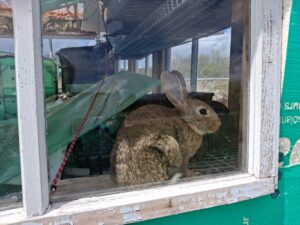
On the fertilizer front, we’re keeping it nice and natural. The rabbits are officially contributing to the operation this year—those little guys are producing garden gold in pellet form, and the plants are going to love it.
All in all, it’s shaping up to be a fun season:
A little less pressure, a lot of good food, and (hopefully) at least a few kale plants that actually make it to harvest.
Stay tuned… because if Meg has anything to say about it, this could turn into a full-blown garden heist series. 😆

Big Moves Coming… Whether We’re Ready or Not – BLOG 2026/APR/12


😅
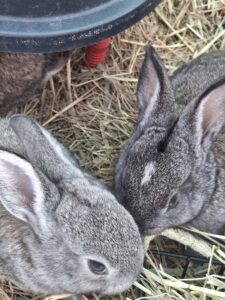
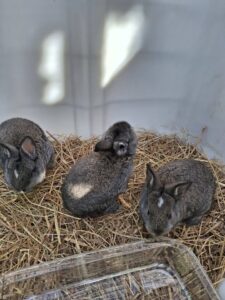
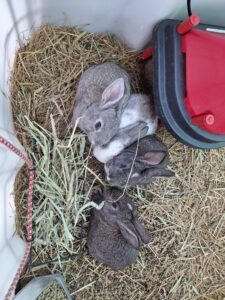
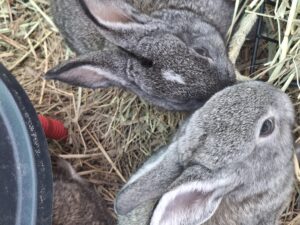
Well… it looks like we’ve reached that stage with the first bunch of bunny babies…
The baby bunnies are officially getting too big for their current digs—and by “too big,” I mean they’ve discovered they can now jump out whenever they feel like it. Which, apparently, is often.
Nothing like starting your morning bunny chores with a spontaneous game of “Where did THAT one go?” 🐇💨
We’re getting their new outdoor enclosure ready, and let me tell you—it’s going to be quite the upgrade. More space, more fresh air, more room for zoomies and general bunny mischief.
BUT… (and it’s a big “but”)
As eager as they are to explore the world, they’re still a bit too young to be out there full-time. The weather has a mind of its own lately, and we’re not about to send these little fluffballs into unpredictable conditions just yet.
So for now, we’re in that in-between phase:
👉 Too big to stay in
👉 Too small to go out
Basically… bunny teenagers. 😄
Give it a little more time, a few more growth spurts, and they’ll be hopping into their new home like they own the place (which, let’s be honest, they will).
Stay tuned… because once they’re out there, the real adventures begin.

Love in the Time of Carrots: A Rabbit’s Romantic Misfire – BLOG 2026/04/11

If you’ve ever thought dating was hard, allow me to introduce you to the chaotic, carrot-fueled drama of rabbit courtship.
This morning on the homestead, I bore witness to what can only be described as a full-blown romantic comedy—starring one very enthusiastic buck and one decidedly unimpressed doe.
Our leading man arrived on the scene with all the confidence of a creature who had clearly rehearsed this moment in his head. Chest puffed. Nose twitching like a Morse code operator on espresso. He was ready. This was his time.
He approached the doe with what I can only assume he believed was irresistible charm.
She glanced at him once.
Once.
And in that single look, she conveyed the emotional equivalent of: “Get lost.”
Undeterred, our hopeful suitor doubled down. He circled. He strutted. He attempted what I can only describe as interpretive hopping—part dance, part declaration, part… confusion.
The doe? She lay there like a queen on her throne, utterly unmoved.
Then came the moment.
He made his move.
And she… simply hopped away.
Not in a panic. Not in distress. Just a calm, deliberate exit, like someone leaving a bad first date after realizing the other person says “expresso.”
He tried again.
She moved again.
At this point, it became less of a courtship and more of a gentle but firm game of “No Means No.”
Eventually, our buck paused, visibly processing the situation. You could almost see the gears turning:
“But… I did the hop.”
Yes, my friend. You did the hop. But as it turns out, consent is imperative, even in the animal kingdom.
And honestly? There’s something oddly admirable about the whole exchange. No drama. No aggression. Just a very clear boundary, politely enforced with a few well-timed hops.
The buck, to his credit, eventually accepted defeat and retreated with what dignity he could muster. I imagine he’ll be back tomorrow, armed with the same optimism and absolutely no lessons learned.
Because if rabbits teach us anything, it’s this:
Hope springs eternal… but success is never guaranteed.
And sometimes, no matter how smooth you think your moves are—
She’s just not that into you. 🐇

Our Online Store is LIVE!

🎉 Well… it finally happened! Our Online Store is LIVE! 🎉
After a whole lot of planning, clicking, second-guessing, snack breaks, and “why is this button doing THAT?” moments… we did it.
👉 Our online store is officially OPEN for business!
You can now browse and purchase our freeze-dried products right from the comfort of your couch—no boots, no mud, no chasing chickens required. (Although… we can’t promise you won’t miss that part just a little.)
We’ve put a lot of love into these products, and we’re so excited to finally share them with you in a whole new way.
Getting there is easy:
1. Head over to 👉 www.bluegypsyhomestead.com
2. Click on “Online Store” in the top menu
3. Try not to add everything to your cart (no judgment if you do 😄)
Whether you’ve been following our journey for a while or you’re just discovering us, this is a big step for our homestead—and we couldn’t have done it without all of your support along the way.
Now if you’ll excuse me, I’ll be over here refreshing the page like it’s opening night. 😅

How COVID Changed Everything for Small Farms (And What I Learned Along the Way) – BLOG 2026/04/10

________________________________________

Let’s be real—no one saw 2020 coming. One minute, we were setting up our usual booth at the Saturday farmers market, chatting with familiar faces about the weather and which tomatoes were doing best that season. The next… everything shut down. Just like that.
And suddenly, we were all left asking the same question: Now what?
If you’re a small farmer, you probably lived your own version of this. And if you’re just curious about how farms adapted during that time, well… it was a wild ride.
________________________________________
When Everything Changed Overnight
Before the pandemic, most of us had a rhythm. Full-time job. Markets on weekends. Maybe a small farm stand during the week. Pick-your-own in the busy season. I knew our customers, remembered their favorites, and built real relationships—one conversation at a time.
Then all of that disappeared.
No more chatting over baskets of strawberries. No more kids running through the fields. No more “try this, it’s the best one I picked this morning.”
But here’s the surprising part…
While I was worrying about how to sell our food, people were suddenly very interested in where their food was coming from. With supply chains getting shaky, buying local didn’t just feel nice—it felt necessary.
________________________________________
What Actually Worked (From One Farmer to Another)
1. Getting Online (Even If It Felt Awkward at First)
I’ll be honest—unlike me, most of us didn’t sign up to be tech experts. Even I had a learning curve and I’ve been in the IT field for over 33 years, but I figured it out, little by little.
Nothing fancy. Just simple, practical steps:
• Learning to use AI to edit and review my posts before they went up
• Create a basic website so people knew what I had (Using AI can make this easier)
• Posting photos on Facebook or Instagram (nothing polished—just real farm life)
• Sending a weekly email update
• Letting customers pre-order for pickup
That was it.
And guess what? People didn’t care about fancy graphics. They just wanted to feel connected. Your story—the real, messy, everyday version of it—mattered more than anything.
________________________________________
2. CSA Programs
Not in my current, short-term plan, but if you’ve ever considered starting a CSA, this was the moment they really proved their value.
CSAs are basically a group of customers who pay upfront for a weekly box of whatever your farm is producing.
During all that uncertainty? That upfront income made a huge difference.
For many, CSAs went beyond the money, something else happened—people felt invested. They were excited. Curious. Genuinely part of the farm.
Honestly, it turned customers into a community.
________________________________________
3. Working Together Instead of Competing
This was a big shift.
Instead of seeing other farms as competition, we started teaming up. And instead of just thinking about selling to restaurants, we sought to partner with them.
Some of the best ideas came out of that:
• Sharing products across farms to create mixed boxes
• Supplying local restaurants adapting to takeout
• Working with small grocery stores to highlight local food
• Even putting together deliveries for workplaces
It stopped being “every farm for itself” and became something much more collaborative.
________________________________________
4. The Rise of “No Contact” Sales
This one surprised me the most.
I went from face-to-face everything… to barely interacting at all. And somehow—it worked.
Simple setups made all the difference:
• Driveway stands
• Scheduled pickups
• Delivery routes
• Honor-system payments
And here’s the kicker—people loved the convenience. Many still do.
________________________________________
What I Really Learned
Looking back, the biggest lesson? Don’t rely on just one way of doing things.
The farms that adapted quickest were the ones willing to try, fail, adjust, and try again.
A few things really stood out:
• People care about who grows their food
• Convenience matters—but connection still counts
• Customers genuinely want to support local farms
• Technology isn’t the enemy—it’s just another tool
________________________________________
Moving Forward (And Why It’s Actually Exciting)
I won’t pretend it was easy. It wasn’t.
But in a strange way, that period pushed us to grow—not just crops, but how I run our farms.
Now, it’s not one or the other. It’s everything working together:
• Online ordering and in-person pickup
• CSA boxes and farmers markets
• Restaurant partnerships and direct sales
And the result? Farms that are more connected to their communities than ever.
If you’re just starting out—or thinking about making changes—keep this in mind:
• People want real food from real people.
• They want your story. They want to support you. They want to feel good about what they’re feeding their families.
And that connection? It’s stronger now than ever.
So wherever you’re at—start there. Use what you have. Try something new.
Because every farm that made it through this started the same way: someone was willing to change their way of thinking and figure it out as they went.

Last year… the chickens escaped – BLOG 2026/04/9

Chickens running away
Homestead version of ‘Chicken Run’

Today, I offer you a real-life Homestead story about chickens escaping and calmly walking away for good. An actual backyard chicken experience about free-ranging, homestead challenges, and lessons learned raising chickens.

There was no chaos.
No frantic flapping.
No dramatic chase.

They just… walked away.

One by one, they crossed the yard like they had quietly agreed on a plan. Past the garden. Past the fence. Toward the trees. I folloId behind them, expecting they’d stop, scratch around, and let us guide them back.

But they didn’t.

They kept going.
Slowly. Calmly.
Without ever looking back.

I stood there waiting for them to turn around… but they never did.
$50 in chicks and another $30 in feed… gone.

No feathers.
No noise.
No obvious predators.
No return at dusk.

Just an empty coop that evening and a strange silence where their clucking used to be.

Homesteading has a way of humbling you. Sometimes you prepare, you build, you plan… and sometimes the chickens simply decide they’re done and walk off into the woods.

I still laugh about it now — but I also double-check the gate every single time.

Anyone else ever lose animals in the most unexpectedly calm way?

Converting a Winery to a Market Garden

The Evolution of Blue Gypsy Wines & Blue Gypsy Homestead

From 2011 to 2019, I founded and operated Blue Gypsy Wines, an off-grid winery south of Ottawa. While it began as a venture into fruit wine production and LCBO distribution, it became an intensive masterclass in business administration, law, and grit.

Business Foundations & Resilience

– Strategic Planning: Secured bank financing in under 24 hours thanks to a comprehensive 57-page business plan—a rarity for small businesses that set the stage for years of growth.

– Operations & Infrastructure: Built a 3,000-sq-ft Quonset steel structure from the ground up, managing everything from land development to 100% off-grid systems.

– Regulatory Excellence: Maintained meticulous records for Provincial and Federal audits. My systems were so efficient that standard multi-hour audits were completed in under 90 minutes.

– Pivoting for Profit: When faced with product spoilage, I pivoted to wine vinegar production, bypassing certain taxes and increasing profit margins by 46%.

The Evolution: From Winery to Homestead

Operating a winery while holding full-time contracts taught me the reality of “carrying” a passion project. In 2019, I made the strategic decision to close the business. Following significant life changes in 2020, I renovated that same off-grid building into my home by bringing in Hydro and Heat, then rebranded the property as a homestead.

Today, I’ve traded wine for self-sufficiency — raising rabbits and growing my own produce. This journey has offered a deeper education than any college course, proving that resilience isn’t just about what you build, but how you adapt when the landscape changes. I am still interested in contracting, so I will continue to pursue that course of action.

I have invested a lot of time and money in the farm with the hope that it will sell for a good price when I finally decide to pack it all in.

I guess my point is that I minimized what I had achieved, the experience I gained, and the peace I find living outside the city. Perhaps this may serve to tell more of a story than I can fit into a 4-page CV. Only time will tell.