
Ticks… I Really Hate Ticks – BLOG 2026-Jun-24

There are a lot of things I love about living on a farm in Eastern Ontario.

The quiet mornings.

Watching the garden come to life.

The rabbits.

The chickens.

The simple satisfaction of building something with your own hands.

Then there are ticks.

I REALLY hate ticks because, ticks nearly killed me.

Living on a farm in Eastern Ontario, ticks have become an unfortunate fact of life. Once the temperature climbs above about 5°C, they become active, and from that point until late fall, they are simply something you learn to live with.

Unfortunately, my education about ticks didn’t begin here.

It began years ago when I was living in Poughkeepsie, New York.

One year, they nearly killed me.

At first, I just wasn’t feeling well.

Actually, that’s not entirely true.

I was running a fever of around 103°F (39.4°C) for two or three days. Every muscle hurt. I felt absolutely miserable. Like most stubborn men, I was convinced I had caught some particularly nasty flu and that eventually I’d get over it.

My wife had other ideas.

Finally, she looked at me and said, “Enough.”

She drove me to see an old country doctor.

I’m glad she did.

The doctor actually listened.

He asked questions.

He examined me.

He took my temperature.

Then he looked at me and said something I’ll never forget.

“I know what you have.”

Ehrlichiosis.

I’d never even heard of it.

Ehrlichiosis is a bacterial illness caused by Ehrlichia species and transmitted through the bite of infected ticks. Symptoms usually appear between 5 and 14 days after a tick bite and often resemble a severe case of the flu—high fever, chills, muscle aches, headaches, fatigue and generally feeling like you’ve been run over by a truck.

Untreated, it can become extremely serious.

The doctor calmly explained that, in his opinion, I was probably only a few days away from organ failure.

Then, in a manner that only an experienced country doctor could manage, he shrugged and said,

“No big deal.”

He prescribed doxycycline, the antibiotic considered the first-line treatment for ehrlichiosis and Lyme disease, and sent me home.

Within twenty-four hours, I was already feeling dramatically better.

That prescription almost certainly saved my life.

Needless to say…

This is why I HATE ticks.

When I eventually moved back to Canada, I assumed I’d left the tick problem behind.

I couldn’t have been more wrong.

The little buggers had simply decided to migrate north.

Marvelous.

Now they’re firmly established throughout much of Eastern Ontario, and if you spend enough time outdoors, especially around long grass, brush, or woodland, chances are you’ll eventually meet one.

Around here, tick encounters have become almost a daily occurrence.

Sometimes they hitchhike on me.

Sometimes they hitchhike on the Wonder Twins.

Sidebar: If you’re new here, “The Wonder Twins” are my two rescue Miniature Pinschers. They’re roughly ten pounds each and somehow possess the confidence of animals ten times their size. Imagine a Greyhound, Dachshund, and Chihuahua all contributing to the same questionable engineering project.

They’re all attitude.

They have absolutely no idea they’re small.

If given the opportunity, I’m convinced they’d challenge a pack of wolves just to prove a point.

Fortunately, they haven’t had the opportunity.

Back to ticks…

Of all the creatures roaming this planet, I simply cannot understand why ticks were necessary.

Mosquitoes are annoying.

Blackflies are relentless.

Horseflies seem fueled entirely by spite.

But ticks occupy a category all their own.

Since they’re usually found in long grass…

…and this is a farm…

…I have long grass.

Conventional wisdom says you should wear long pants whenever you’re walking through areas where ticks may be present.

That is excellent advice.

I, however, have discovered something that works surprisingly well for me.

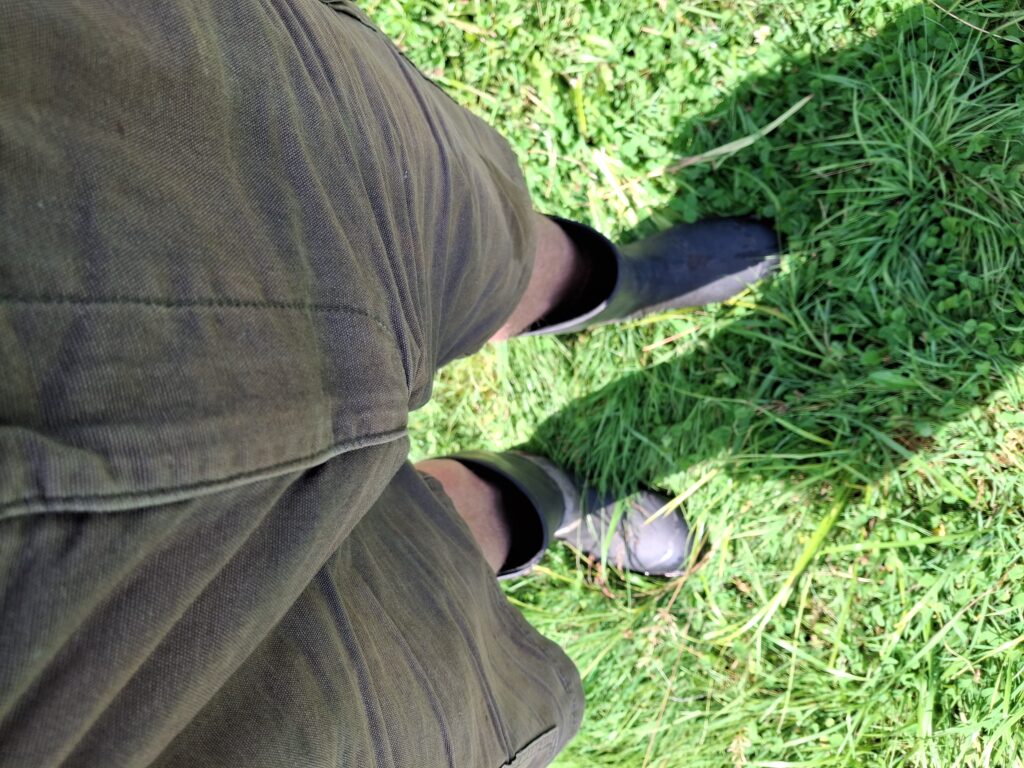
I wear shorts.

Now before everyone starts writing angry emails, let me explain.

I have hairy legs.

TMI?

As strange as this sounds, those hairy legs act like an early warning system. I can usually feel a tick crawling long before it reaches somewhere I’d rather it didn’t. Ninety-nine times out of a hundred, I simply pluck it off and drop it into a small pill bottle filled with rubbing alcohol that I carry with me.

The alcohol kills the tick quickly, ensuring it can’t crawl off and find another victim.

Unfortunately, every now and then one manages to sneak past my early warning system.

The worst offenders seem to head for my scalp.

That’s one of the reasons I keep my hair cut very short during the summer months.

It makes tick checks much easier.

One thing people often associate with tick bites is the famous bull’s-eye rash, known medically as erythema migrans.

It is one of the most recognizable signs of early Lyme disease and usually appears 3 to 30 days after an infected tick bite. In many people, it slowly expands over time and may resemble a target.

The important thing to remember is that not everyone develops the rash.

In fact, some people never see one at all.

Likewise, many people never notice the tick itself. Young ticks, called nymphs, can be no bigger than a poppy seed.

That’s why it’s important to pay attention not only to your skin but also to how you’re feeling.

If you remove an attached tick, don’t simply forget about it.

Watch for symptoms over the following days and weeks.

Here in Ontario, pharmacists can prescribe a single preventive 200 mg dose of doxycycline in certain high-risk situations after a black-legged tick bite, provided treatment begins within 72 hours of removing the tick and other clinical criteria are met. Not every tick bite requires antibiotics, so if you’re unsure, it’s worth speaking with your pharmacist or healthcare provider.

While Lyme disease gets most of the attention, ticks can carry several other diseases as well.

As my experience demonstrated, Lyme disease isn’t the only thing they have in their microscopic arsenal.

The key is awareness.

Remove ticks promptly using fine-tipped tweezers.

Monitor for symptoms.

Seek medical advice if you’re concerned.

Don’t assume you’re “probably fine” just because you don’t see a rash.

Trust me.

I’ve already tested that theory.

There are plenty of tick repellents on the market, and I absolutely recommend using them when appropriate.

But they’re a bit like the safety on a shotgun.

Use them.

Just don’t trust them completely.

Ultimately, living on a homestead means accepting that nature comes with both beauty and hazards.

The birds.

The gardens.

The wildlife.

The fresh air.

And yes…

The ticks.

I still wouldn’t trade this life for anything.

I just wish it came with fewer passengers looking for a free meal.

Stay safe.

Check yourself.

Check your kids.

Check your pets.

It only takes a few minutes, and those few minutes could make all the difference.

Read more:

👉10 Types of Ticks That Transmit Diseases, Where They Live, and How to Identify Them

Come Follow Along!

I’ve launched a YouTube channel for the homestead.
If you could, please stop in, view the video, select “Like,” subscribe, and share the link. These things will really help the channel get off the ground.

👉 YouTube Channel


Now on TikTok!

Starting this week, I have launched a page on TikTok.
Please drop by if you get a chance.
More content is forthcoming.

👉 TikTok


Ready to Start Your Own Journey?

If you’re thinking about starting your own homestead, check this out:
👉 Learn More 


Shop For Blue Gypsy Homestead Products Online!

If you’d like to see more of what we offer for sale, please stop in at our
👉 Online Store

Happy Father’s Day, Dad – Blog 2026-Jun-21

Picture of my Dad after he was done crushing grapes

Father’s Day was yesterday, but I was so busy that I never really took the time to stop and reflect.

My father passed away on July 10, 2014, just three days shy of his 78th birthday. Cancer eventually took him from us, but even now, more than a decade later, I find myself thinking about him more often than I would have imagined.

My dad’s story was not an ordinary one.

In 1956, at the age of seventeen, he and his best friend fled Hungary during the Soviet invasion that was intended to crush the Hungarian Revolution. They left behind everything they knew and stepped into an uncertain future with little more than determination and hope. Looking back on it now, I cannot begin to imagine the courage that must have taken.

That willingness to face uncertainty head-on stayed with him for the rest of his life.

My father was a machinist by trade, but that description never quite captured who he was. He was one of those rare people who could look at a problem and immediately start seeing possibilities. He could stare at an object that had been designed for one purpose and somehow envision three others.

He learned by watching.

If something broke, he fixed it.

If something didn’t exist, he built it.

If there wasn’t an obvious solution, he created one.

What he taught me was not simply how to use tools or work with my hands. He taught me to look beyond what something was and consider what it could become. Long before people started talking about “thinking outside the box,” that was simply how he approached life.

Looking back, I suspect he inherited that trait from his own father.

My relationship with my dad was complicated.

There were good times and difficult times.

As I’ve gotten older and learned more about myself, I’ve come to believe that he may have struggled with bipolar disorder as well. At the time, nobody talked about those things. There were no conversations about mental health around our kitchen table. There were simply good days and bad days, and sometimes we all found ourselves trying to navigate the storms that came with them.

My father could be crass, stubborn, rude, and quick-tempered. His outbursts could shake the entire house. Even now, there are moments when memories of those explosions of anger come back to me unexpectedly.

But there is another truth that exists alongside those memories.

He loved us.

Of that, I have never had any doubt.

Like most parents, he wasn’t perfect. He carried his own burdens and fought battles that I don’t think he fully understood himself. Yet through all of it, he showed his love the way many men of his generation did—through hard work, sacrifice, and teaching.

He taught me how to fix things instead of immediately replacing them.

He taught me how to build houses and structures.

He taught me how to work with my hands.

He taught me how to fish.

He taught me how to drive.

He taught me how to make wine.

He taught me that if you don’t know how to do something, you can usually figure it out if you’re willing to learn.

Those lessons have followed me throughout my entire life.

When I look around the homestead today, I see his fingerprints everywhere.

Not literally, of course.

But in every project I tackle, every repair I attempt, every solution I cobble together from materials already on hand, I can see the influence he had on me.

My father was also an avid reader. Every day, he would sit down with the newspaper and read it from the front page to the very last page. Every now and then, he would tell me about some historical event or obscure fact he had come across.

At the time, I probably wasn’t paying nearly as much attention as I should have.

Now I find myself doing exactly the same thing—reading, researching, and disappearing down rabbit holes of curiosity simply because I want to understand how something works or why something happened.

I suspect I inherited that from him too.

My father wasn’t the only curious one in the family. Somewhere along the way, I inherited that trait as well, although I suspect my version occasionally caused him more stress than he would have preferred.

One example still makes me smile.

When I was about ten years old, I became fascinated by how flush toilets worked. Like many childhood experiments, the idea seemed perfectly reasonable at the time. Unfortunately, I failed to consider one very important detail: we lived in a one-bathroom house.

Armed with curiosity and a complete lack of foresight, I proceeded to disassemble our only toilet.

To be fair, the experiment was a success. I learned exactly how it worked.

The problem was that once I had everything spread across the bathroom floor, I discovered that understanding how something comes apart and understanding how to put it back together again are two entirely different skill sets.

By the time my father came home from work, the family toilet was still in pieces.

Needless to say, he was not pleased. In fact, saying he was “not pleased” might be one of the great understatements of my childhood.

Still, after the initial shock and frustration wore off, he did what he always did. He helped solve the problem. Together, we got everything back where it belonged, and in the process I learned something that stayed with me for the rest of my life.

Curiosity is valuable, but it occasionally comes with consequences.

The funny thing is that all these years later, that lesson paid off. Today I can take a toilet apart, repair it, rebuild it, or replace it entirely if necessary. What started as a childhood disaster became another useful skill tucked away in the toolbox.

Looking back, that story feels like a perfect illustration of both my father and me. His curiosity inspired mine, and my curiosity frequently created situations that required his patience, expertise, and occasionally his temper to resolve.

He worked incredibly hard throughout his life. There were times when he held down two or even three jobs simply to make ends meet and provide for his family.

That kind of work ethic leaves an impression.

It certainly left one on me.

Whatever challenges he faced, whatever burdens he carried, he showed up and did what needed to be done. He made the best of what he had available, even when circumstances were less than ideal.

That is a lesson I find myself leaning on more and more these days.

Especially now.

The older I get, the more I realize that many of the skills I rely upon every day came directly from him.

And perhaps the strangest thing is that he still helps me.

Every once in a while, when I am standing in front of a tractor that refuses to start, trying to figure out how to build something by myself, or staring at a problem that seems determined not to cooperate, I can almost hear his voice.

Not the angry voice.

Not the frustrated voice.

The problem-solving voice.

The voice that asks questions.

The voice that points out the thing I haven’t noticed yet.

The voice that quietly walks me through the solution.

Whether that is memory, imagination, or something else entirely, I honestly don’t know.

What I do know is that it still brings me comfort.

I loved my father.

Sometimes that wasn’t easy.

Relationships rarely fit neatly into simple categories of good or bad. The people who shape us most often leave us with a mixture of gratitude, frustration, admiration, and regret.

My father certainly did.

But as the years pass, I find myself thinking less about the difficult moments and more about the lessons, the sacrifices, and the gifts he left behind.

The greatest of those gifts wasn’t a possession.

It was the ability to think, build, solve problems, and persevere.

Those gifts continue to serve me every day.

Happy Father’s Day, Dad.

My greatest wish is that you knew how much of what I have accomplished came from what you taught me.

I’d like to think you’d be proud of the life I’ve built, the homestead I’ve created, and the person I’ve become.

Who knows?

Maybe you are.

Rest peacefully.

You earned it.

The Next Chapter: An Involuntary Retirement – BLOG 2026-Jun-20

It’s another Friday.

Despite submitting dozens of applications for contracts, my extensive work experience consistently falls short of the current job market’s needs.

I never imagined that I would be sitting down one day and seriously contemplating what comes next after more than thirty-five years in the workforce.

The concept of retirement is one of those things that always seemed to exist somewhere off in the distance. It was a concept, not a destination. Something that happened to other people. Something I would eventually get around to thinking about when the time came.

Apparently, the time has arrived, and I am facing the prospect of accepting it.

The funny thing is that when people hear the word retirement, they often picture freedom. Sleeping in. Relaxing. Golf courses. Cruises. Long afternoons with nowhere to be and nothing that absolutely has to get done.

I have discovered that my version looks considerably different.

Perhaps the best description is that I have entered what might be called an involuntary retirement phase. Not necessarily because I wanted to stop working, but because circumstances have pushed me into a position where I need to take a hard look at what comes next and decide, very deliberately, where I want to invest the years ahead.

That sounds exciting when I write it down.

Some days it even feels exciting.

Other days it feels a little terrifying.

For more than three decades, I built a career around solving problems. Business analysis. Project management. Technical writing. Process improvement. Consulting. Government projects. Corporate projects. Technology projects. Meetings, deadlines, requirements, budgets, risks, stakeholders, deliverables and all the other things that become second nature after you’ve spent a lifetime doing them.

Now I find myself applying those same skills to a project that is much more personal.

Me.

More specifically, what comes next.

One piece of advice I keep hearing from people is that I finally have the opportunity to do what I love.

That sounds wonderful.

The challenge, of course, is figuring out how to monetize it.

Loving something and making it financially sustainable are often two very different things.

If there is one thing my years in business have taught me, it is that enthusiasm is not a business model.

So I have approached this transition the same way I would approach any major initiative. Before deciding where to go, I need to understand what resources I have available.

That means taking inventory.

Not of equipment or buildings or financial assets.

Of skills.

Over thirty-five years, I have accumulated an unusual collection of experiences. Some obvious. Some less so. Project management. Business consulting. Technical writing. Public speaking. Training. Process analysis. Technology. Artificial intelligence. Content creation. Farming. Food preservation. Freeze drying. Marketing. Problem solving. Building things. Fixing things. Figuring things out when there is no manual and nobody to call for help.

Prior to my IT career, I worked as: a semi-professional photographer, kitchen staff, restaurant management, and a bartender.

When I step back and look at that list, I realize that the challenge is not whether I have useful skills.

The challenge is deciding which combination of those skills offers the best path forward.

Like many things in life, possibilities are both a blessing and a curse.

Too few options can leave you trapped.

Too many can leave you standing still.

At the moment, the most likely path appears to be continuing to build Blue Gypsy Homestead into a sustainable business.

That feels right.

The homestead has become more than a place. It has become part of my identity. It is where I create. It is where I learn. It is where I make mistakes. It is where I find purpose when other parts of life become uncertain.

The challenge isn’t deciding whether the homestead should play a central role in the future.

The challenge is determining exactly how to make it work.

That is where reality enters the conversation.

When your cash flow is reduced to the point where traditional financing becomes difficult or impossible, expansion takes on a completely different meaning.

The old approach of throwing money at a problem is no longer available.

Every decision matters.

Every dollar matters.

Every purchase must justify itself.

Every opportunity must be evaluated carefully.

That means being creative.

It means being frugal.

It means being purposeful.

It means learning how to do more with less.

Perhaps more importantly, it means accepting that constraints are not necessarily weaknesses. Sometimes constraints force innovation. Sometimes limitations force us to focus on what truly matters instead of chasing every shiny opportunity that comes along.

There is another layer to all of this that I don’t often talk about in great detail, but it would be dishonest not to acknowledge it.

For most of my life, I have navigated the world with a brain that doesn’t always cooperate with my plans. Living with bipolar disorder and ADHD means that even on the best of days, there is a constant negotiation taking place between what I want to accomplish and what my mind decides it wants to focus on.

Some days, ideas arrive faster than I can write them down. Every possibility seems exciting. Every project feels achievable. The future appears limitless and I can almost see the finished product before I’ve even begun.

Other days, the same future can feel impossibly distant.

Tasks that should be simple become difficult. Decisions that would normally take minutes can consume hours. Motivation becomes elusive. Progress slows. Self-doubt becomes louder.

Over the years, I have learned that neither version tells the whole truth.

The challenge has never been a lack of ideas. If anything, I have spent much of my life with the opposite problem. My mind is an endless source of projects, plans, opportunities, and what-if scenarios. The difficult part has always been determining which ideas deserve my energy and which ones should remain ideas.

Now that I find myself standing at this crossroads, those challenges haven’t disappeared simply because I have entered a new phase of life.

In some ways, they have become more significant.

When you have a traditional career, there is often an external structure imposed upon you. Meetings happen at specific times. Deadlines exist. Expectations are clearly defined. Someone else determines many of the priorities.

When you are building your own future, especially with limited resources, that structure largely disappears.

The freedom sounds wonderful until you realize that freedom also comes with responsibility.

Every decision becomes your decision.

Every success and every mistake belongs to you.

For someone with ADHD, that freedom can sometimes feel like being handed a map with a thousand possible roads and being told to choose wisely.

For someone with bipolar disorder, there is an added challenge of learning to trust the process rather than the emotional weather of any particular day.

That has become one of the most important lessons I continue to learn.

Not every exciting idea deserves immediate action.

Not every difficult day means the plan is failing.

Not every setback is permanent.

Not every success is proof that I have everything figured out.

The goal is not perfection.

The goal is consistency.

Fortunately, the homestead has become one of the most effective tools I have found for maintaining that consistency.

Animals need feeding whether I feel motivated or not.

Gardens need watering whether I am inspired or not.

Fences need repairing whether I am having a good day or a bad one.

The homestead doesn’t care about my mood. It simply asks me to show up.

There is something profoundly grounding about that.

When my thoughts become noisy, there is comfort in tangible work. A rabbit doesn’t care about strategic planning. Tomatoes don’t care about business forecasts. A broken gate doesn’t care about my anxieties.

They simply need attention.

Perhaps that is one of the reasons Blue Gypsy Homestead has become so important to me. It provides purpose, structure, and a connection to something real at a time when many things feel uncertain.

I would be lying if I said there isn’t a mental and emotional component to all of this.

There is.

A big one.

When you spend decades building a career, much of your identity becomes intertwined with what you do. Whether we admit it or not, our work often becomes part of how we define ourselves.

When that changes, even unexpectedly, it can leave you feeling unsteady.

There are moments when discouragement creeps in.

Moments when the numbers don’t look the way you’d like them to.

Moments when the list of obstacles appears longer than the list of opportunities.

Moments when the path ahead seems frustratingly unclear.

Those moments are real.

Ignoring them doesn’t make them disappear.

What helps me is remembering that every meaningful thing I have ever accomplished started with uncertainty.

Every project.

Every career move.

Every business venture.

Every major life decision.

None of them arrived with guarantees attached.

They began with a decision to move forward despite not having all the answers.

Which brings me to a phrase that feels particularly appropriate right now.

Failure is not an option.

Not because I believe success is guaranteed.

Not because I think positive thinking magically solves difficult problems.

Not because I am immune to setbacks.

Quite the opposite.

Failure is not an option because quitting is not an option.

The future may require adjustments.

It may require pivots.

It may require learning new skills, abandoning old assumptions, and reinventing myself more than once.

But moving forward remains non-negotiable.

I don’t know exactly what the future will look like.

I don’t know which of my many ideas will succeed.

I don’t know how many times I will need to adjust course before I find the right path.

What I do know is that I have spent a lifetime overcoming obstacles that once seemed overwhelming.

This challenge is simply the latest chapter.

And just like every chapter before it, I intend to keep moving forward.

The next chapter is unwritten.

That uncertainty is both frightening and exciting.

For now, I will continue taking inventory, evaluating opportunities, building the homestead, and looking for ways to turn passion into something sustainable.

One careful, deliberate step at a time.

After all, that’s how most worthwhile journeys begin.

Failure is not an option—not because I expect the journey to be easy, but because I have already survived too many difficult chapters to quit writing the story now.


Come Follow Along!

I’ve launched a YouTube channel for the homestead.
If you could, please stop in, view the video, select “Like,” subscribe, and share the link. These things will really help the channel get off the ground.

👉 YouTube Channel


Now on TikTok!

Starting this week, I have launched a page on TikTok.
Please drop by if you get a chance.
More content is forthcoming.

👉 TikTok


Ready to Start Your Own Journey?

If you’re thinking about starting your own homestead, check this out:
👉 Learn More 


Shop For Blue Gypsy Homestead Products Online!

If you’d like to see more of what we offer for sale, please stop in at our
👉 Online Store

New Blue Gypsy Homestead T-Shirts Are Coming!

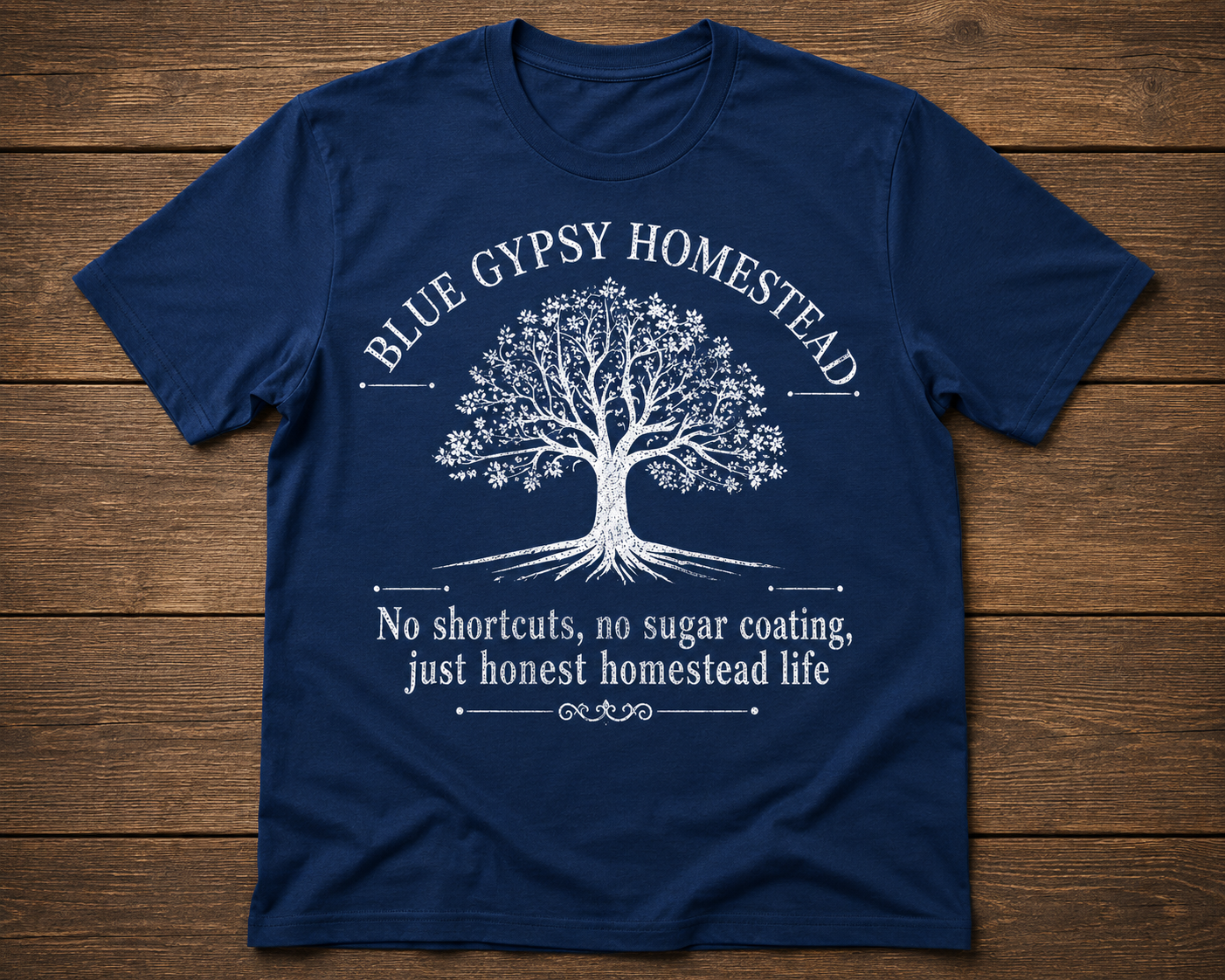
There are moments when something starts as a simple idea and slowly turns into something tangible you can hold in your hands. This new Blue Gypsy Homestead t-shirt is one of those moments.

Over the past few years, Blue Gypsy Homestead has grown from an idea into a lifestyle, a business, a community, and a place where I can share both the victories and the inevitable misadventures that come with homestead life. Along the way, one phrase kept coming back to me:

“No shortcuts, no sugar coating, just honest homestead life.”

That simple statement captures everything I try to share here. The successes. The mistakes. The projects that work exactly as planned and the ones that most definitely do not. It reflects the belief that there is value in being honest about the journey rather than pretending everything is always picture perfect.

With that in mind, I’m excited to announce that this design will soon be available as an official Blue Gypsy Homestead t-shirt.

The shirt features the Blue Gypsy Homestead tree logo in a vintage distressed style, printed in white on a classic blue t-shirt. The design is simple, clean, and unmistakably homestead-focused—something you can wear at the farmers’ market, around the farm, in the workshop, or anywhere you want to show your support for honest, practical living.

One thing that’s important to me is keeping the price reasonable. I’m still working out the final pricing, but my goal is straightforward: make these shirts affordable without sacrificing quality.

To help achieve that, I’ll be producing them in-house. By handling the printing myself, I can avoid many of the markups associated with third-party print services and pass those savings directly on to you. It also gives me far more flexibility when it comes to customization and special requests.

Initially, I’ll be stocking Large (L) and Extra Large (XL) sizes as standard inventory. However, one of the advantages of printing in-house is that I’m not limited to only a few sizes. If you need a different size, simply let me know and I’ll do my best to accommodate your request.

The standard shirt colour will be the classic Blue Gypsy Homestead blue shown in the design preview. That said, other shirt colours may also be available upon request. Depending on the cost of sourcing the base shirt, alternate colours may carry a small additional charge, but I’ll always keep pricing as fair as possible.

As for delivery:

Local pickup is free
Local delivery is free
World-wide shipping is available at actual cost — no inflated handling fees or hidden charges

As always, I appreciate every person who follows the blog, watches the videos, visits the farmers’ market booth, shops the online store, or simply takes the time to read about life on the homestead.

This shirt is more than merchandise. It’s a reflection of what Blue Gypsy Homestead stands for:

No shortcuts, no sugar coating, just honest homestead life.

Stay tuned for pricing, ordering information, and availability updates coming soon.

— Louis
Blue Gypsy Homestead


Come Follow Along!

I’ve launched a YouTube channel for the homestead.
If you could, please stop in, view the video, select “Like,” subscribe, and share the link. These things will really help the channel get off the ground.

👉 YouTube Channel


Now on TikTok!

Starting this week, I have launched a page on TikTok.
Please drop by if you get a chance.
More content is forthcoming.

👉 TikTok


Ready to Start Your Own Journey?

If you’re thinking about starting your own homestead, check this out:
👉 Learn More 


Shop For Blue Gypsy Homestead Products Online!

If you’d like to see more of what we offer for sale, please stop in at our
👉 Online Store

The Rabbit Roundup: Bunnies Don’t Care About Your Plans – BLOG 2026-Jun-16

I came home expecting an ordinary evening.

Feed the animals. Check on the gardens. Cross a few things off the ever-growing list that lives permanently in the back of my mind. Maybe sit down for a few minutes and enjoy the quiet that settles over the farm at the end of the day.

Instead, I looked over toward the Rabbit Palace and immediately felt that sinking sensation that every homesteader eventually comes to recognize.

The door was open.

Not broken. Not forced open by a predator. Just… open.

I must not have latched it properly.

Despite the electric fence, which rabbit are immune to because of their fur, several of the rabbits had escaped.

It’s funny how quickly your mind can travel when you realize you’ve made a mistake. In the space of a few heartbeats, I had already pictured the worst-case scenarios. Predators. Lost breeding stock. Weeks and months of planning were undone because of one small oversight that probably took less than two seconds to happen.

Coming up the driveway, I saw what I thought was a wild rabbit… then I noticed movement in the yard.

Rabbits.

Everywhere.

About half of them had apparently decided that life beyond the Rabbit Palace deserved further investigation. Some were grazing contentedly as if this was the arrangement all along. Others were making a determined effort to test both my patience and my cardio endurance.

There wasn’t time to dwell on the guilt.

Thankfully, I wasn’t facing the situation alone. Snoopy stepped up as my reluctant but invaluable assistant, helping me round up as many escapees as possible. There was a lot of slow walking, gentle coaxing, strategic repositioning, and more than one muttered promise to myself that I would double-check every latch from this day forward.

As the evening wore on, we managed to recover several rabbits. Each one safely returned brought a wave of relief that lasted only until I remembered there were still others unaccounted for.

Eventually, daylight gave way to darkness, and with it came uncertainty.

I wouldn’t know until morning how many are gone for good.

I keep hoping they’re tucked away somewhere nearby, hidden beneath a structure or nestled into long grass, waiting for the world to quiet down before emerging. Rabbits are prey animals. Their instincts tell them to freeze, hide, and survive.

I hope those instincts serve them well tonight.

More than anything, I hope my breeding pair are safe.

As I stood in the yard gathering rabbits, I found myself thinking back to last season and the chickens. They had managed an escape of their own, slipping beyond the boundaries that had been carefully built to keep them safe. At first, I convinced myself they would turn up. Chickens have a way of surprising you, after all. I kept expecting to catch sight of them wandering back toward the coop at dusk, indignant and demanding their supper as though nothing had happened. But they never returned. There was no dramatic ending, no clear explanation, just the quiet realization over days and weeks that they were gone. That experience stayed with me. It taught me that hope and realism often coexist uneasily on a homestead. You hope for the best because there isn’t much else you can do, while quietly preparing yourself for the possibility that not every story will end the way you want it to. Standing there with Snoopy, counting rabbits and recounting them again, I couldn’t help but revisit that earlier loss and wonder what lesson the homestead was trying to teach me this time.

The practical side of homesteading often revolves around planning. You select breeding stock carefully. You think months ahead. You calculate feed costs, housing requirements, and future litters. There’s a rhythm to it, an underlying belief that if you prepare properly, things will unfold more or less according to plan.

And then life reminds you that planning only takes you so far.

The truth is, homesteading has a way of exposing our humanity. The mistakes we make aren’t usually dramatic. More often, they’re ordinary. A gate is not secured. A water bucket was forgotten. A task is postponed because you’re tired and promise yourself you’ll get to it tomorrow.

Most days, those moments pass without consequence.

Sometimes they don’t.

That’s the part of this life that doesn’t fit neatly into carefully curated social media posts. We see the overflowing harvest baskets, the adorable kits, and the beautiful sunsets over the pasture. Those moments are real. They’re part of the story.

But so is this.

So are the evenings spent chasing rabbits around the yard while mentally replaying the exact moment you might have failed them.

So are the sleepless nights spent hoping that a mistake hasn’t cost more than you’re prepared to lose.

I don’t know what tomorrow morning will bring.

Maybe there will be rabbits waiting impatiently outside the Rabbit Palace for breakfast as though none of this ever happened. Maybe there will be difficult realities to face. Right now, all I can do is hope for the best, learn from what happened, and carry that lesson forward. One thing was certain, I needed to purchase a new fishing net with a long handle.

Did you know that rabbits are incredibly fast; several times faster than chickens…?

One thing that has worked in my favour through all of this has been having live trap cages tucked away among the assortment of tools and supplies that seem to accumulate on a homestead. They were originally purchased with entirely different intentions in mind, but as is so often the case out here, you learn to appreciate the value of having practical solutions close at hand. Armed with a selection of irresistible rabbit delicacies, I set the traps and hoped curiosity and an empty stomach would succeed where frantic chasing had failed.

To my immense relief, they did. One by one, the escape artists found their way back into custody, no doubt questioning why the forbidden treats had suddenly become so easy to acquire. As of now, all but one rabbit has been recovered. There’s still one holdout somewhere on the property, and while I can’t help but admire its determination and apparent commitment to independence, I’m holding onto the hope that a little patience—and perhaps the promise of another favourite snack—will eventually bring this final wanderer home. After all, if homesteading teaches anything, it’s that ingenuity often matters just as much as hard work, and sometimes the gentlest solutions turn out to be the most effective.

Homesteading has taught me many things over the years, but perhaps one of the hardest is this: responsibility doesn’t mean perfection.

It means showing up.

It means acknowledging when you’ve fallen short.

It means doing everything you can to make things right.

Tonight, that means one final walk around the property before bed, listening for movement in the underbrush and whispering quiet promises into the darkness that tomorrow will be better.

And from this day forward, check the rabbit door twice.

Because this is homesteading.

Not the polished version.

The real version.

Warts and all.


Come Follow Along!

I’ve launched a YouTube channel for the homestead.
If you could, please stop in, view the video, select “Like,” subscribe, and share the link. These things will really help the channel get off the ground.

👉 YouTube Channel


Now on TikTok!

Starting this week, I have launched a page on TikTok.
Please drop by if you get a chance.
More content is forthcoming.

👉 TikTok


Ready to Start Your Own Journey?

If you’re thinking about starting your own homestead, check this out:
👉 Learn More 


Shop For Blue Gypsy Homestead Products Online!

If you’d like to see more of what we offer for sale, please stop in at our
👉 Online Store

The Natives Are Getting Restless – BLOG 2026/May/13

There are moments on a homestead when you realize nature doesn’t negotiate. She doesn’t care how many weekends you gave to a project, how carefully you squared every corner, or how many times you stood back with your hands on your hips thinking, yeah… that’ll do.

She takes one hard wind, one heavy rain, one season that pushes a little harder than the last, and suddenly something you built with your own hands is lying in pieces.

That’s what happened here at Blue Gypsy Homestead.

The enclosure I had built—the one that first housed the chickens, and later became home to the rabbits—didn’t survive what nature decided to throw at it. I wish I could tell you I stood there with some noble farmer’s stoicism, nodding quietly as if destruction is just part of the cycle. Truth is, I stood there staring at it longer than I’d care to admit, trying to decide whether I was angry, disappointed, or just tired.

Probably all three.

And maybe that’s part of this life nobody talks about when they ask questions like:

    • What is homesteading really like?
    • How do you build animal shelters that actually last?
    • What happens when your farm structures fail?
    • Can you build a rabbit enclosure using pallets?

The answer, at least from where I’m standing, is that you rebuild. Not because you’re feeling inspired. Not because some motivational quote told you to. You rebuild because the animals still need shelter, the work still needs doing, and standing still doesn’t make broken things whole again.

So the rabbits had to move.

Back into the greenhouse.

Safe. Dry. Comfortable enough, I suppose.

But if you’ve ever kept rabbits—really spent time watching them instead of just feeding them—you know they communicate plenty without making much noise.

These ones sit in the greenhouse windows now, pressed up against the glass, staring out across the property like prisoners who remember freedom.

And honestly?

I get it.

They had space before. Room to run. Dirt under their feet. Things to explore. Then overnight they were back inside, looking out instead of living out.

Me too, bunnies.

Me too.

So I went back to work.

Not with fancy lumber. Not with some expensive prefab solution. What’s worked for me on this homestead—especially when budget matters more than pride—is using what’s available and building smarter the second time.

Pallets.

Strong, imperfect, practical pallets.

They’ve become the bones of the new enclosure, and there’s something fitting about that. Taking discarded things and turning them into something stronger than what existed before feels… honest somehow.

The new rabbit enclosure will sit at roughly 22 x 22 feet, giving them far more room to move, dig, play, and act like rabbits instead of decorations in a greenhouse window.

But the part I’m most excited about—the part that keeps me out there even when I probably should’ve called it a day—is the underground burrow system.

Not because it sounds clever.

Because it solves a real problem.

Summer heat can be brutal. Winter can be worse. So this burrow will be insulated, giving them a place to cool off in July and a little protection when January starts reminding us where we live here in Ontario.

That’s something I’ve learned building here: the best homestead designs aren’t the ones that look good in photos.

They’re the ones that survive seasons.

They’re the ones the animals actually use.

They’re the ones that make you rebuild after nature tears your work apart, not because you enjoy starting over—but because you’ve started caring too much to quit.

Pictures are coming soon.

And if the rabbits have their way… not soon enough.


Come Follow Along!

I’ve launched a YouTube channel for the homestead.
If you could, please stop in, view the video, select “Like,” subscribe, and share the link. These things will really help the channel get off the ground.

👉 YouTube Channel


Ready to Start Your Own Journey?

If you’re thinking about starting your own homestead, check this out:
👉 Learn More 


Shop For Blue Gypsy Homestead Products Online!

If you’d like to see more of what we offer for sale, please stop in at our
👉 Online Store

When the Market Says “Maybe Next Year” — Facing Adversity on a Small Budget: The Reality of Breaking Into Farmer’s Markets – BLOG 2026/May/5

It doesn’t kick down the door and announce itself.

It shows up quietly—usually after the third email, the fifth application, or the polite rejection that says “We’re currently full for the season.”

And if you’re trying to build something on a limited budget, those words land heavier than people realize.

Because when you don’t have deep pockets, you don’t have the luxury of wasting time.

You can’t afford to throw money at advertising just to “build awareness.” You can’t hire a consultant to open doors. You can’t pay for premium shelf space, a flashy storefront, or someone else’s audience.

So you do what most small producers do.

    • You make the product yourself.
    • You package it yourself.
    • You test recipes, labels, pricing, branding, and customer feedback yourself.

And then, when you’re finally ready to put your work in front of actual people… you discover there’s another gate.

This time, it’s the farmer’s market.

Now before anyone gets defensive—I understand why markets have rules.

They need standards. They need consistency. They need to protect the customers, the vendors, and the reputation of the market itself.

I get that.

But understanding something doesn’t make it any less discouraging when you’re standing on the outside looking in.

This year, I started reaching out to farmer’s markets, hoping to find a place where I could sell the products I’ve been working so hard to build.

What I found instead was a wall made of deadlines, quotas, waiting lists, category caps, committee approvals, and application windows that closed months ago.

    • Some markets were already full.
    • Some had limits on product categories.

Some had exclusivity rules that meant if one vendor was already selling something similar, there simply wasn’t room for another.

And almost every conversation carried the same underlying message:

You’re too late.

That phrase can do strange things to your head.

Especially when you’re already operating on a tight budget.

Because “too late” doesn’t just mean you missed a deadline.

It feels like being told your effort arrived after the party was over.

And when you’ve poured your own money, your own time, and more of your own faith into something than you probably should have… that hits.

I won’t pretend I handled every rejection with grace.

Some days I was motivated.

Other days I questioned the whole thing.

Not because I don’t believe in the products.

Not because I’m afraid of hard work.

But because barriers feel different when every dollar matters.

When your budget is thin, every setback has a price tag attached to it.

Every “no” means fuel, packaging, ingredients, licensing, labels, and hours that still have to be paid for somehow.

And yet…

I’m still here.

That has to count for something.

Because adversity doesn’t always look dramatic.

Sometimes it looks like sending one more email after being ignored.

Sometimes it looks like filling out another application you’re not sure anyone will read.

Sometimes it looks like sitting at your kitchen table with a calculator, trying to figure out how to stretch one more month out of a budget that already looks impossible.

And sometimes it looks like accepting that the original plan might not work—not because the dream is wrong, but because the path needs to change.

That’s where I’m at right now.

    • Not defeated.
    • Not naïve.
    • Just realistic enough to know the road isn’t going to clear itself.

If the farmer’s markets are full this season, then I’ll find another way.

    • Pop-up events.
    • Online sales.
    • Community partnerships.
    • Word of mouth.
    • Direct-to-customer.

Whatever honest road opens next.

Because when you build something from scratch on a limited budget, you learn an uncomfortable truth:

    • Nobody owes you access.
    • Nobody owes you a platform.
    • Nobody owes you a shot.

But that doesn’t mean you stop building.

It just means you get better at building doors where walls used to be.

And honestly?

That might be the real business lesson nobody talks about.


Come Follow Along!

I’ve launched a YouTube channel for the homestead.
If you could, please stop in, view the video, select “Like,” subscribe, and share the link. These things will really help the channel get off the ground.

👉 YouTube Channel


Ready to Start Your Own Journey?

If you’re thinking about starting your own homestead, check this out:
👉 Learn More 

#FarmersMarket #SmallBusiness #Entrepreneurship #HomesteadLife #FarmBusiness #SupportLocal #ShopLocal #MadeInCanada#HomesteadBusiness #SmallFarm #FarmStartup #LocalProducer #DirectToConsumer #ArtisanProducts #CanadianBusiness #RuralEntrepreneur #BuildAnyway #RealTalkBusiness #StartupStruggles #BusinessJourney #KeepGoing #SmallBusinessLife #BehindTheScenes #BusinessReality

Today Was a Busy One – BLOG 2026/May/ 1

Another Day at the Homestead: Rabbits, Repairs, and a Well-Earned Cup of Tea 🌱

Some days on the homestead are big adventure days.

Some are quiet days filled with chores.

And some are a little bit of both.

Today was one of those days.

The weather was beautiful, and you could feel spring in the air. Everything seems to be waking up again, and that always brings a little extra energy to the farm.


Morning Chores With the Rabbits 🐇

The day started by checking in on the rabbits.

That means both the original breeding pair and the young kits.

The breeding pair is still in the greenhouse while I wait for Bonnie to give birth. The young rabbits have been moved into the Coopa Cabana—which used to house meat chickens.

Now it’s rabbit space.

I fixed broken wall sections, added extra wire inside to help stop digging, and set up electric fencing around the enclosure for added protection.

Most of homesteading is like that—taking old things and making them work in new ways.


Protecting Livestock From Predators

https://images.openai.com/static-rsc-4/Nr8_l31Ios7BIDMKH5x1GJ0VPw4Z8hzcONyIMa2x_LiclhA2xzR_NXT9B4jzsbOPZ07gmDsb6GaV3b3XV1ZSdpbh52JR7lzC9bhkWOEsvIICKfTTcMjfYruORmC4WFs42zeNgv1MdW6XZtNCRJqAiL9Ejy2tO3sMBuaVn7V6jjXkLnNUB1ESt1imcF74cZMr?purpose=fullsize
https://images.openai.com/static-rsc-4/HI5rH7MF2Ltvahf8HT07PUVbJwgATtE5MfmPXRUoEdx16W8GNH3shOMk1BYAQgyd-o26np0CQFese34ttOJ1qZVOYCY_Gz4gVKjPOIIX1FO-yiWpeRySk289WsO0e9bppPIVPSOl8YtC17nBVECkYVTG2_edD2GdLRWHuOaSVkeWhXTnjwbkJyP1Emqt_S0N?purpose=fullsize
https://images.openai.com/static-rsc-4/bmiLY-WUBA-GETmrXwJT-Bs_llfI61s298tpSMVjNqFVPN0brYbRRvPGeltIHjJSMw5qgpH8Cunogo8cplKMKmOGwz4YKenbCs7p3QxcBlHRDFl0eGEKkZY1dT-fZhHvMuh1TEO09sPPXh_NOGRhyf2_1E_kLPSlu9RHHt6pVNOFpKTnnDihpVPK5HN1u36P?purpose=fullsize
A few days ago, I spotted a fisher moving in the distance.

That gets your attention.

Out here, predators are part of life:

    • Coyotes
    • Wolves
    • Fishers
    • And a few others

They are just trying to survive.

And so am I.

I try to give wildlife as much space as possible. I have no interest in harming an animal unless there is a real threat to livestock.

That’s why prevention matters.

Good fencing. Strong enclosures. Awareness.

That’s the first line of defense.

And yes—living in a rural area still means being careful. There are homes nearby, and safety always comes first. Tools like firearms must always be handled responsibly and carefully.

Most problems are better solved before they ever become problems.


Repairs Never Take “Just a Minute” 🔧

https://images.openai.com/static-rsc-4/ij5xDXKWnBh7UH0nGMCY8-dbSpv9gkZlPGEHVOFSHaetz3XdeXqxlQ1x5ScLbAmMeJPHFHyLNR1ZLyvzgiKNhGJWklt2W8Y1I_14aQ0XATEYr9bqbvpjk61Vr19LM6VOem4MzfoRjoxXnF2iIh4wkTevFRrmnBDe4gQEqPmYN-cG70VOvYk9WCfKaccNQJqE?purpose=fullsize
https://images.openai.com/static-rsc-4/GSClE9tMLBM5oGYiH5z-KSvlvuOYyiXCEx37j5NKVN4TdndwYfkouIR6mE3ceIyzF5mUWa_PZ3tGN7n2UVUlc27WglC3eT_6-P6jfjLEAKPPIzF6hUkzJ_dPUckmgjRR9w1Y5zOmUePRe5AToLLfbMsj8NEJeVCE2eymoC5bqT9dK09Ub8HwpYBU1zaaJDZv?purpose=fullsize
https://images.openai.com/static-rsc-4/1dm2B9TirM5Nb8G6D0-yZL5XkH_pamB2uzVALwdhBsQ5ZIL4qfi0EwIcenBghU08TY44OPOIPhA4IseHi2fnWf6sMxOLA9_vYXTGSV8DBqce0-IfK9iL9ObAIXOA0ZqtA350i-zSIudaGBZrkyrejW9ZnNtBRPs1sql7bYZ1z-XqREOLBCFMo0awRu54mKyK?purpose=fullsize
After animal chores, I spent the rest of the day working on my car.

It was supposed to be a simple repair.

You probably know how that goes.

Six hours later…

It was fixed.

That’s homestead life too.

Sometimes what should take 30 minutes takes all afternoon.

Still, I learned something.

And next time, the repair should go much faster.

At $125 an hour at the garage, learning to do some things yourself can save a lot of money.

Homesteading teaches you that skills often matter as much as tools.


The Importance of Slowing Down ☕

https://images.openai.com/static-rsc-4/CC8awFb-7vXg6V_od_eZojaeo51vrBqdm9j6Smyt4pQokQkjpbetb-sFxYRty4UQQLqiU6ps7HA41GrVjb3PP8aPoHFXIb184oht12MFga5sWyNgEOj-jOGChhQZPWaEepA5vIujsyTwyDzZH98qLTzPa7bDnV2PTHCCcxaRcjGgDZkJg0sSiwuccnHQFV36?purpose=fullsize
https://images.openai.com/static-rsc-4/T-KHFkYvMk0_f615JcTBmtefZ3Yylg2l0QYeiPcuXLKHRcMCLt_PfXt5tPsAfy1CeibiNsplCjtxPni4EAhSD7ckkVb5di2Q3Dm263AZ-UjQ8MD0GsDmEgM-6op3FS39pMRUVVKWgBjmsse955B9HjO7YcBmhawTFxwboAEyWxNoQN63g7FrHFhaLM78nk3_?purpose=fullsize
After a long day, it’s important to slow down.

My plan?

    • Brew a good cup of tea
    • Catch up on Facebook
    • Take a long, very hot shower
    • Maybe watch a couple episodes of Dick Tracy from 1939

Simple things.

And honestly, those quiet moments matter.

Homestead life isn’t only about chores.

It’s also about the little comforts at the end of the day.


Every Day Teaches Something

That may be one of the biggest lessons of homesteading.

Today taught me:

    • Better predator prevention
    • More about rabbit housing
    • A new car repair skill
    • And maybe a reminder to appreciate a hot shower

Not a bad day.

Just a real one.

Messy, busy, practical, and satisfying.


Tomorrow Starts Again 🌄

With luck, sleep comes easy tonight.

And tomorrow?

Another busy day.

More chores. More surprises. More lessons.

That’s the rhythm of homestead life.

And honestly…

I wouldn’t trade it.


Come Follow Along!

I’ve launched a YouTube channel for the homestead.
If you could, please stop in, view the video, select “Like,” subscribe, and share the link. These things will really help the channel get off the ground.

👉 YouTube Channel


Ready to Start Your Own Journey?

If you’re thinking about starting your own homestead, check this out:
👉 Learn More


When Mother Nature Reminds You Who’s in Charge 🌧️💨- BLOG 2026/Apr/30

One minute everything looks fine.

The sun is shining. The animals are calm. Your projects are coming together.

Then the weather changes.

And sometimes, all it takes is one strong wind, one heavy rainstorm, or one late-season snowfall to destroy something you worked hard to build.


Small Structures Take the Hardest Hit

https://images.openai.com/static-rsc-4/USEEeWhuREHqjskpnvnHktTchSSs6xW8R6hZFn1YTY3lLDVAMAb29boi7cQKjguOBiaEdsmtwiy87t1sWayaxSZuMkf4G-l65XzrNufmCNaIEPsaXx9PCQOkAoE4in3EaSyrIaAo7qFT1w_cRsI-TrJIpQzvqoCU_lLrDdTDbYa8BvesTVI1O12UOORv_lPN?purpose=fullsize
https://images.openai.com/static-rsc-4/NMLZl0rqdVWPa62wrfeqU1RSaRRUUqUTK7Ic9DaLXgfIxbZc4iCNOnJCClZuSOl5ot5X7PthUf6Ho32WtakQaokDnE7wTX0C_Pg2CPY7EzLkCcbnsmTHNsaCeaRkv9ecwblv6WrmhFcufCd1rqAGj4Ofs2dnZYXjCsL3LVDr65UvfNo-s5F7ZnHOmUV6v625?purpose=fullsize
https://images.openai.com/static-rsc-4/cy5N09pu13BVbFwh0cCCS46AjY2XvJ4pg5DbSS13qCjGuWEVbni-Ce7M5mtYMrxjZFHGc7JrBfhIoixwtGzF8lUoTcLX0WU_NNKXRuYMyJFHtEf4AHm0zDvrjB0r9W8aBx7WaDEnS48r3cIBcW8PGV8hLzIdMvWEohLP6Sw9bULeN52_sYX5wfjQJ6SoFD_Z?purpose=fullsize
On a homestead, small structures often face the biggest challenges.

Things like:

    • Chicken coops
    • Rabbit tractors
    • Mini greenhouses
    • Tool sheds
    • Raised bed covers
    • Temporary fencing

These structures may look solid on a calm day—but weather can test every weak spot.

A strong gust of wind can tear roofing off.

Heavy snow can collapse a roof.

Too much rain can soften the ground and cause posts to shift.

And before you know it, a project you spent days building needs repairs.


Weather Doesn’t Care About Your Schedule

https://images.openai.com/static-rsc-4/ddFi8qaoZ3pCp955L0MeM2IoqEX8y6D8x1I-nmnVAn-2a4i2oE0bB-mawRTWA2jX5dqeKMuxw9EDeYLgEHbGKnJpoEOkEWhMFi9fxErB6UeMWEGU8VXNXUoJOUVZ1EC08GhvfHy0U-9MKf95d__tKPstzfHP-qAUxGUDsVX-kzFJjBU6uq6nvmrN7Frr6xZM?purpose=fullsize
https://images.openai.com/static-rsc-4/6NIcgKxayV6sImu0c0Irbuhiq_egU27hhAq6qYG9dc4eOMFecT8gEDltivWTEqw53n3-okJ9YmBK_AOWZKablLqxVHNCY0o4c6wM9iUpHKoSoRd_bpHwO4f7v0YhmJ7xKbYHMv68YxvZyUz0NRVQ5wp2mqOaeGqI8hSTrdIMODSjstpuf9xgNvm75qTyjBdP?purpose=fullsize
https://images.openai.com/static-rsc-4/7Ih_gFyAmrqOfZzqmqQdGtG40NTD_nmmiySDZzNpkPj9uO4diK4COEK9HbA5OVcoZXd5WNB3uQTj-MQjaSLm3TU-9RV288tuFNJ2Swmp8I1piX4_lc3nTwIti_jlTRUkZ-3Bvz9hynp8I18EUzOjx7ebfaYDerJU0JLs1V3KRxYVJQWRARGTKRUJOnjQnRRj?purpose=fullsize
That’s one of the hardest lessons in homesteading.

Weather doesn’t wait until you’re ready.

Storms come when they come.

Sometimes:

    • Right after you finish building
    • During planting season
    • Late at night
    • When you’re already exhausted

And that’s part of real homestead life.


Every Failure Teaches Something 🔧

https://images.openai.com/static-rsc-4/USEEeWhuREHqjskpnvnHktTchSSs6xW8R6hZFn1YTY3lLDVAMAb29boi7cQKjguOBiaEdsmtwiy87t1sWayaxSZuMkf4G-l65XzrNufmCNaIEPsaXx9PCQOkAoE4in3EaSyrIaAo7qFT1w_cRsI-TrJIpQzvqoCU_lLrDdTDbYa8BvesTVI1O12UOORv_lPN?purpose=fullsize
https://images.openai.com/static-rsc-4/NMLZl0rqdVWPa62wrfeqU1RSaRRUUqUTK7Ic9DaLXgfIxbZc4iCNOnJCClZuSOl5ot5X7PthUf6Ho32WtakQaokDnE7wTX0C_Pg2CPY7EzLkCcbnsmTHNsaCeaRkv9ecwblv6WrmhFcufCd1rqAGj4Ofs2dnZYXjCsL3LVDr65UvfNo-s5F7ZnHOmUV6v625?purpose=fullsize
https://images.openai.com/static-rsc-4/wv3y3nc02Ga2qomQNMShWkZ_nAy8ixkZ7kGBlYJujHFs6dsltBxm8mcg7DbNh-vyu7GhTTRd4QkPbwiUpoccJx1RHOMkrfJsLeYOIGXHhb5FLYpLi-qp-BnEKXzz8vuFAmFDTjHiJKp3i56uPPBvZt_x9lFcrONwMzfAsf7ePuEh-9h0Qs_FKoBjxm8dhAk3?purpose=fullsize
The good news?

Every broken structure teaches you something.

Maybe next time you:

    • Use stronger screws instead of nails
    • Sink fence posts deeper
    • Add extra braces
    • Choose heavier roofing materials
    • Anchor things better

Homesteading is often about building, learning, and building again—better than before.


Final Thoughts

    • Weather can destroy wood.
    • Weather can destroy plastic.
    • Weather can destroy plans.

But if you stick with it, weather can also build experience.

And sometimes, that experience becomes stronger than the structure ever was.


Come Follow Along!

I’ve launched a YouTube channel for the homestead.
If you could, please stop in, view the video, select “Like,” subscribe, and share the link. These things will really help the channel get off the ground.

👉 YouTube Channel


Ready to Start Your Own Journey?

If you’re thinking about starting your own homestead, check this out:
👉 Learn More


Raising Animals for Food: The Honest Side of It – BLOG 2026/Apr/30

🌾This topic isn’t easy.

And not everyone agrees on it.

https://images.openai.com/static-rsc-4/3vXPabFSpm0Wmvg-rEpwGqsvIGJ8SVjrHtOxI4jBmUxCpOYO6ypz2oayEWvSEceEi_-CKDDiis0g7L8ie_bFpXUjYPtqcSA2Swj8Ymg3mgtg5TY9reY5haTbZFsvDKJ31KieluNEhl3nCwQW-9CS8XpYc-bLfnpqjfpa7KK-QWuXz9G8pUdZpLPZwyLovutD?purpose=fullsize
Some people choose not to eat meat.
Others do.

Both views are valid.

But when you raise your own animals for food, something changes.

You see the full picture.


🐾 You Learn What It Really Takes

https://images.openai.com/static-rsc-4/hb3rXeHDJJZn6Ds0x7gL7NiGL3CF8_FPhsT-LzdnHIZpT--Cy4ijjkmk9kCDZWlU_kXo_HLojeq45GAB7ovI6CDBCkXkrP02fzj1-EALFKjqtbhQvIUGq-IdOH6Ket_avBUlpniYcEzRARcP2FlYzEfyIr3M9z_okfXog0hJp0U8Rr_Pvb234qjVPZANfd5d?purpose=fullsizeWhen you raise animals, food is no longer just something from a store.

You know:

    • What the animals ate
    • Where they slept
    • How they were cared for

You’re part of the whole process.

Not just the end result.


🏡 Giving Animals a Good Life

https://images.openai.com/static-rsc-4/jWqdwG0aXFyl6maF8VcB8yTdiBpELpxdOlEfPm5n6UuOJh19PNoJS66WfwLxGJr-307arIZm9mRHsbyRNjm63CpEICpzfh8PqHGfJvRnGZXByUQqmqQYtis0R1R4DeGdHFpVsS8K7KQbpranz71ukl53GHMNUg8Qnze1ZfCflCNHQLNviNwV1b7-vCdsRX-c?purpose=fullsizeThe goal is simple:

👉 Give them the best life possible.

That means:

    • Clean space
    • Good food
    • Fresh water
    • Room to move
    • Protection from harm

Comfort matters.

Care matters.

Every day matters.


💔 The Hardest Part

There’s no way around this.

Taking the life of an animal is one of the hardest things a homesteader faces.

    • It’s not easy.
    • It’s not casual.

It shouldn’t be and that’s important because it reminds you that food has a cost.


🕊️ Making It as Humane as Possible

If you’re going to raise animals for food, there’s a responsibility that comes with it.

That final day should be:

    • Calm
    • Quick
    • As stress-free as possible

Respect doesn’t stop at life.

It carries through to the end.


🧠 A Different Way of Thinking

Raising your own food changes your mindset.

    • You don’t waste as much.
    • You appreciate your meals more.
    • You understand what went into them.

It builds respect—for the animal and the process.


🌍 Why This Matters (For Everyone)

Even if you don’t raise animals, this still matters.

It helps you think about:

    • Where your food comes from
    • How it was raised
    • The choices you make

Awareness is powerful.


🌞 Final Thought

This isn’t about telling anyone what they should or shouldn’t eat.

It’s about understanding because once you see the full process… you never look at food the same way again and you don’t take it for granted.

Come Follow Along!

I’ve launched a YouTube channel for the homestead.
If you could, please stop in, view the video, select “Like,” subscribe, and share the link. These things will really help the channel get off the ground.

👉 YouTube Channel


Ready to Start Your Own Journey?

If you’re thinking about starting your own homestead, check this out:
👉 Learn More