
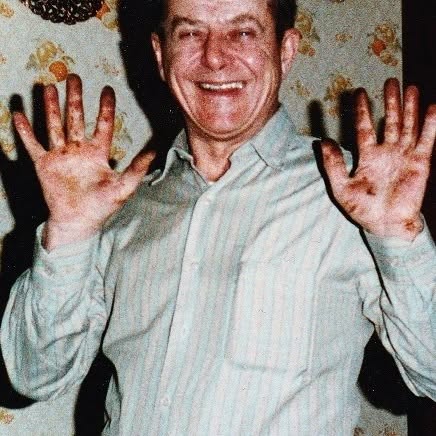
Picture of my Dad after he was done crushing grapes
Father’s Day was yesterday, but I was so busy that I never really took the time to stop and reflect.
My father passed away on July 10, 2014, just three days shy of his 78th birthday. Cancer eventually took him from us, but even now, more than a decade later, I find myself thinking about him more often than I would have imagined.
My dad’s story was not an ordinary one.
In 1956, at the age of seventeen, he and his best friend fled Hungary during the Soviet invasion that was intended to crush the Hungarian Revolution. They left behind everything they knew and stepped into an uncertain future with little more than determination and hope. Looking back on it now, I cannot begin to imagine the courage that must have taken.
That willingness to face uncertainty head-on stayed with him for the rest of his life.
My father was a machinist by trade, but that description never quite captured who he was. He was one of those rare people who could look at a problem and immediately start seeing possibilities. He could stare at an object that had been designed for one purpose and somehow envision three others.
He learned by watching.
If something broke, he fixed it.
If something didn’t exist, he built it.
If there wasn’t an obvious solution, he created one.
What he taught me was not simply how to use tools or work with my hands. He taught me to look beyond what something was and consider what it could become. Long before people started talking about “thinking outside the box,” that was simply how he approached life.
Looking back, I suspect he inherited that trait from his own father.
My relationship with my dad was complicated.
There were good times and difficult times.
As I’ve gotten older and learned more about myself, I’ve come to believe that he may have struggled with bipolar disorder as well. At the time, nobody talked about those things. There were no conversations about mental health around our kitchen table. There were simply good days and bad days, and sometimes we all found ourselves trying to navigate the storms that came with them.
My father could be crass, stubborn, rude, and quick-tempered. His outbursts could shake the entire house. Even now, there are moments when memories of those explosions of anger come back to me unexpectedly.
But there is another truth that exists alongside those memories.
He loved us.
Of that, I have never had any doubt.
Like most parents, he wasn’t perfect. He carried his own burdens and fought battles that I don’t think he fully understood himself. Yet through all of it, he showed his love the way many men of his generation did—through hard work, sacrifice, and teaching.
He taught me how to fix things instead of immediately replacing them.
He taught me how to build houses and structures.
He taught me how to work with my hands.
He taught me how to fish.
He taught me how to drive.
He taught me how to make wine.
He taught me that if you don’t know how to do something, you can usually figure it out if you’re willing to learn.
Those lessons have followed me throughout my entire life.
When I look around the homestead today, I see his fingerprints everywhere.
Not literally, of course.
But in every project I tackle, every repair I attempt, every solution I cobble together from materials already on hand, I can see the influence he had on me.
My father was also an avid reader. Every day, he would sit down with the newspaper and read it from the front page to the very last page. Every now and then, he would tell me about some historical event or obscure fact he had come across.
At the time, I probably wasn’t paying nearly as much attention as I should have.
Now I find myself doing exactly the same thing—reading, researching, and disappearing down rabbit holes of curiosity simply because I want to understand how something works or why something happened.
I suspect I inherited that from him too.
My father wasn’t the only curious one in the family. Somewhere along the way, I inherited that trait as well, although I suspect my version occasionally caused him more stress than he would have preferred.
One example still makes me smile.
When I was about ten years old, I became fascinated by how flush toilets worked. Like many childhood experiments, the idea seemed perfectly reasonable at the time. Unfortunately, I failed to consider one very important detail: we lived in a one-bathroom house.
Armed with curiosity and a complete lack of foresight, I proceeded to disassemble our only toilet.
To be fair, the experiment was a success. I learned exactly how it worked.
The problem was that once I had everything spread across the bathroom floor, I discovered that understanding how something comes apart and understanding how to put it back together again are two entirely different skill sets.
By the time my father came home from work, the family toilet was still in pieces.
Needless to say, he was not pleased. In fact, saying he was “not pleased” might be one of the great understatements of my childhood.
Still, after the initial shock and frustration wore off, he did what he always did. He helped solve the problem. Together, we got everything back where it belonged, and in the process I learned something that stayed with me for the rest of my life.
Curiosity is valuable, but it occasionally comes with consequences.
The funny thing is that all these years later, that lesson paid off. Today I can take a toilet apart, repair it, rebuild it, or replace it entirely if necessary. What started as a childhood disaster became another useful skill tucked away in the toolbox.
Looking back, that story feels like a perfect illustration of both my father and me. His curiosity inspired mine, and my curiosity frequently created situations that required his patience, expertise, and occasionally his temper to resolve.
He worked incredibly hard throughout his life. There were times when he held down two or even three jobs simply to make ends meet and provide for his family.
That kind of work ethic leaves an impression.
It certainly left one on me.
Whatever challenges he faced, whatever burdens he carried, he showed up and did what needed to be done. He made the best of what he had available, even when circumstances were less than ideal.
That is a lesson I find myself leaning on more and more these days.
Especially now.
The older I get, the more I realize that many of the skills I rely upon every day came directly from him.
And perhaps the strangest thing is that he still helps me.
Every once in a while, when I am standing in front of a tractor that refuses to start, trying to figure out how to build something by myself, or staring at a problem that seems determined not to cooperate, I can almost hear his voice.
Not the angry voice.
Not the frustrated voice.
The problem-solving voice.
The voice that asks questions.
The voice that points out the thing I haven’t noticed yet.
The voice that quietly walks me through the solution.
Whether that is memory, imagination, or something else entirely, I honestly don’t know.
What I do know is that it still brings me comfort.
I loved my father.
Sometimes that wasn’t easy.
Relationships rarely fit neatly into simple categories of good or bad. The people who shape us most often leave us with a mixture of gratitude, frustration, admiration, and regret.
My father certainly did.
But as the years pass, I find myself thinking less about the difficult moments and more about the lessons, the sacrifices, and the gifts he left behind.
The greatest of those gifts wasn’t a possession.
It was the ability to think, build, solve problems, and persevere.
Those gifts continue to serve me every day.
Happy Father’s Day, Dad.
My greatest wish is that you knew how much of what I have accomplished came from what you taught me.
I’d like to think you’d be proud of the life I’ve built, the homestead I’ve created, and the person I’ve become.
Who knows?
Maybe you are.
Rest peacefully.
You earned it.