
From Garden Herb to Market Product: Adding a Line of Seasoning Salts, Smoked Seasonings, and Pre-Mixed Spice Blends to My Store
There is something I really enjoy about growing food.
I can put a tiny seed in the ground, spend months fighting weeds, insects, weather and everything else that decides it has a personal interest in my garden, and eventually end up with something I can eat.
That’s pretty damn satisfying.
But lately, I’ve been looking at my garden a little differently.
I’m not just asking myself:
“What can I eat?”
I’m also asking:
“What can I turn this into?”
That question has led me to my next product development project at Blue Gypsy Homestead.
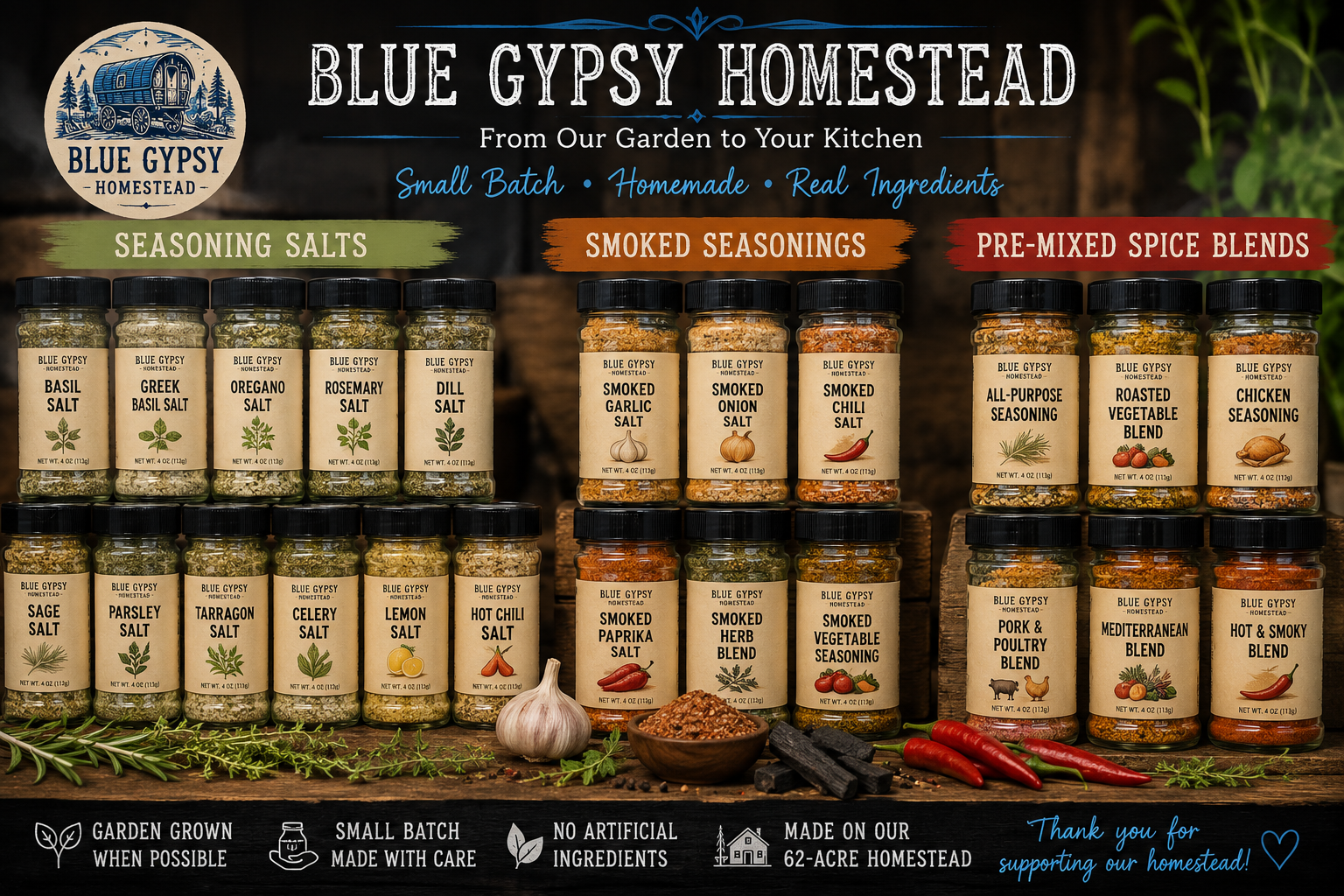
I’m adding a new line of seasoning salts, smoked seasonings and pre-mixed spice blends to my online store.
And like most things I do here, it started with a fairly simple idea that has already become considerably more complicated.
It Started With Herbs
I grow herbs because I use them.
-
-
- Basil.
- Oregano.
- Rosemary.
- Dill.
- Sage.
- Parsley.
- Tarragon.
-
They’re useful in the kitchen, relatively easy to grow, and they can produce far more than I can realistically use fresh.
That’s where preservation comes in.
-
-
- I can dry them.
- I can preserve them.
- And now I’m experimenting with turning them into seasoning products.
-
The idea of taking something I grew in my garden and eventually putting it into a jar that someone else can use in their kitchen is pretty exciting.
It also fits perfectly with the direction I’m taking Blue Gypsy Homestead.
I’m Trying to Build a Product From What I Already Have
I’m not sitting on an unlimited pile of money looking for something to spend it on.
Quite the opposite.
I’m trying to build a viable homestead business while making the best possible use of the resources I already have.
That means I’m constantly looking for ways to add value.
-
-
- If I grow herbs, can I preserve them?
- If I preserve them, can I make something useful?
- If I make something useful, can I sell it?
-
That leads to a simple concept:
Grow → Preserve → Create → Sell.
That’s the basic idea behind the new seasoning line.
Seasoning Salts Are the Beginning
My first experiments were with herb salts.
The basic concept is simple enough.
Take salt.
Add properly dried herbs, vegetables, citrus or peppers.
Process them into a consistent blend.
Package the finished product.
Simple?
Well… sort of.
Making a good seasoning salt isn’t difficult.
Making a consistent seasoning salt is another matter.
-
-
- I need to know exactly how much of each ingredient I’m using.
- I need the ingredients to have consistent moisture levels.
- I need the texture to be right.
- I need the flavour to be strong enough to notice without overwhelming the food.
- And I need to be able to make the same product again next month.
-
That’s when a kitchen experiment becomes product development.
The Seasoning Salts I’m Developing
I’ve already been experimenting with a variety of flavours.
Some are straightforward.
Some are a little more unusual.
And some are designed specifically for people who like their food to fight back.
The initial lineup includes possibilities such as:
-
-
- Basil Salt
- Greek Basil Salt
- Oregano Salt
- Rosemary Salt
- Dill Salt
- Sage Salt
- Parsley Salt
- Tarragon Salt
- Celery Salt
- Lemon Salt
- Hot Chili Salt
-
These aren’t simply herbs dumped into salt.
I’m working on recipes and ratios that create a consistent flavour and texture.
That’s important if I’m going to put my name on the jar.
Then I Started Thinking About Smoke
Once I started working with dried herbs and peppers, it didn’t take long for me to start thinking about another flavour profile I really enjoy.
Smoke.
Smoking can completely change an ingredient.
Garlic becomes something else entirely.
Peppers take on a deeper flavour.
Onions become richer.
Salt itself can become a seasoning ingredient rather than simply something added to food.
So I’ve started experimenting with smoked seasonings.
And this is where the possibilities really start to open up.
Smoked Garlic
Smoked garlic is one of the ingredients I’m particularly interested in.
I already use dried garlic in some seasoning blends.
But smoked garlic has another dimension.
-
-
- It’s deeper.
- It’s richer.
- It’s more complex.
-
And it can completely change the character of a seasoning blend.
I’m experimenting with how much smoke is enough.
That’s an important question.
Too little and you don’t notice it.
Too much and suddenly everything tastes like you’ve been cooking over a campfire.
There is a balance and I’m trying to find it.
Smoked Peppers
This one was almost inevitable.
-
-
- I already grow hot peppers.
- I already dry peppers.
- I like smoky flavours.
-
So naturally, I’m experimenting with smoking them before incorporating them into seasoning blends.
Different peppers produce very different results.
-
-
- Some bring heat.
- Some bring sweetness.
- Some bring smoke.
- Some bring all three.
-
That’s where I can start developing blends that have a little more personality than the average grocery-store seasoning.
Smoked Salt
I’m also experimenting with smoked salt itself.
This opens up some interesting possibilities.
A smoked salt can be used on:
-
-
- Steak
- Burgers
- Potatoes
- Eggs
- Vegetables
- Grilled meat
- Popcorn
- Corn on the cob
- Roasted nuts
-
It’s a simple ingredient, but smoke gives it a completely different character.
Then Came the Spice Blends
Once I started developing salts and smoked ingredients, I naturally started thinking about pre-mixed spice blends.
Because sometimes I don’t want to stand in front of the spice cabinet measuring seven different things just to make dinner.
I suspect I’m not alone.
Sometimes I just want to grab a jar, sprinkle some seasoning on the food and get on with my day.
So I’m developing ready-to-use spice blends designed for specific types of cooking.
Things like:
All-Purpose Seasoning
Something I can reach for when I don’t know exactly what I want.
-
-
- Meat.
- Vegetables.
- Potatoes.
- Eggs.
-
Pretty much anything.
Seasoning Packets in Development
Roasted Vegetable Seasoning
Designed for potatoes, squash, carrots, root vegetables and other things that benefit from a good coating of herbs and spices before going into the oven.
Chicken Seasoning
A blend built around herbs, garlic, onion and spices that works particularly well with chicken.
Pork & Poultry Seasoning
A slightly more robust blend for pork, chicken and turkey.
Mediterranean-Style Blend
Herbs, garlic, lemon and spices designed around the flavours I associate with Mediterranean cooking.
Hot & Smoky Seasoning
This one is for people who think regular seasoning is boring.
It’s still being developed.
And yes, there will be heat.
I’m Not Trying to Make 50 Different Products
I’ve learned enough about business to know that having a huge product catalog doesn’t automatically make a business successful.
In fact, it can create a lot of problems.
-
-
- More ingredients.
- More inventory.
- More packaging.
- More labels.
- More recipes to maintain.
- More products to photograph.
- More products to price.
- More products to track.
- More opportunities to have something sitting on a shelf that nobody wants.
-
I’d rather start with a smaller group of products that I believe in.
Then I’ll see what happens.
If people love a particular seasoning, I’ll make more.
If something doesn’t sell, I’ll figure out why.
And if a recipe simply isn’t good enough, I’ll change it or drop it.
That’s the advantage of being a small operation.
I can adapt.
The Garden Is Becoming Part of My Supply Chain
This is one of the things I find most interesting about this project.
My garden can become part of the supply chain for my store.
That’s a very different way of thinking about growing food.
-
-
- If I grow basil, I don’t necessarily have to sell basil. I can turn it into basil salt.
- If I grow peppers, I can preserve them and potentially use them in chili salts or spice blends.
- If I grow rosemary, I can turn it into rosemary salt.
- If I grow onions, I can dry them, smoke them or incorporate them into a seasoning blend.
-
Suddenly, the value of the garden isn’t just the food I eat.
It’s the products I can create.
Not Everything Will Come From My Garden
I’m also realistic.
I can’t grow everything.
And I’m not going to pretend that I can.
Some ingredients will need to be purchased.
That’s just reality.
What matters to me is that when I can reasonably grow something myself, I want to explore using it.
That’s part of what makes this a homestead product rather than simply another generic seasoning line.
I’m trying to create products that have a connection to the work I’m actually doing.
The Difference Between Homemade and Commercial Production
There’s another lesson I’m learning through this process.
-
-
- Making something at home is easy.
- Making it consistently is harder.
- Making it consistently while knowing exactly what it costs is harder still.
-
And making it consistently, cost-effectively, safely and at a scale where I can sell it?
That’s a completely different exercise.
I have to think about:
-
-
- Ingredient sourcing
- Recipe consistency
- Drying
- Smoking
- Grinding
- Mixing
- Packaging
- Labels
- Storage
- Inventory
- Cost of goods
- Labour
- Equipment
- Electricity
- Shipping
- Market fees
-
It’s a lot more than putting herbs into a jar.
But I enjoy this part.
After decades of working in business, information technology, project management and business analysis, I tend to look at these things as systems.
And that’s exactly what I’m building.
A system.
I’m Going to Make Mistakes
There will be failed recipes.
There will be blends that sounded fantastic in my head and taste like disappointment.
There will probably be something I love that nobody else cares about.
There will be batches that need adjusting.
That’s okay.
I’m not afraid of experimentation.
I’d rather try something, learn from it and improve it than sit around waiting for the perfect recipe to magically appear.
That’s pretty much how the entire homestead has evolved.
Try something.
See what happens.
Fix what doesn’t work.
Try again.
I Want These Products to Have Character
There are plenty of mass-produced seasonings available.
I’m not trying to beat those companies at their game.
I don’t have their factories.
I don’t have their purchasing power.
I don’t have their distribution networks.
And I don’t want to.
What I can offer is something different.
Small-batch products made by me, on a working homestead, using ingredients and techniques I can stand behind.
I want the products to have personality.
I want the flavours to be noticeable.
And I want the jars to reflect the fact that these aren’t anonymous products rolling off a giant assembly line somewhere.
They’re part of Blue Gypsy Homestead.
Why Seasoning Products Make Sense for My Homestead
I like products that solve more than one problem.
Seasoning salts and spice blends do exactly that.
-
-
- They give me another use for garden herbs.
- They help preserve seasonal ingredients.
- They create products that don’t require refrigeration.
- They are relatively compact.
- They’re easy to store.
- They’re easy to transport.
-
And they give me another category of products to offer customers.
That’s important when I’m trying to build a small business.
I don’t need one product to carry the entire operation.
I need a collection of products that each contribute something.
This Is Still an Experiment
I want to be clear about that.
-
-
- I’m not announcing a giant new manufacturing operation.
- I’m experimenting.
- I’m developing recipes.
- I’m testing flavours.
- I’m working out costs.
- I’m figuring out packaging.
- I’m deciding which products deserve a permanent place in the store.
- I’m listening to what customers want.
-
The final product line may look different from what I’m imagining today.
That’s okay.
Actually, I’d be disappointed if it didn’t change.
From Garden Herb to Market Product
There is something incredibly satisfying about this whole process.
-
-
- A seed goes into the ground.
- A plant grows.
- I harvest it.
- I preserve it.
- I experiment with it.
- I develop a recipe.
- I package it.
-
Eventually, if things go well, someone takes it home and uses it to make dinner.
That’s a pretty remarkable journey.
And it represents exactly what I’m trying to accomplish with Blue Gypsy Homestead.
-
-
- I’m trying to find ways to take the resources I have and create more value from them.
- I’m trying to build something sustainable.
- I’m trying to reduce waste.
- I’m trying to produce more of my own food.
- I’m trying to turn some of that work into a business.
-
Not overnight.
Not perfectly.
And definitely not without a few mistakes along the way.
But one jar at a time.
What’s Coming to the Blue Gypsy Homestead Store?
I’m currently working toward three related product lines:
🧂 Seasoning Salts
Herb salts, citrus salts, chili salts and specialty seasoning salts.
🔥 Smoked Seasonings
Smoked salts, smoked garlic, smoked onions, smoked peppers and other smoky combinations.
🌶️ Pre-Mixed Spice Blends
Ready-to-use blends for chicken, pork, vegetables, potatoes, grilling, roasting and everyday cooking.
-
-
- Some will be mild.
- Some will be savoury.
- Some will be smoky.
- Some will be hot.
-
And I’m sure a few will make me question whether I really needed to put that much pepper in the recipe.
That’s part of the fun.
I’ll be adding the finished products to my Blue Gypsy Homestead Online Store as I finalize the recipes, packaging and production process.
For now, the experiments continue.
-
-
- The garden is producing.
- The freeze dryer is running.
- The smoker is getting some exercise.
- The spice grinder is working overtime.
- And my kitchen is slowly turning into a very small seasoning laboratory.
-
From garden herb to market product.
That’s the idea.
And I’m just getting started.
🌿 Follow the Blue Gypsy Homestead Journey
I share the real process behind growing food, preserving the harvest, developing products, raising animals and trying to turn a 62-acre homestead into a sustainable one-man business.

▶️ YouTube
Watch my homesteading projects, gardening, food preservation, smoking experiments, seasoning development, rabbit raising and more.
Blue Gypsy Homestead on YouTube
🎵 TikTok
Follow me for shorter videos, product experiments, behind-the-scenes projects, homestead updates and the occasional spectacular failure.
Blue Gypsy Homestead on TikTok
🌱 Learn More
Visit my website to learn more about my homestead, projects, services, products and the ongoing journey.
Blue Gypsy Homestead – Learn More
🛒 Online Store
Browse my current freeze-dried foods, merchandise and other homestead products—and watch for the new seasoning salts, smoked seasonings and pre-mixed spice blends as they become available.
Blue Gypsy Homestead Online Store
Blue Gypsy Homestead is a 62-acre farm located approximately 35 minutes south of Ottawa, Ontario, Canada. As a one-man homestead operation, I grow and preserve food, raise livestock, experiment with food production and develop products for my online store. My new seasoning product line is being developed around three categories: seasoning salts, smoked seasonings and pre-mixed spice blends. Where practical, I plan to incorporate garden-grown herbs, peppers and other ingredients into these products, creating value-added products from the resources available on the homestead. The seasoning project is part of my broader effort to build a sustainable small-scale homestead business while preserving food, reducing waste and finding additional ways to generate income from the land.