The Things About Homesteading Nobody Puts on the Internet – BLOG – 2026-Aug-29

The Things About Homesteading Nobody Puts on the Internet

In 2019, two major events changed the course of my life. I closed the winery, and my wife and I decided to go our separate ways. We sold the house, and I made the decision to renovate the old winery building into my new home. At the time, I had no idea just how much that decision would change my life. What started as a practical solution to a major transition eventually became the beginning of an entirely new journey—one that would lead me to homesteading.

When I started looking into homesteading, I did what most people probably do.

    • I went online.
    • I watched videos. I read articles. I looked at photographs of beautiful gardens, neatly stacked firewood, happy chickens wandering through green grass, perfectly organized pantries and baskets overflowing with vegetables.

It all looked wonderful.

And, to be fair, some of it really is wonderful.

What I didn’t see nearly as often were the less glamorous parts.

      • The broken equipment.
      • The muddy boots.
      • The endless cleaning.
      • The projects that take three times longer than expected.
      • The money that disappears into things I never knew I needed.
      • The vegetables that refuse to grow.
      • The animals that have their own ideas about how things should work.

And the fact that sometimes I spend an entire day working outside and, at the end of it, I’m not entirely sure what I accomplished.

That’s the part of homesteading that doesn’t always make it onto the internet.

So, after spending some time doing this myself, I thought I’d talk about it.

Not to discourage anyone from homesteading.

Quite the opposite.

I think understanding the reality makes the good parts even better.


Homesteading Is a Lot of Work

This probably shouldn’t come as a surprise, but I underestimated it anyway.

      • There is always something to do.
      • If I’m not working in the garden, something needs repairing.
      • If nothing needs repairing, there is probably something that needs cleaning.
      • If everything is clean, there are animals to feed.
      • If the animals are fed, there is probably a fence that needs attention.
      • And if everything is somehow working perfectly, I can always find another project.

That’s one of the realities of having land.

Things don’t stay finished.

      • A garden doesn’t become “done.”
      • A fence doesn’t stay perfect forever.
      • Buildings need maintenance.
      • Equipment needs attention.
      • Animals need care.

The work doesn’t end simply because I finished the project I started that morning.

I’ve learned to accept that.

The homestead is less like a list of projects and more like a living system that requires ongoing attention.


Things Break

This is another one that doesn’t photograph particularly well.

      • A piece of equipment breaks.
      • A hinge fails.
      • A board rots.
      • A water line leaks.
      • A tool stops working.
      • A gate doesn’t close properly.
      • Something that worked perfectly yesterday suddenly doesn’t.
      • And, of course, it usually happens when I need it most.

I’ve learned that maintenance is part of homesteading.

It’s not something I do only when something breaks.

I’m getting better at looking at things and asking:

“What is likely to fail next?”

This isn’t negativity, it’s just good planning.  Sometimes spending a little time fixing a small problem today prevents a much bigger problem later.

Not always.

But often enough that I’ve learned to pay attention.


The Weather Is in Charge

I can make plans.

The weather does not care.

I can decide that today is the perfect day to plant something, build something, paint something or work on a particular project.

      • Then it rains.
      • Or it gets too hot.
      • Or the wind picks up.
      • Or the temperature drops.
      • Or we get an unexpected stretch of weather that changes everything.

Gardening has made this especially obvious.

I can prepare the soil, plant carefully and do everything I think I’m supposed to do.

Then Mother Nature gets involved.

Sometimes she helps.

Sometimes she doesn’t.

I’ve learned that one of the most useful homesteading skills is being able to change plans without becoming frustrated by the fact that the original plan didn’t survive contact with reality.


A Garden Does Not Follow a Schedule

I used to think of gardening in fairly simple terms.

      • Plant.
      • Water.
      • Grow.
      • Harvest.

The reality is considerably more complicated.

      • Some things grow beautifully.
      • Some things barely grow at all.
      • Some plants produce much earlier than expected.
      • Others seem to be waiting for a completely different season.
      • Sometimes everything ripens at once.

That’s when the fun really starts.

Suddenly I have more vegetables than I can eat, and I need to decide what I’m going to do with them.

That’s why I’ve become increasingly interested in food preservation.

Canning, freezing, dehydrating and freeze-drying aren’t just hobbies for me.

They’re ways of dealing with the reality of having a productive garden.

The goal isn’t simply to grow food.

It’s to make use of the food I grow.


More Food Can Actually Create More Work

This sounds like a strange problem to have.

It isn’t.

Imagine spending months trying to get a garden producing well.

Then it works.

Really well.

Suddenly I have tomatoes everywhere.

Or peppers.

Or herbs.

Or berries.

That’s a good problem to have, but it’s still a problem that needs solving.

Fresh food doesn’t wait for my schedule.

If I don’t preserve it, use it or give it away, eventually it becomes waste.

That’s one reason I’ve been experimenting with freeze-drying.

Freeze-drying gives me another way to preserve some of the food I grow and turn seasonal abundance into something I can store and use later.

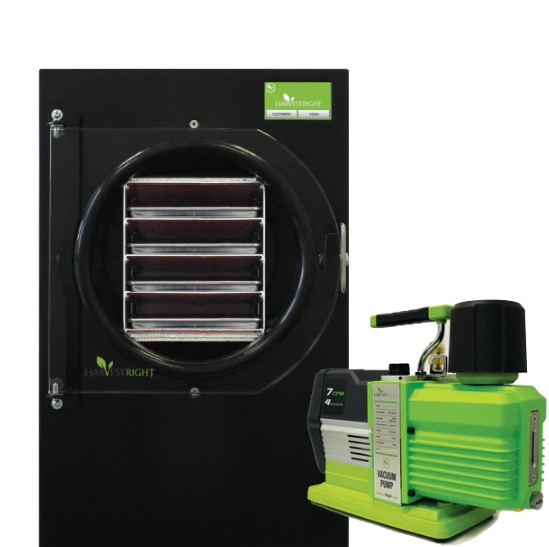
It also led me to another opportunity: custom freeze-drying services for people who have their own garden surplus but don’t own a freeze dryer.

Sometimes one homestead project leads naturally to another.


Animals Don’t Follow My Schedule Either

I’ve also learned that animals are very good at reminding me who is actually in charge.

I can have a plan for the rabbits.

The rabbits may have a different plan.

I can build an enclosure that I think is secure.

The rabbits may immediately begin investigating how to defeat it.

I’ve learned that raising animals means paying attention.

      • They need food.
      • They need water.
      • They need clean housing.
      • They need protection.
      • They need observation.
      • And they occasionally need me to solve a problem that wasn’t on my schedule for the day.

There was also the memorable occasion when a rabbit enclosure door was left unsecured and I suddenly had rabbits exploring the property.

That was not part of the plan.

It was, however, a very effective lesson in making sure doors are actually closed.


Homesteading Costs Money

This is one of the biggest misconceptions I had to reconsider.

Homesteading can save money in some areas.

It can also cost quite a bit of money.

      • Seeds cost money.
      • Feed costs money.
      • Fencing costs money.
      • Lumber costs money.
      • Tools cost money.
      • Animal housing costs money.
      • Equipment costs money.

And then there are all the little things.

A small purchase here.

Another one there.

Before long, the “inexpensive” project has accumulated quite a bill.

I’ve learned that I need to look at homesteading as an investment rather than assuming everything I produce will automatically be cheaper than buying it.

      • Sometimes I save money.
      • Sometimes I don’t.
      • Sometimes I gain something more valuable than the difference in price.

Knowing where my food came from has value.

Learning a new skill has value.

Being able to preserve my own food has value.

Becoming more capable has value.

Those things don’t always show up on a spreadsheet.


Your Time Has Value Too

This is another one I didn’t fully appreciate at the beginning.

If I spend four hours growing, harvesting and processing something that costs very little at the grocery store, I need to be honest about what I’m actually doing.

I’m not necessarily saving money.

I’m choosing to spend my time differently.

And that’s perfectly legitimate.

The important thing is recognizing the difference.

I enjoy many of the things I do on the homestead.

That’s part of the reason I’m doing them.

But enjoying something doesn’t mean my time has no value.

I’ve become much more conscious of that as I’ve started turning some homestead activities into products for my store.

If I’m making seasoning salts, freeze-dried foods or other products, I need to understand not just the ingredient cost but also the time and effort involved.

That’s where homesteading and business start meeting each other.


You Will Buy Things You Don’t Need

I have learned this lesson more than once.

I’ll see a tool or piece of equipment and think:

“That would make things easier.”

Sometimes it does.

Sometimes it turns out to be something I rarely use.

I’ve become much more cautious about buying equipment simply because it looks useful.

Now I ask myself:

What problem does this actually solve?

If I can’t answer that question clearly, I probably don’t need it yet.

This has become particularly important because I’m trying to build Blue Gypsy Homestead without spending money simply for the sake of expanding.

Sometimes the best tool is the one I already own.


Simple Projects Rarely Stay Simple

I’ve learned not to use the phrase “This should be easy.”

It seems to tempt fate.

I’ll start a project thinking it should take an afternoon.

Then I discover a problem.

Solving that problem creates another problem.

That requires a different solution.

And suddenly I’m looking at a project that has evolved into something completely different from what I originally imagined.

This happens frequently enough that I’ve learned to build flexibility into my plans.

I also try to remind myself that not every project needs to be completed in one day.

That’s easier said than done.

But I’m getting better at it.


Homesteading Requires Learning Constantly

There is a lot I don’t know.

That’s not a complaint; it’s actually one of the things I enjoy most.

      • Every season gives me something new to learn.
      • Every animal teaches me something.
      • Every crop teaches me something.
      • Every failed project teaches me something.

Sometimes the lesson is:

“That was not a good idea.”

That’s still useful information.

      • I’ve discovered that I don’t need to know everything before I start.
      • I need to be willing to learn as I go.
      • Research is valuable.
      • Experience is even more valuable.
      • And the combination of the two is where I seem to make the most progress.

You Have to Be Comfortable With Failure

This is probably one of the most important lessons I’ve learned.

      • Not everything works.
      • Some plants fail.
      • Some projects fail.
      • Some ideas aren’t practical.
      • Some products don’t sell.
      • Some equipment purchases aren’t as useful as I expected.

That’s part of the process.

I used to see failure as evidence that I had done something wrong.

Now I try to see it as information.

If something fails, I want to understand why.

      • Was the timing wrong?
      • Was the design wrong?
      • Did I underestimate the cost?
      • Did I misunderstand what customers wanted?
      • Did I simply get unlucky?

Once I know why something didn’t work, I can make a better decision the next time.

That’s progress.


The Homestead Is Never Going to Look Like the Pictures

This might be my favourite one.

The internet is very good at showing the best five minutes.

      • A beautiful sunrise.
      • A basket of vegetables.
      • A perfectly organized pantry.
      • A rabbit sitting peacefully in the sunshine.
      • A freshly built garden bed.

What you don’t always see is what happened immediately before the photograph.

      • The weeds.
      • The mud.
      • The broken fence.
      • The tools scattered everywhere.
      • The failed crop.
      • The animal enclosure that needs cleaning.
      • The project that is only halfway finished.

That’s my reality.

And I’ve become comfortable with it.

My homestead isn’t a magazine spread.

It’s a working property.

It’s supposed to show evidence that something is happening.


Sometimes I Don’t Accomplish as Much as I Planned

This is another reality that isn’t particularly photogenic.

There are days when I have a long list of things I want to accomplish.

Then something unexpected happens.

      • Maybe a repair takes longer than expected.
      • Maybe the weather changes.
      • Maybe an animal needs attention.
      • Maybe I discover a problem I didn’t know existed.

At the end of the day, I may have completed only one thing on my list.

It can be frustrating.

But I’ve learned that one important thing accomplished is still progress.

Homesteading isn’t a race.

The property isn’t going anywhere.

There will be another day.


You Don’t Need to Do Everything Yourself

This is something I think gets misunderstood.

Self-sufficiency doesn’t have to mean doing absolutely everything yourself.

      • I can grow food and still buy things.
      • I can raise animals and still purchase feed.
      • I can preserve food and still go to the grocery store.
      • I can build things and still buy equipment.
      • I can learn skills without pretending I have every skill.

For me, homesteading is about becoming more capable and less dependent, not about eliminating every outside resource from my life.

There is a difference.

And I think it’s a healthier way to approach the idea.


Homesteading Is Not Always Productive

Sometimes I spend time outside and simply enjoy being there.

That’s not necessarily wasted time.

There is something satisfying about walking through the garden, checking the animals, looking at what’s growing and seeing the property change with the seasons.

      • Not everything has to become a product.
      • Not every activity has to generate income.
      • Not every hour has to produce something measurable.

Sometimes the benefit is simply knowing that I’m building something that matters to me.


The Good Parts Are Better Than the Internet Makes Them Look

Here’s the funny thing.

After talking about all of the things nobody puts on the internet, I don’t want to give the impression that homesteading is miserable.

It isn’t.

There are moments that are genuinely wonderful.

      • Harvesting something I grew myself.
      • Eating food from my own garden.
      • Watching animals grow.
      • Opening a jar of something I preserved months earlier.
      • Taking an ingredient from the garden and turning it into a product.
      • Solving a problem I couldn’t solve before.
      • Standing outside early in the morning when everything is quiet.

Those moments are real too.

And they’re probably the reason I keep doing all the other work.


What Homesteading Has Really Taught Me

The biggest surprise for me is that homesteading isn’t really about creating a perfect life.

It’s about creating a more intentional one.

      • I’m learning to pay attention.
      • I’m learning to use what I have.
      • I’m learning to preserve abundance.
      • I’m learning to repair instead of replace when it makes sense.
      • I’m learning to accept that plans will change.
      • I’m learning that mistakes are part of the process.
      • And I’m learning that progress doesn’t always look impressive from the outside.

Sometimes progress is a new garden bed.

Sometimes it’s a repaired fence.

Sometimes it’s a successful litter of rabbits.

Sometimes it’s a jar of seasoning salt.

Sometimes it’s simply figuring out a better way to do something I’ve already done ten times.

That’s the part of homesteading I wish I had seen more often when I started.

It’s not perfect.

It’s not always efficient.

It isn’t always inexpensive.

It isn’t always easy.

But it is real.

And for me, that’s what makes it worthwhile.


🌱 Follow the Blue Gypsy Homestead Journey

I share the good, the bad, the unfinished projects and the lessons I’m learning as I continue building Blue Gypsy Homestead into a productive one-man homestead and business.

▶️ YouTube

Follow my homesteading projects, gardening, rabbit raising, food preservation, freeze-drying, product development and everyday life on the homestead.

Blue Gypsy Homestead on YouTube

🎵 TikTok

Follow me for shorter videos, quick updates, behind-the-scenes projects and the occasional homestead surprise.

Blue Gypsy Homestead on TikTok

🌱 Learn More

Learn more about my homestead, projects, services, products and the journey I’m documenting along the way.

Blue Gypsy Homestead – Learn More

🛒 Online Store

Browse the products I’m making and selling from Blue Gypsy Homestead, including freeze-dried foods, seasoning salts, smoked seasonings, spice blends, merchandise and other homestead products.

Blue Gypsy Homestead Online Store


Blue Gypsy Homestead is a 62-acre farm located approximately 35 minutes south of Ottawa, Ontario, Canada. I operate the homestead as a one-man operation focused on practical homesteading, gardening, livestock, food preservation, freeze-drying, value-added food products and rural entrepreneurship. Through my blog and social media channels, I share the realities of building a working homestead, including the ongoing maintenance, costs, unexpected problems, failed projects, gardening challenges, livestock responsibilities and lessons that are often missing from idealized online portrayals of homestead life. My goal is to document the experience honestly while sharing practical information that can help others understand what homesteading actually involves.
Adding a Line of Seasoning Salts, Smoked Seasonings, and Pre-Mixed Spice Blends to My Store – BLOG – 2026-Aug-28

From Garden Herb to Market Product: Adding a Line of Seasoning Salts, Smoked Seasonings, and Pre-Mixed Spice Blends to My Store

There is something I really enjoy about growing food.

I can put a tiny seed in the ground, spend months fighting weeds, insects, weather and everything else that decides it has a personal interest in my garden, and eventually end up with something I can eat.

That’s pretty damn satisfying.

But lately, I’ve been looking at my garden a little differently.

I’m not just asking myself:

“What can I eat?”

I’m also asking:

“What can I turn this into?”

That question has led me to my next product development project at Blue Gypsy Homestead.

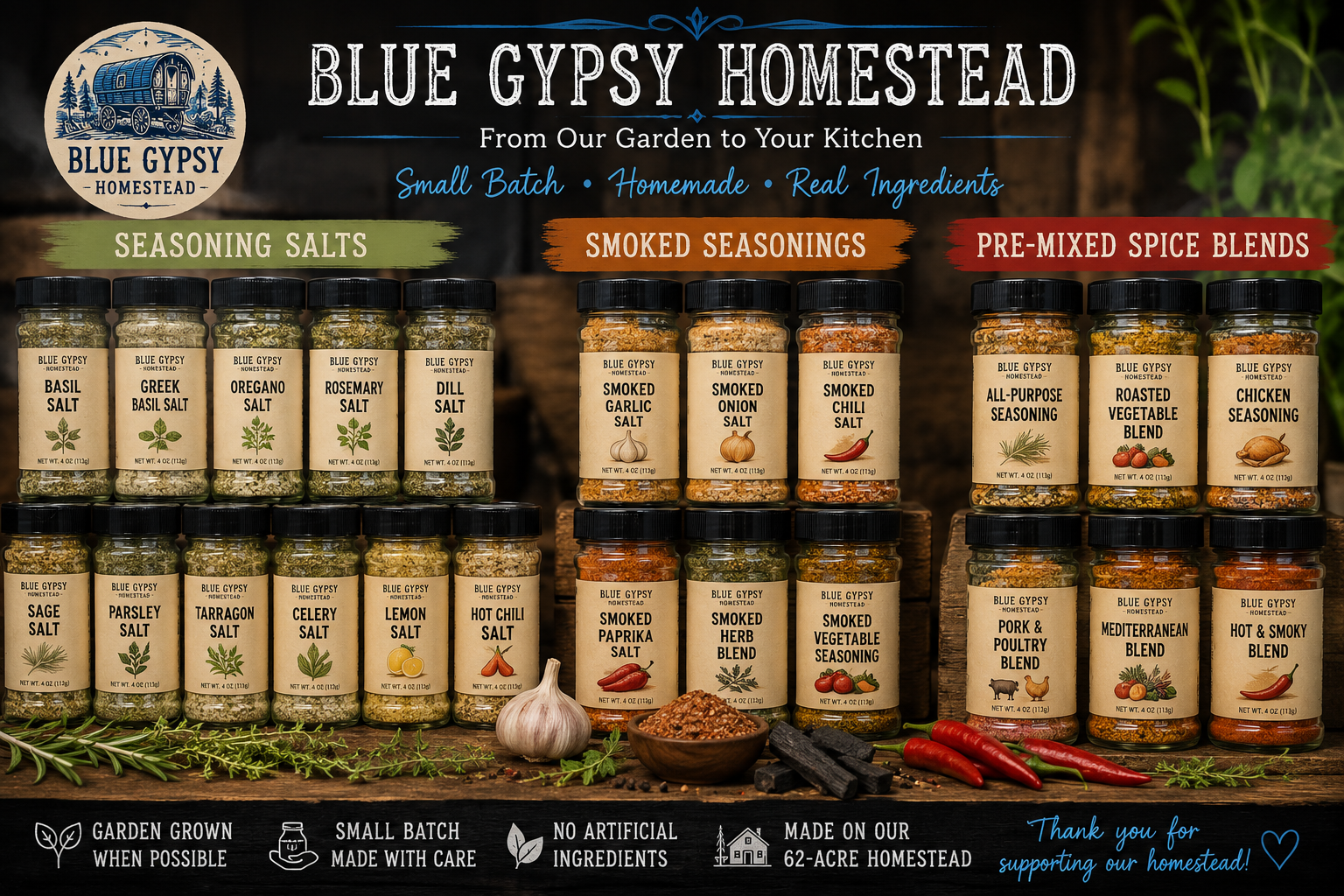
I’m adding a new line of seasoning salts, smoked seasonings and pre-mixed spice blends to my online store.

And like most things I do here, it started with a fairly simple idea that has already become considerably more complicated.

It Started With Herbs

I grow herbs because I use them.

      • Basil.
      • Oregano.
      • Rosemary.
      • Dill.
      • Sage.
      • Parsley.
      • Tarragon.

They’re useful in the kitchen, relatively easy to grow, and they can produce far more than I can realistically use fresh.

That’s where preservation comes in.

      • I can dry them.
      • I can preserve them.
      • And now I’m experimenting with turning them into seasoning products.

The idea of taking something I grew in my garden and eventually putting it into a jar that someone else can use in their kitchen is pretty exciting.

It also fits perfectly with the direction I’m taking Blue Gypsy Homestead.

I’m Trying to Build a Product From What I Already Have

I’m not sitting on an unlimited pile of money looking for something to spend it on.

Quite the opposite.

I’m trying to build a viable homestead business while making the best possible use of the resources I already have.

That means I’m constantly looking for ways to add value.

      • If I grow herbs, can I preserve them?
      • If I preserve them, can I make something useful?
      • If I make something useful, can I sell it?

That leads to a simple concept:

Grow → Preserve → Create → Sell.

That’s the basic idea behind the new seasoning line.

Seasoning Salts Are the Beginning

My first experiments were with herb salts.

The basic concept is simple enough.

Take salt.

Add properly dried herbs, vegetables, citrus or peppers.

Process them into a consistent blend.

Package the finished product.

Simple?

Well… sort of.

Making a good seasoning salt isn’t difficult.

Making a consistent seasoning salt is another matter.

      • I need to know exactly how much of each ingredient I’m using.
      • I need the ingredients to have consistent moisture levels.
      • I need the texture to be right.
      • I need the flavour to be strong enough to notice without overwhelming the food.
      • And I need to be able to make the same product again next month.

That’s when a kitchen experiment becomes product development.

The Seasoning Salts I’m Developing

I’ve already been experimenting with a variety of flavours.

Some are straightforward.

Some are a little more unusual.

And some are designed specifically for people who like their food to fight back.

The initial lineup includes possibilities such as:

      • Basil Salt
      • Greek Basil Salt
      • Oregano Salt
      • Rosemary Salt
      • Dill Salt
      • Sage Salt
      • Parsley Salt
      • Tarragon Salt
      • Celery Salt
      • Lemon Salt
      • Hot Chili Salt

These aren’t simply herbs dumped into salt.

I’m working on recipes and ratios that create a consistent flavour and texture.

That’s important if I’m going to put my name on the jar.

Then I Started Thinking About Smoke

Once I started working with dried herbs and peppers, it didn’t take long for me to start thinking about another flavour profile I really enjoy.

Smoke.

Smoking can completely change an ingredient.

Garlic becomes something else entirely.

Peppers take on a deeper flavour.

Onions become richer.

Salt itself can become a seasoning ingredient rather than simply something added to food.

So I’ve started experimenting with smoked seasonings.

And this is where the possibilities really start to open up.

Smoked Garlic

Smoked garlic is one of the ingredients I’m particularly interested in.

I already use dried garlic in some seasoning blends.

But smoked garlic has another dimension.

      • It’s deeper.
      • It’s richer.
      • It’s more complex.

And it can completely change the character of a seasoning blend.

I’m experimenting with how much smoke is enough.

That’s an important question.

Too little and you don’t notice it.

Too much and suddenly everything tastes like you’ve been cooking over a campfire.

There is a balance and I’m trying to find it.

Smoked Peppers

This one was almost inevitable.

      • I already grow hot peppers.
      • I already dry peppers.
      • I like smoky flavours.

So naturally, I’m experimenting with smoking them before incorporating them into seasoning blends.

Different peppers produce very different results.

      • Some bring heat.
      • Some bring sweetness.
      • Some bring smoke.
      • Some bring all three.

That’s where I can start developing blends that have a little more personality than the average grocery-store seasoning.

Smoked Salt

I’m also experimenting with smoked salt itself.

This opens up some interesting possibilities.

A smoked salt can be used on:

      • Steak
      • Burgers
      • Potatoes
      • Eggs
      • Vegetables
      • Grilled meat
      • Popcorn
      • Corn on the cob
      • Roasted nuts

It’s a simple ingredient, but smoke gives it a completely different character.

Then Came the Spice Blends

Once I started developing salts and smoked ingredients, I naturally started thinking about pre-mixed spice blends.

Because sometimes I don’t want to stand in front of the spice cabinet measuring seven different things just to make dinner.

I suspect I’m not alone.

Sometimes I just want to grab a jar, sprinkle some seasoning on the food and get on with my day.

So I’m developing ready-to-use spice blends designed for specific types of cooking.

Things like:

All-Purpose Seasoning

Something I can reach for when I don’t know exactly what I want.

      • Meat.
      • Vegetables.
      • Potatoes.
      • Eggs.

Pretty much anything.

Seasoning Packets in Development

Roasted Vegetable Seasoning

Designed for potatoes, squash, carrots, root vegetables and other things that benefit from a good coating of herbs and spices before going into the oven.

Chicken Seasoning

A blend built around herbs, garlic, onion and spices that works particularly well with chicken.

Pork & Poultry Seasoning

A slightly more robust blend for pork, chicken and turkey.

Mediterranean-Style Blend

Herbs, garlic, lemon and spices designed around the flavours I associate with Mediterranean cooking.

Hot & Smoky Seasoning

This one is for people who think regular seasoning is boring.

It’s still being developed.

And yes, there will be heat.

I’m Not Trying to Make 50 Different Products

I’ve learned enough about business to know that having a huge product catalog doesn’t automatically make a business successful.

In fact, it can create a lot of problems.

      • More ingredients.
      • More inventory.
      • More packaging.
      • More labels.
      • More recipes to maintain.
      • More products to photograph.
      • More products to price.
      • More products to track.
      • More opportunities to have something sitting on a shelf that nobody wants.

I’d rather start with a smaller group of products that I believe in.

Then I’ll see what happens.

If people love a particular seasoning, I’ll make more.

If something doesn’t sell, I’ll figure out why.

And if a recipe simply isn’t good enough, I’ll change it or drop it.

That’s the advantage of being a small operation.

I can adapt.

The Garden Is Becoming Part of My Supply Chain

This is one of the things I find most interesting about this project.

My garden can become part of the supply chain for my store.

That’s a very different way of thinking about growing food.

      • If I grow basil, I don’t necessarily have to sell basil. I can turn it into basil salt.
      • If I grow peppers, I can preserve them and potentially use them in chili salts or spice blends.
      • If I grow rosemary, I can turn it into rosemary salt.
      • If I grow onions, I can dry them, smoke them or incorporate them into a seasoning blend.

Suddenly, the value of the garden isn’t just the food I eat.

It’s the products I can create.

Not Everything Will Come From My Garden

I’m also realistic.

I can’t grow everything.

And I’m not going to pretend that I can.

Some ingredients will need to be purchased.

That’s just reality.

What matters to me is that when I can reasonably grow something myself, I want to explore using it.

That’s part of what makes this a homestead product rather than simply another generic seasoning line.

I’m trying to create products that have a connection to the work I’m actually doing.

The Difference Between Homemade and Commercial Production

There’s another lesson I’m learning through this process.

      • Making something at home is easy.
      • Making it consistently is harder.
      • Making it consistently while knowing exactly what it costs is harder still.

And making it consistently, cost-effectively, safely and at a scale where I can sell it?

That’s a completely different exercise.

I have to think about:

      • Ingredient sourcing
      • Recipe consistency
      • Drying
      • Smoking
      • Grinding
      • Mixing
      • Packaging
      • Labels
      • Storage
      • Inventory
      • Cost of goods
      • Labour
      • Equipment
      • Electricity
      • Shipping
      • Market fees

It’s a lot more than putting herbs into a jar.

But I enjoy this part.

After decades of working in business, information technology, project management and business analysis, I tend to look at these things as systems.

And that’s exactly what I’m building.

A system.

I’m Going to Make Mistakes

There will be failed recipes.

There will be blends that sounded fantastic in my head and taste like disappointment.

There will probably be something I love that nobody else cares about.

There will be batches that need adjusting.

That’s okay.

I’m not afraid of experimentation.

I’d rather try something, learn from it and improve it than sit around waiting for the perfect recipe to magically appear.

That’s pretty much how the entire homestead has evolved.

Try something.

See what happens.

Fix what doesn’t work.

Try again.

I Want These Products to Have Character

There are plenty of mass-produced seasonings available.

I’m not trying to beat those companies at their game.

I don’t have their factories.

I don’t have their purchasing power.

I don’t have their distribution networks.

And I don’t want to.

What I can offer is something different.

Small-batch products made by me, on a working homestead, using ingredients and techniques I can stand behind.

I want the products to have personality.

I want the flavours to be noticeable.

And I want the jars to reflect the fact that these aren’t anonymous products rolling off a giant assembly line somewhere.

They’re part of Blue Gypsy Homestead.

Why Seasoning Products Make Sense for My Homestead

I like products that solve more than one problem.

Seasoning salts and spice blends do exactly that.

      • They give me another use for garden herbs.
      • They help preserve seasonal ingredients.
      • They create products that don’t require refrigeration.
      • They are relatively compact.
      • They’re easy to store.
      • They’re easy to transport.

And they give me another category of products to offer customers.

That’s important when I’m trying to build a small business.

I don’t need one product to carry the entire operation.

I need a collection of products that each contribute something.

This Is Still an Experiment

I want to be clear about that.

      • I’m not announcing a giant new manufacturing operation.
      • I’m experimenting.
      • I’m developing recipes.
      • I’m testing flavours.
      • I’m working out costs.
      • I’m figuring out packaging.
      • I’m deciding which products deserve a permanent place in the store.
      • I’m listening to what customers want.

The final product line may look different from what I’m imagining today.

That’s okay.

Actually, I’d be disappointed if it didn’t change.

From Garden Herb to Market Product

There is something incredibly satisfying about this whole process.

      • A seed goes into the ground.
      • A plant grows.
      • I harvest it.
      • I preserve it.
      • I experiment with it.
      • I develop a recipe.
      • I package it.

Eventually, if things go well, someone takes it home and uses it to make dinner.

That’s a pretty remarkable journey.

And it represents exactly what I’m trying to accomplish with Blue Gypsy Homestead.

      • I’m trying to find ways to take the resources I have and create more value from them.
      • I’m trying to build something sustainable.
      • I’m trying to reduce waste.
      • I’m trying to produce more of my own food.
      • I’m trying to turn some of that work into a business.

Not overnight.

Not perfectly.

And definitely not without a few mistakes along the way.

But one jar at a time.

What’s Coming to the Blue Gypsy Homestead Store?

I’m currently working toward three related product lines:

🧂 Seasoning Salts

Herb salts, citrus salts, chili salts and specialty seasoning salts.

🔥 Smoked Seasonings

Smoked salts, smoked garlic, smoked onions, smoked peppers and other smoky combinations.

🌶️ Pre-Mixed Spice Blends

Ready-to-use blends for chicken, pork, vegetables, potatoes, grilling, roasting and everyday cooking.

      • Some will be mild.
      • Some will be savoury.
      • Some will be smoky.
      • Some will be hot.

And I’m sure a few will make me question whether I really needed to put that much pepper in the recipe.

That’s part of the fun.

I’ll be adding the finished products to my Blue Gypsy Homestead Online Store as I finalize the recipes, packaging and production process.

For now, the experiments continue.

      • The garden is producing.
      • The freeze dryer is running.
      • The smoker is getting some exercise.
      • The spice grinder is working overtime.
      • And my kitchen is slowly turning into a very small seasoning laboratory.

From garden herb to market product.

That’s the idea.

And I’m just getting started.


🌿 Follow the Blue Gypsy Homestead Journey

I share the real process behind growing food, preserving the harvest, developing products, raising animals and trying to turn a 62-acre homestead into a sustainable one-man business.

▶️ YouTube

Watch my homesteading projects, gardening, food preservation, smoking experiments, seasoning development, rabbit raising and more.

Blue Gypsy Homestead on YouTube

🎵 TikTok

Follow me for shorter videos, product experiments, behind-the-scenes projects, homestead updates and the occasional spectacular failure.

Blue Gypsy Homestead on TikTok

🌱 Learn More

Visit my website to learn more about my homestead, projects, services, products and the ongoing journey.

Blue Gypsy Homestead – Learn More

🛒 Online Store

Browse my current freeze-dried foods, merchandise and other homestead products—and watch for the new seasoning salts, smoked seasonings and pre-mixed spice blends as they become available.

Blue Gypsy Homestead Online Store


Blue Gypsy Homestead is a 62-acre farm located approximately 35 minutes south of Ottawa, Ontario, Canada. As a one-man homestead operation, I grow and preserve food, raise livestock, experiment with food production and develop products for my online store. My new seasoning product line is being developed around three categories: seasoning salts, smoked seasonings and pre-mixed spice blends. Where practical, I plan to incorporate garden-grown herbs, peppers and other ingredients into these products, creating value-added products from the resources available on the homestead. The seasoning project is part of my broader effort to build a sustainable small-scale homestead business while preserving food, reducing waste and finding additional ways to generate income from the land.

Custom Freezing Drying Service – BLOG 2026-Aug-24

Turning Garden Surplus Into Shelf-Stable Food

There is something deeply satisfying about walking into the garden and realizing you have more food than you can possibly eat.

It is also when the reality of gardening tends to set in.

The tomatoes are ripening faster than we can eat them. The peppers seem to multiply overnight. The zucchini have apparently decided to take over the entire property. Suddenly, that bumper crop you were so proud of becomes a race against time.

For years, the traditional answer has been canning, freezing, pickling, or dehydrating. Those are all excellent ways to preserve food, and we use several of them here at Blue Gypsy Homestead.

But there is another option that has become an increasingly important part of what we do:

freeze-drying.

And now, we’re taking that idea one step further by offering custom freeze-drying services for people who have food they want to preserve but don’t necessarily own a freeze dryer.

When “Too Much” Becomes a Good Problem

One of the funny things about gardening is that you rarely get exactly the amount of food you planned for.

You plant six tomato plants because six seemed reasonable.

Then they all produce.

And produce.

And produce.

Before long, you’re giving tomatoes to neighbours, making sauce, eating tomatoes with everything, and wondering if there is a legal limit to how many tomatoes one household can reasonably possess.

The same thing happens with peppers, berries, herbs, fruit and vegetables.

That surplus represents time, money, water, fertilizer, seeds and a lot of work. Throwing it away because you couldn’t use it quickly enough feels like a waste—and it is.

This is where food preservation becomes more than simply stocking the pantry.

It’s a way of getting the full value out of the food you’ve already grown.

Freeze-Drying Changes the Equation

Freeze-drying removes moisture from food while preserving much of its original shape, flavour, colour and nutritional value.

The finished product is remarkably light and, when properly packaged and protected from moisture and oxygen, can be stored for a long time.

That makes freeze-drying particularly interesting for garden surplus.

Instead of trying to figure out what to do with twenty pounds of tomatoes this week, you can preserve them for later.

Instead of watching berries spoil in the refrigerator, you can turn them into a shelf-stable ingredient.

Instead of having more peppers than you can possibly use fresh, you can preserve them for future meals.

And unlike freezing, freeze-dried food doesn’t require freezer space.

That’s a pretty significant advantage when you’re already trying to make the most of limited storage space.

What Can You Freeze-Dry?

Quite a lot.

Some of the foods that lend themselves particularly well to freeze-drying include:

      • Fruits and berries
      • Tomatoes
      • Peppers
      • Corn
      • Onions
      • Mushrooms
      • Herbs
      • Garden vegetables
      • Cooked meals
      • Snacks and treats

The important thing is understanding that not every food behaves exactly the same way in a freeze dryer.

Some foods need preparation before processing. Others may need to be cut into a particular size or thickness. Foods containing higher amounts of fat can present additional challenges.

That’s one of the reasons we enjoy doing this.

There is a bit of science involved, but there is also plenty of hands-on experience.

From Garden to Pantry

One of my favourite things about preservation is that it changes how you think about the garden.

A garden isn’t just producing food for today’s dinner.

It can produce food for next month, next winter or even much further down the road.

Imagine harvesting a basket of tomatoes in August and still having those tomatoes available months later.

Imagine having your own garden-grown peppers available when the garden is covered in snow.

Imagine pulling a jar of freeze-dried berries from the pantry in January and knowing that those berries came from a summer harvest.

That’s what makes food preservation so appealing to me.

It creates a bridge between abundance and scarcity.

The garden gives us abundance in the summer.

The pantry gives us options when the garden is sleeping.

But What If You Don’t Own a Freeze Dryer?

This is where our new service comes in.

Freeze dryers are incredible machines, but they aren’t exactly an impulse purchase.

They are expensive pieces of equipment. They take up space, require electricity, need regular cleaning and maintenance, and there is a learning curve involved in using them properly.

And honestly, not everyone needs one.

Maybe you have a large garden but only one or two major harvests each year.

Maybe you grow berries but don’t have enough volume to justify buying a machine.

Maybe you inherited a bumper crop from a friend or neighbour.

Maybe you’re simply curious about freeze-drying and want to try it before investing in your own equipment.

That’s why Blue Gypsy Homestead is now offering custom freeze-drying services.

Our Custom Freeze-Drying Service

The basic idea is simple.

You grow it. We freeze-dry it. You get it back.

Instead of buying a freeze dryer, you can have selected foods processed for you.

This can be particularly useful for gardeners who suddenly find themselves with more produce than they can reasonably consume or preserve using traditional methods.

Rather than watching that food deteriorate, we can help turn your surplus into a lightweight, shelf-stable product that can be stored and used later.

And because this is a custom service, the goal isn’t simply to run generic products through a machine.

We’re interested in helping people preserve their food.

That distinction matters.

Why Preserve Your Own Garden Produce?

There is something different about opening a container of food that you grew yourself.

      • You know where it came from.
      • You know what went into growing it.
      • You know that the tomatoes came from your garden, the peppers came from your plants and the berries came from your harvest.
      • You’re not simply buying another packaged food product.
      • You’re preserving a piece of your own harvest.

For us, that’s one of the biggest reasons we got into food preservation in the first place.

Homesteading isn’t necessarily about producing everything yourself.

Sometimes it’s about finding practical ways to make better use of what you already have.

Reducing Food Waste

Food waste bothers me.

Not because I think every single scrap of food needs to be preserved forever, but because growing food takes real resources.

      • There is work involved.
      • There is water.
      • There is soil preparation.
      • There are seeds.
      • There is fertilizer.

There are weeds, insects, weather, wildlife and all the other things that make gardening an adventure.

When the garden finally produces, throwing away a significant portion because we couldn’t use it quickly enough seems like a poor ending.

Preservation gives that food another opportunity.

Instead of:

Garden → harvest → too much → waste

we can create:

Garden → harvest → preserve → pantry → future meals.

That’s a much better use of the work we’ve already put in.

Freeze-Drying Isn’t About Being Perfect

One thing I’ve learned from homesteading is that there is no perfect system.

You can plan the garden perfectly and still lose crops.

You can preserve 50 jars of something and discover your family doesn’t actually like eating it.

You can buy equipment that seemed like a great idea at the time and later wonder what you were thinking.

That’s homesteading.

The goal isn’t perfection.

The goal is figuring out what works for you, making adjustments and getting better over time.

For us, freeze-drying has become one of those tools.

      • It doesn’t replace canning.
      • It doesn’t replace freezing.
      • It doesn’t replace dehydration.

It’s simply another tool in the toolbox.

And now, we’re making that tool available to people who don’t own one themselves.

Is Custom Freeze-Drying Right for You?

If you have a garden surplus that you don’t know what to do with, it may be worth considering.

It could be:

      • A bumper crop of tomatoes
      • More peppers than you can possibly eat
      • Excess berries
      • Garden vegetables
      • Herbs
      • Fruit
      • Cooked foods or meals suitable for freeze-drying
      • Produce you’ve grown specifically for long-term storage

The best place to start is with a conversation about what you have and what you’re hoping to accomplish.

Not everything is a good candidate for freeze-drying, and some foods require particular preparation.

We’ll be happy to discuss the possibilities before you commit your harvest.

Making the Most of What You Grow

For me, this is really what homesteading is about.

It’s not about having the perfect garden.

It’s not about producing absolutely everything yourself.

And it’s definitely not about posting a picture of a perfectly arranged basket of vegetables while ignoring the weeds growing behind it.

It’s about making practical use of what you have.

If your garden produces more than you can eat today, preserve it for tomorrow.

If you don’t own a freeze dryer, you don’t necessarily have to buy one.

And if you’ve got a freezer full of berries, a counter covered in tomatoes or a garden producing more peppers than you know what to do with, we’d love to talk about how we might be able to help.

Your garden worked hard to produce that food. Let’s give it a longer life.


Custom Freeze-Drying at Blue Gypsy Homestead

Our new custom freeze-drying service is designed for gardeners, homesteaders and families who want to preserve their own food without having to purchase and operate a freeze dryer themselves.

Have a surplus you’d like to preserve?

Contact Blue Gypsy Homestead to discuss your project and we’ll help you determine whether freeze-drying is a good fit for your food.


Learn More About Blue Gypsy Homestead

Blue Gypsy Homestead is a 62-acre homestead located approximately 35 minutes south of Ottawa, Ontario. What started as a homestead project has grown into an ongoing experiment in gardening, food preservation, livestock, small-scale agriculture, entrepreneurship and figuring out how to make better use of what we have.

We don’t pretend to have everything figured out.

We’re learning, experimenting, occasionally making spectacular mistakes, and sharing what we discover along the way.

📺 Follow the Blue Gypsy Homestead Journey

Whether it’s raising rabbits, growing food, preserving harvests, building infrastructure, or sharing the realities of homestead life, you’re invited to follow along.

▶️ YouTube

Watch videos about homesteading, gardening, food preservation, rabbit husbandry, DIY projects, and life on a working homestead.

Blue Gypsy Homestead on YouTube

🎵 TikTok

Follow for short videos, quick updates, behind-the-scenes projects, and everyday homestead life.

Blue Gypsy Homestead on TikTok

🌱 Learn More

Read more articles about homesteading, food production, self-sufficiency, gardening, livestock, food preservation, and rural living.

Blue Gypsy Homestead – Learn More

🛒 Online Store

Browse freeze-dried foods, gourmet seasonings, homestead products, merchandise, and other items available from Blue Gypsy Homestead.

Blue Gypsy Homestead Online Store


About Blue Gypsy Homestead

Blue Gypsy Homestead is a 62-acre farm located approximately 35 minutes south of Ottawa, Ontario, Canada. What was once a winery is being transformed into a productive sustenance and market farm focused on growing food, raising livestock, preserving harvests, building practical infrastructure, and increasing self-sufficiency.

Through articles, videos, and real-world experiences, Blue Gypsy Homestead shares the successes, failures, lessons learned, and realities of modern homestead life. There is no expectation that everything will be perfect—and there is definitely no sugar-coating the difficult parts.

The Reality of Building a Profitable Homestead Business – BLOG 2026/Jul/24

One of the toughest challenges on the homestead isn’t raising animals, growing food, repairing fences, or fixing equipment. It’s figuring out how to make the whole thing start to pay for itself.

I don’t think people realize how much time goes into trying to turn a homestead into a business. The physical work is only half of it. The other half happens behind a computer screen.

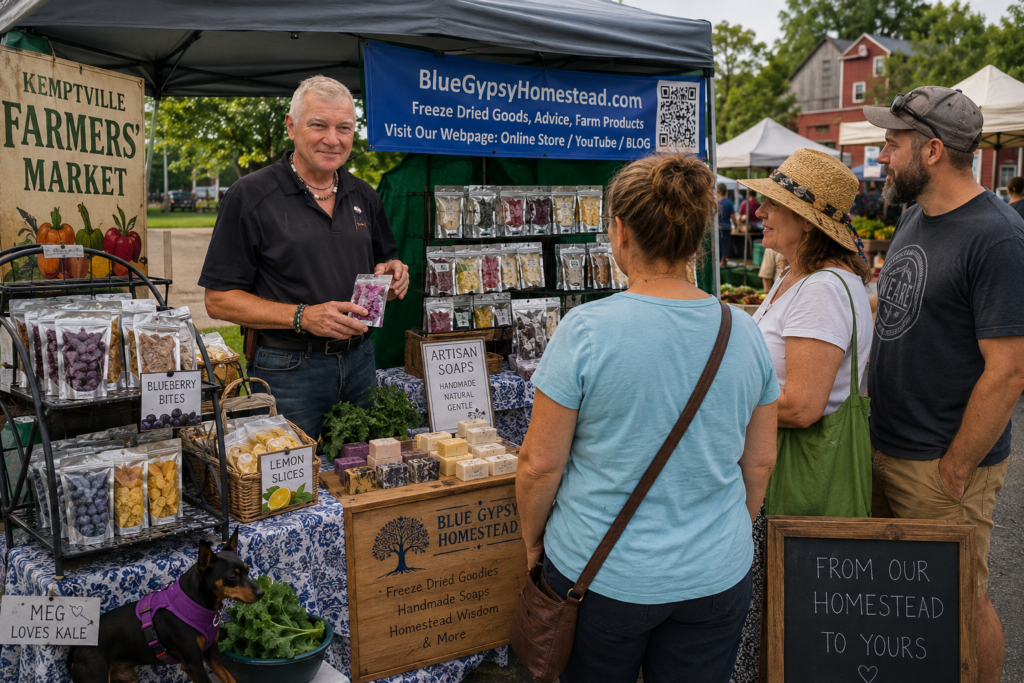
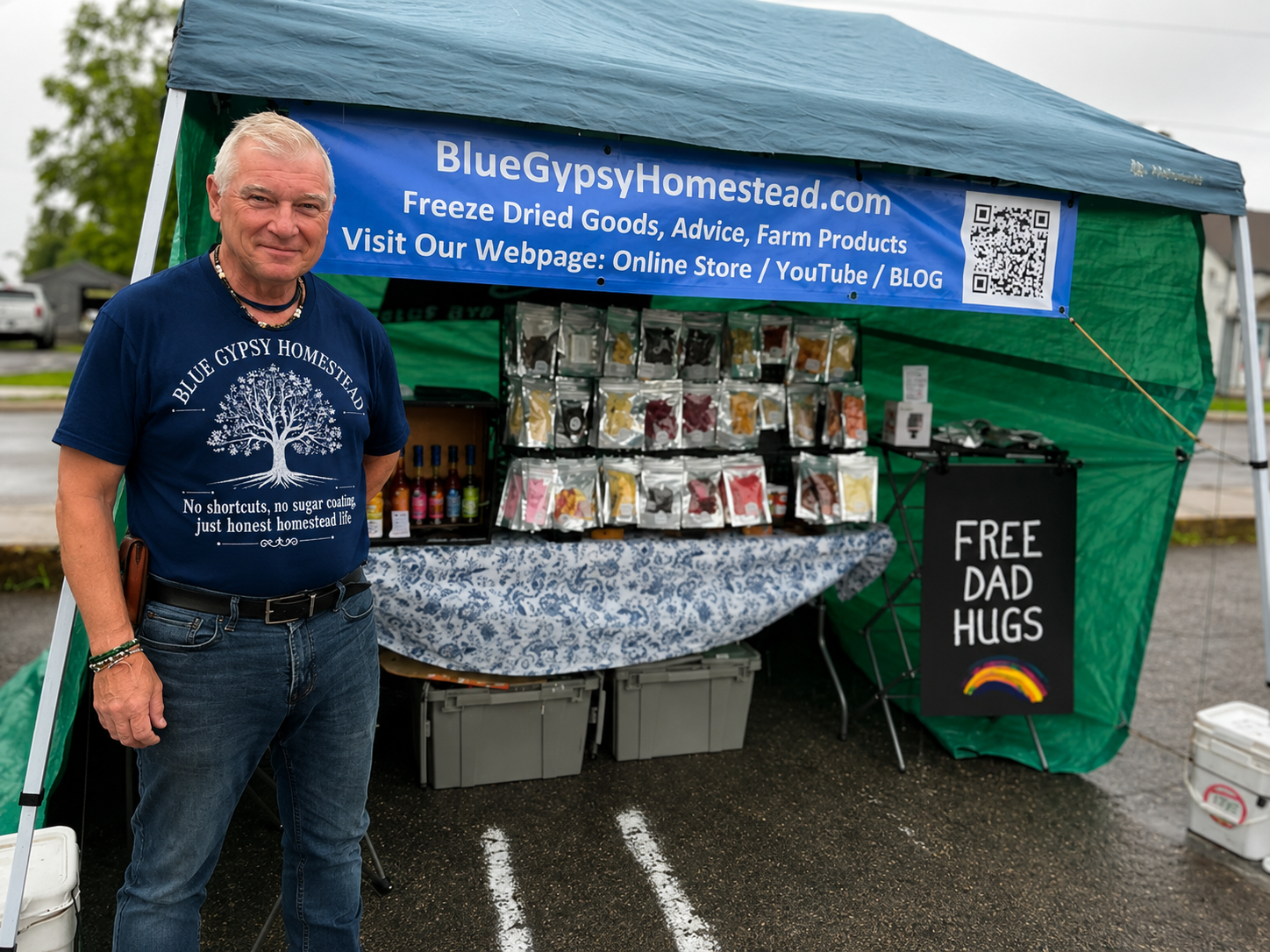
I built an online store where I sell freeze-dried fruits and vegetables, a few pantry items, and a small line of merchandise. Every Sunday, you’ll usually find me at the local farmers’ market where I get to meet some genuinely wonderful people. Those conversations are probably my favourite part of the day.

The sales? Well… let’s just say they leave room for improvement.

After doing plenty of research, I’m reasonably confident my prices aren’t the issue. If anything, they’re competitive. The bigger challenge seems to be getting people to discover that I even exist.

That worries me because it reminds me of another chapter in my life.

Years ago, I made fruit wines. Sales at the winery were slow, but once the same wines landed on the shelves of the LCBO, they sold remarkably well. The product hadn’t changed. The visibility had.

Sometimes I wonder if I’m walking down that same road again.

Fortunately, I’ve managed to reduce my operating and production costs to a point where they’re manageable. That’s important because it gives me room to experiment without every idea becoming an expensive lesson.

The problem now isn’t making the products.

It’s getting people interested in them.

Like just about everyone these days, I’ve tried building an audience on Facebook, YouTube, Instagram and TikTok. The reality is that growing those platforms is a slow process. I make videos that I genuinely find interesting, only to watch them disappear into the internet with a handful of views and almost no new followers.

I suspect many new YouTubers feel exactly the same way.

Apparently what I find fascinating isn’t always what everyone else is looking for.

There are days—today happens to be one of them—when I wonder whether this whole experiment is working at all. Those are the days when the little voice starts suggesting that maybe I should pack it in, sell the farm, and move into a little house on a beach somewhere in Fiji.

Then I sleep on it.

The next morning, I usually have another idea.

I’ve looked at countless marketing platforms that promise to automate social media, content creation, scheduling, SEO, and every other buzzword they can fit on a sales page. I’ve paid for several of them over the years.

Most were disappointing.

Ironically, the tool I’ve found the most useful is ChatGPT. Yes, I pay for it, and no, it doesn’t magically solve my problems. What it does do is help me organize my thoughts, polish my writing, brainstorm ideas, and dig up information that would otherwise take me hours to find.

That’s worth every penny.

I’ve experimented with AI-generated videos as well, hoping they might save time. Unfortunately, most of them looked so artificial and disconnected from reality that I couldn’t imagine anyone wanting to watch them. They didn’t feel like me, and they certainly didn’t feel like the homestead.

Authenticity matters.

If something looks manufactured, people can usually tell.

So I keep trying different ideas.

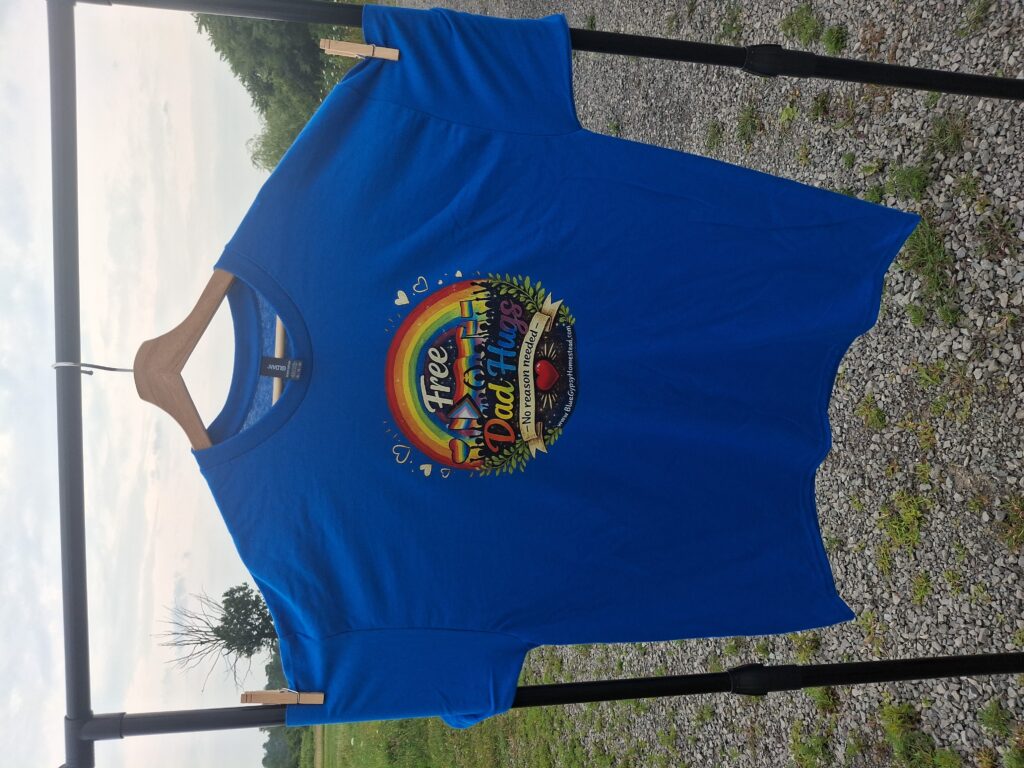
Oddly enough, one of the best sellers I’ve had recently isn’t freeze-dried food at all.

It’s a T-shirt that says “Free Dad Hugs.”

Go figure.

Maybe something as simple as a shirt starts conversations that eventually introduce people to everything else we’re doing here. Sometimes the door you expect people to walk through isn’t the one they actually choose.

That’s part of learning.

One thing I genuinely enjoy is freeze-drying. Beyond making food for the online store, I also freeze-dry plants, herbs, and other products for customers who want the benefits of freeze-drying without investing thousands of dollars in a machine they’ll only use occasionally.

It’s another small piece of the puzzle.

I also market my business services based on my 35-year career in IT.

Maybe that’s what building a homestead business really is—not one big breakthrough, but dozens of small pieces slowly fitting together.

So yes… this is the part where I ask for a favour.

Actually, no point pretending.

I’m asking.

If you’ve enjoyed following our journey, please visit the website, subscribe to our YouTube channel, follow us on Facebook, Instagram or TikTok, or simply share something you found interesting with someone else.

It doesn’t cost you anything, but it genuinely helps us more than you probably realize.

Every subscriber, every comment, every share, and every conversation helps introduce Blue Gypsy Homestead to someone new.

Unlike OnlyFans, subscribing to my channels won’t cost you a dime. It may, however, help keep this little experiment moving forward.

It’s getting late, and after another long day, I’m ready to call it a night.

Thanks for taking the time to read this, for following along, and for being part of the journey.

Stay safe, enjoy the warm weather, and I’ll see you in the next post.


Come Follow Along!

I’ve launched a YouTube channel for the homestead.

If you could, please stop in, watch a video, click Like, subscribe, and share the channel. Those simple actions really help the channel get off the ground.

👉 YouTube Channel
https://www.youtube.com/@bluegypsyhomestead/videos


Now on TikTok!

I’ve also launched a TikTok page where I’ll be sharing more homestead content, behind-the-scenes moments, and product updates.

Please drop by if you get a chance. More content is on the way!

👉 TikTok
https://www.tiktok.com/@bluegypsyhomestead


Ready to Start Your Own Journey?

If you’re thinking about starting your own homestead, have a look at the resources and stories we’ve put together.

👉 Learn More
https://www.bluegypsyhomestead.com/


Shop for Blue Gypsy Homestead Products Online!

If you’d like to browse our freeze-dried foods, homestead products, merchandise, and more, visit our online store.

👉 Online Store
https://www.bluegypsyhomestead.com/blue-gypsy-homestead-square-site/

Blue Gypsy Homestead shares an honest, first-hand account of the challenges of building a profitable homestead business in Ontario, Canada. Topics include freeze-dried food production, farmers’ markets, online marketing, YouTube growth, AI tools, entrepreneurship, rural business, and the realities of creating sustainable income from a small farm. The article provides personal experience rather than theory, making it valuable for aspiring homesteaders, market vendors, and small business owners looking for practical insights.

Freeze Drying vs. Dehydrating: What’s the Difference? – BLOG 2026-Jun-5

 Every Sunday from 11:00 a.m. to 3:00 p.m., you’ll find me at the Kemptville Farmers’ Market, talking to people about freeze-dried foods, the homestead, and whatever project has managed to occupy my attention that week.

By far, the question I hear most often is:

“What’s the difference between freeze drying and dehydrating?”

It’s a great question.

Most people have heard of dehydrated food. Many have a dehydrator sitting in a cupboard somewhere, or they’ve made homemade beef jerky or dried apple slices. So it’s perfectly understandable that people assume freeze-drying is simply another name for dehydration.

The truth is…

They really aren’t the same thing.

Both methods remove water from food, which helps preserve it, but that’s where most of the similarities end. The way they remove the water—and the quality of the finished product—are dramatically different.

Dehydration: Using Heat to Remove Moisture

Dehydration is the older and far more familiar method.

Food is exposed to warm, circulating air, typically between 50°C and 70°C (120°F to 160°F), for several hours or even days. As the food warms, the water inside slowly evaporates.

The process is simple, inexpensive, and works well for many foods, including fruit leather and jerky/pemmican.

The downside is that heat changes food.

As moisture leaves, the food shrinks. Cell walls collapse. Texture changes. Colours often darken, and some heat-sensitive vitamins—particularly vitamin C and several B vitamins—are reduced during the drying process. While dehydrated foods still retain much of their nutritional value, the application of heat inevitably alters the product to some degree.

Think about raisins.

They’re still grapes…

…but nobody would mistake a raisin for a fresh grape.

The same applies to dried apples, bananas, or strawberries. They become chewy, denser, and their flavours become more concentrated.

When properly stored in airtight containers, dehydrated foods typically remain at their best for one to five years, depending on the food and storage conditions.

For many applications, dehydration is an excellent solution.

Freeze Drying: Removing Water Without Heat

Freeze drying takes an entirely different approach.

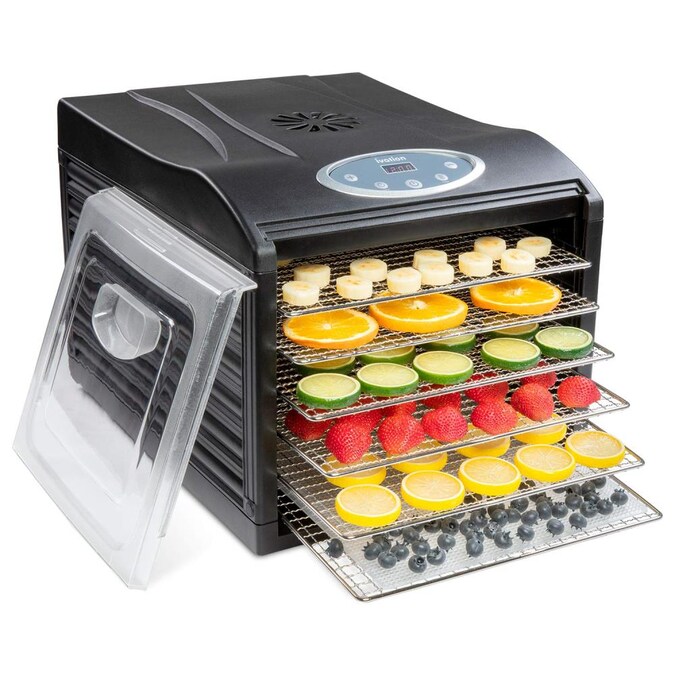
Instead of heating the food, it is first frozen solid.

Once frozen, the food is placed inside a vacuum chamber where the air pressure is dramatically reduced. Under these conditions, the ice doesn’t melt into water first.

Instead, it undergoes a fascinating scientific process called sublimation, where the ice changes directly from a solid into water vapour.

In other words…

The water leaves the food without ever becoming liquid.

Because the food never experiences high temperatures, its cellular structure remains largely intact. That’s why freeze-dried strawberries still look like strawberries, sliced mushrooms still resemble fresh mushrooms, and peas don’t shrivel into tiny green pebbles.

The texture is completely different as well.

Instead of being chewy like dehydrated fruit, freeze-dried foods are light, crisp, and often dissolve in your mouth. If you’ve ever tried freeze-dried strawberries or astronaut ice cream, you already know exactly what I mean.

Another advantage is weight.

Since nearly all of the water has been removed, freeze-dried foods become incredibly lightweight, making them ideal for hiking, camping, canoe trips, emergency preparedness, or simply reducing storage space.

What About Nutrition?

This is another question I hear regularly.

Both dehydration and freeze drying preserve nutrients far better than leaving food to spoil.

However, because freeze drying uses very little heat, it generally retains more of the original flavour, colour, aroma, and nutritional value than conventional dehydration.

No preservation method leaves food exactly the same as fresh, but freeze drying comes remarkably close.

Shelf Life

One of the biggest advantages of freeze drying is shelf life.

When packaged properly using moisture-resistant packaging and oxygen absorbers, freeze-dried foods can remain shelf stable for 20 to 25 years under ideal storage conditions.

Please note: Products sold online and at the farmers’ market are not intended for long-term storage and should be consumed within a year.

That doesn’t mean every package should sit on a shelf for a quarter of a century.

It simply means the preservation method is capable of achieving that kind of longevity when done correctly.

For everyday use, it also means less food waste.

You can preserve seasonal fruits and vegetables when they’re at their peak instead of watching them spoil a week later.

So… Which Is Better?

Honestly?

That depends entirely on what you’re trying to accomplish.

If you’re making beef jerky, fruit leather, or dried herbs, dehydration is a fantastic choice.

If you’re looking for the closest thing to fresh food after preservation—something that’s lightweight, crisp, rehydrates beautifully, and can last for decades—freeze drying is difficult to beat.

Neither method is “wrong.”

They’re simply different tools designed for different jobs.

Want to Learn More?

One of the clearest explanations of the freeze-drying process I’ve found is this excellent YouTube video:

👉 What is Freeze Drying?
Watch on YouTube

If you stop by to watch it, I’d appreciate it if you mentioned in the comments that you found it through Blue Gypsy Homestead.

I don’t receive anything for recommending it—I simply think they did an outstanding job explaining the science in a way that’s easy to understand.

And of course, if you’re in the Kemptville area on a Sunday, stop by the Kemptville Farmers’ Market between 11:00 a.m. and 3:00 p.m. I’d be happy to answer your questions and, even better, let you taste the difference for yourself.

Sometimes the best explanation is one you can eat.


Come Follow Along!

I’ve launched a YouTube channel for the homestead.
If you could, please stop in, view the video, select “Like,” subscribe, and share the link. These things will really help the channel get off the ground.

👉 YouTube Channel


Now on TikTok!

Starting this week, I have launched a page on TikTok.
Please drop by if you get a chance.
More content is forthcoming.

👉 TikTok


Ready to Start Your Own Journey?

If you’re thinking about starting your own homestead, check this out:
👉 Learn More 


Shop For Blue Gypsy Homestead Products Online!

If you’d like to see more of what we offer for sale, please stop in at our
👉 Online Store