

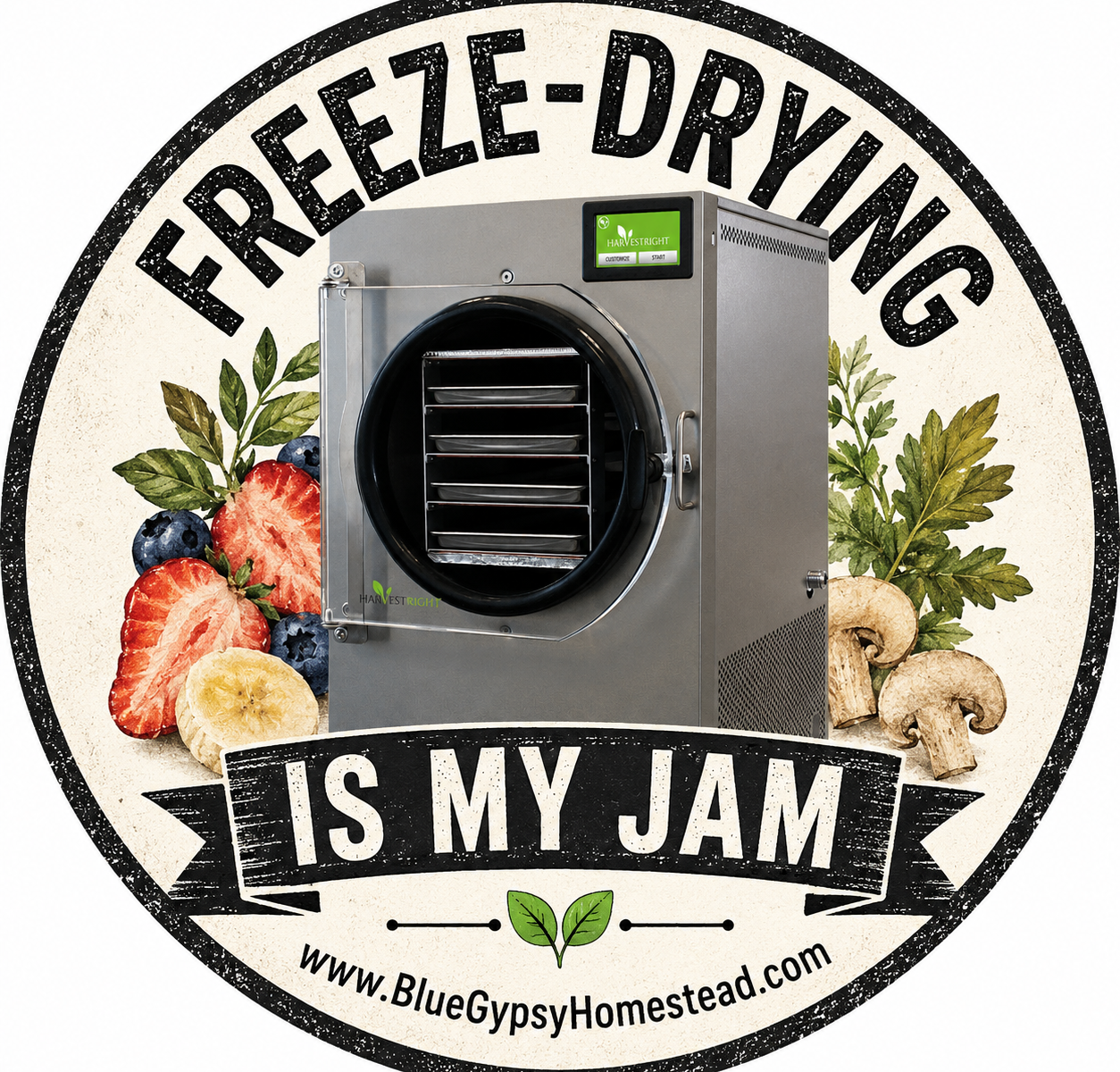
Turning Garden Surplus Into Shelf-Stable Food
There is something deeply satisfying about walking into the garden and realizing you have more food than you can possibly eat.
It is also when the reality of gardening tends to set in.
The tomatoes are ripening faster than we can eat them. The peppers seem to multiply overnight. The zucchini have apparently decided to take over the entire property. Suddenly, that bumper crop you were so proud of becomes a race against time.
For years, the traditional answer has been canning, freezing, pickling, or dehydrating. Those are all excellent ways to preserve food, and we use several of them here at Blue Gypsy Homestead.
But there is another option that has become an increasingly important part of what we do:
freeze-drying.
And now, we’re taking that idea one step further by offering custom freeze-drying services for people who have food they want to preserve but don’t necessarily own a freeze dryer.
When “Too Much” Becomes a Good Problem
One of the funny things about gardening is that you rarely get exactly the amount of food you planned for.
You plant six tomato plants because six seemed reasonable.
Then they all produce.
And produce.
And produce.
Before long, you’re giving tomatoes to neighbours, making sauce, eating tomatoes with everything, and wondering if there is a legal limit to how many tomatoes one household can reasonably possess.
The same thing happens with peppers, berries, herbs, fruit and vegetables.
That surplus represents time, money, water, fertilizer, seeds and a lot of work. Throwing it away because you couldn’t use it quickly enough feels like a waste—and it is.
This is where food preservation becomes more than simply stocking the pantry.
It’s a way of getting the full value out of the food you’ve already grown.
Freeze-Drying Changes the Equation
Freeze-drying removes moisture from food while preserving much of its original shape, flavour, colour and nutritional value.
The finished product is remarkably light and, when properly packaged and protected from moisture and oxygen, can be stored for a long time.
That makes freeze-drying particularly interesting for garden surplus.
Instead of trying to figure out what to do with twenty pounds of tomatoes this week, you can preserve them for later.
Instead of watching berries spoil in the refrigerator, you can turn them into a shelf-stable ingredient.
Instead of having more peppers than you can possibly use fresh, you can preserve them for future meals.
And unlike freezing, freeze-dried food doesn’t require freezer space.
That’s a pretty significant advantage when you’re already trying to make the most of limited storage space.
What Can You Freeze-Dry?
Quite a lot.
Some of the foods that lend themselves particularly well to freeze-drying include:
-
-
- Fruits and berries
- Tomatoes
- Peppers
- Corn
- Onions
- Mushrooms
- Herbs
- Garden vegetables
- Cooked meals
- Snacks and treats
-
The important thing is understanding that not every food behaves exactly the same way in a freeze dryer.
Some foods need preparation before processing. Others may need to be cut into a particular size or thickness. Foods containing higher amounts of fat can present additional challenges.
That’s one of the reasons we enjoy doing this.
There is a bit of science involved, but there is also plenty of hands-on experience.
From Garden to Pantry
One of my favourite things about preservation is that it changes how you think about the garden.
A garden isn’t just producing food for today’s dinner.
It can produce food for next month, next winter or even much further down the road.
Imagine harvesting a basket of tomatoes in August and still having those tomatoes available months later.
Imagine having your own garden-grown peppers available when the garden is covered in snow.
Imagine pulling a jar of freeze-dried berries from the pantry in January and knowing that those berries came from a summer harvest.
That’s what makes food preservation so appealing to me.
It creates a bridge between abundance and scarcity.
The garden gives us abundance in the summer.
The pantry gives us options when the garden is sleeping.
But What If You Don’t Own a Freeze Dryer?
This is where our new service comes in.
Freeze dryers are incredible machines, but they aren’t exactly an impulse purchase.
They are expensive pieces of equipment. They take up space, require electricity, need regular cleaning and maintenance, and there is a learning curve involved in using them properly.
And honestly, not everyone needs one.
Maybe you have a large garden but only one or two major harvests each year.
Maybe you grow berries but don’t have enough volume to justify buying a machine.
Maybe you inherited a bumper crop from a friend or neighbour.
Maybe you’re simply curious about freeze-drying and want to try it before investing in your own equipment.
That’s why Blue Gypsy Homestead is now offering custom freeze-drying services.
Our Custom Freeze-Drying Service
The basic idea is simple.
You grow it. We freeze-dry it. You get it back.
Instead of buying a freeze dryer, you can have selected foods processed for you.
This can be particularly useful for gardeners who suddenly find themselves with more produce than they can reasonably consume or preserve using traditional methods.
Rather than watching that food deteriorate, we can help turn your surplus into a lightweight, shelf-stable product that can be stored and used later.
And because this is a custom service, the goal isn’t simply to run generic products through a machine.
We’re interested in helping people preserve their food.
That distinction matters.
Why Preserve Your Own Garden Produce?
There is something different about opening a container of food that you grew yourself.
-
-
- You know where it came from.
- You know what went into growing it.
- You know that the tomatoes came from your garden, the peppers came from your plants and the berries came from your harvest.
- You’re not simply buying another packaged food product.
- You’re preserving a piece of your own harvest.
-
For us, that’s one of the biggest reasons we got into food preservation in the first place.
Homesteading isn’t necessarily about producing everything yourself.
Sometimes it’s about finding practical ways to make better use of what you already have.
Reducing Food Waste
Food waste bothers me.
Not because I think every single scrap of food needs to be preserved forever, but because growing food takes real resources.
-
-
- There is work involved.
- There is water.
- There is soil preparation.
- There are seeds.
- There is fertilizer.
-
There are weeds, insects, weather, wildlife and all the other things that make gardening an adventure.
When the garden finally produces, throwing away a significant portion because we couldn’t use it quickly enough seems like a poor ending.
Preservation gives that food another opportunity.
Instead of:
Garden → harvest → too much → waste
we can create:
Garden → harvest → preserve → pantry → future meals.
That’s a much better use of the work we’ve already put in.
Freeze-Drying Isn’t About Being Perfect
One thing I’ve learned from homesteading is that there is no perfect system.
You can plan the garden perfectly and still lose crops.
You can preserve 50 jars of something and discover your family doesn’t actually like eating it.
You can buy equipment that seemed like a great idea at the time and later wonder what you were thinking.
That’s homesteading.
The goal isn’t perfection.
The goal is figuring out what works for you, making adjustments and getting better over time.
For us, freeze-drying has become one of those tools.
-
-
- It doesn’t replace canning.
- It doesn’t replace freezing.
- It doesn’t replace dehydration.
-
It’s simply another tool in the toolbox.
And now, we’re making that tool available to people who don’t own one themselves.
Is Custom Freeze-Drying Right for You?
If you have a garden surplus that you don’t know what to do with, it may be worth considering.
It could be:
-
-
- A bumper crop of tomatoes
- More peppers than you can possibly eat
- Excess berries
- Garden vegetables
- Herbs
- Fruit
- Cooked foods or meals suitable for freeze-drying
- Produce you’ve grown specifically for long-term storage
-
The best place to start is with a conversation about what you have and what you’re hoping to accomplish.
Not everything is a good candidate for freeze-drying, and some foods require particular preparation.
We’ll be happy to discuss the possibilities before you commit your harvest.
Making the Most of What You Grow
For me, this is really what homesteading is about.
It’s not about having the perfect garden.
It’s not about producing absolutely everything yourself.
And it’s definitely not about posting a picture of a perfectly arranged basket of vegetables while ignoring the weeds growing behind it.
It’s about making practical use of what you have.
If your garden produces more than you can eat today, preserve it for tomorrow.
If you don’t own a freeze dryer, you don’t necessarily have to buy one.
And if you’ve got a freezer full of berries, a counter covered in tomatoes or a garden producing more peppers than you know what to do with, we’d love to talk about how we might be able to help.
Your garden worked hard to produce that food. Let’s give it a longer life.
Custom Freeze-Drying at Blue Gypsy Homestead
Our new custom freeze-drying service is designed for gardeners, homesteaders and families who want to preserve their own food without having to purchase and operate a freeze dryer themselves.
Have a surplus you’d like to preserve?
Contact Blue Gypsy Homestead to discuss your project and we’ll help you determine whether freeze-drying is a good fit for your food.
Learn More About Blue Gypsy Homestead
Blue Gypsy Homestead is a 62-acre homestead located approximately 35 minutes south of Ottawa, Ontario. What started as a homestead project has grown into an ongoing experiment in gardening, food preservation, livestock, small-scale agriculture, entrepreneurship and figuring out how to make better use of what we have.
We don’t pretend to have everything figured out.
We’re learning, experimenting, occasionally making spectacular mistakes, and sharing what we discover along the way.
📺 Follow the Blue Gypsy Homestead Journey
Whether it’s raising rabbits, growing food, preserving harvests, building infrastructure, or sharing the realities of homestead life, you’re invited to follow along.

▶️ YouTube
Watch videos about homesteading, gardening, food preservation, rabbit husbandry, DIY projects, and life on a working homestead.
Blue Gypsy Homestead on YouTube
🎵 TikTok
Follow for short videos, quick updates, behind-the-scenes projects, and everyday homestead life.
Blue Gypsy Homestead on TikTok
🌱 Learn More
Read more articles about homesteading, food production, self-sufficiency, gardening, livestock, food preservation, and rural living.
Blue Gypsy Homestead – Learn More
🛒 Online Store
Browse freeze-dried foods, gourmet seasonings, homestead products, merchandise, and other items available from Blue Gypsy Homestead.
Blue Gypsy Homestead Online Store
About Blue Gypsy Homestead
Blue Gypsy Homestead is a 62-acre farm located approximately 35 minutes south of Ottawa, Ontario, Canada. What was once a winery is being transformed into a productive sustenance and market farm focused on growing food, raising livestock, preserving harvests, building practical infrastructure, and increasing self-sufficiency.
Through articles, videos, and real-world experiences, Blue Gypsy Homestead shares the successes, failures, lessons learned, and realities of modern homestead life. There is no expectation that everything will be perfect—and there is definitely no sugar-coating the difficult parts.
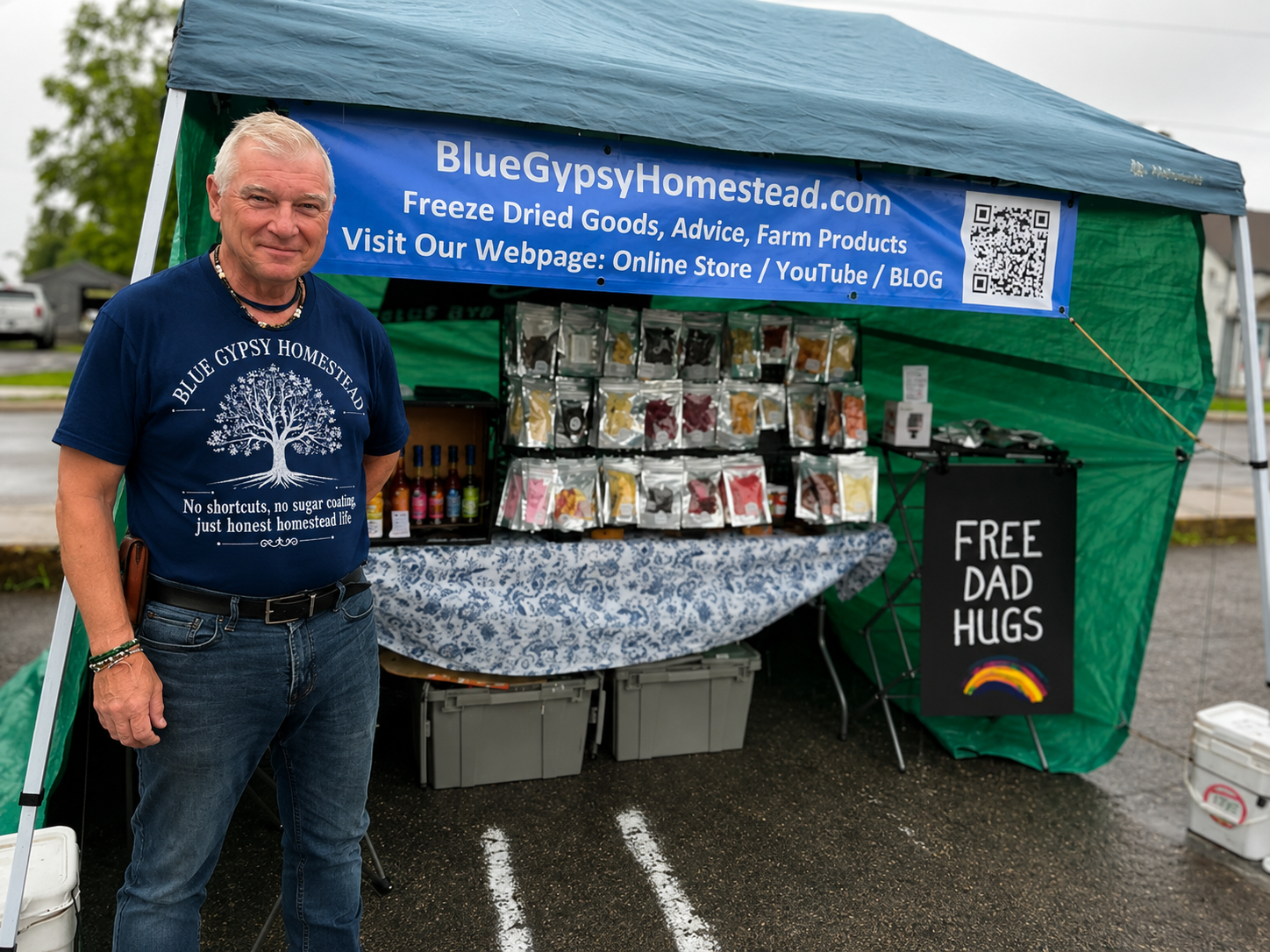
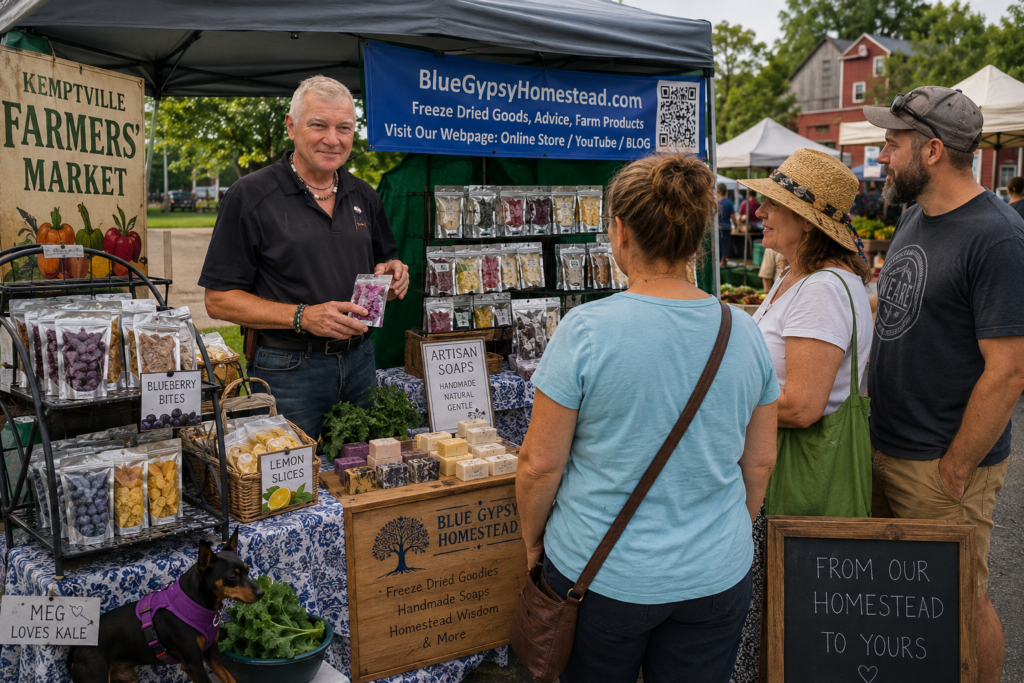 Every Sunday from 11:00 a.m. to 3:00 p.m., you’ll find me at the Kemptville Farmers’ Market, talking to people about freeze-dried foods, the homestead, and whatever project has managed to occupy my attention that week.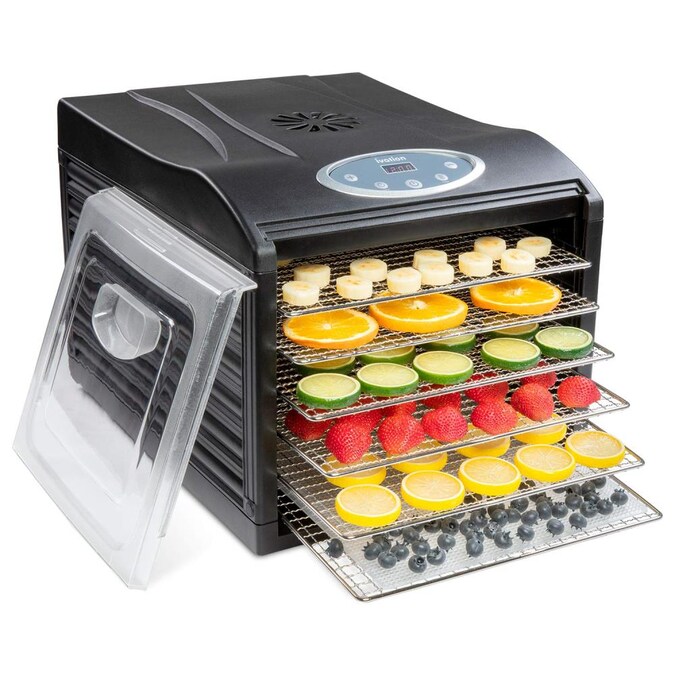
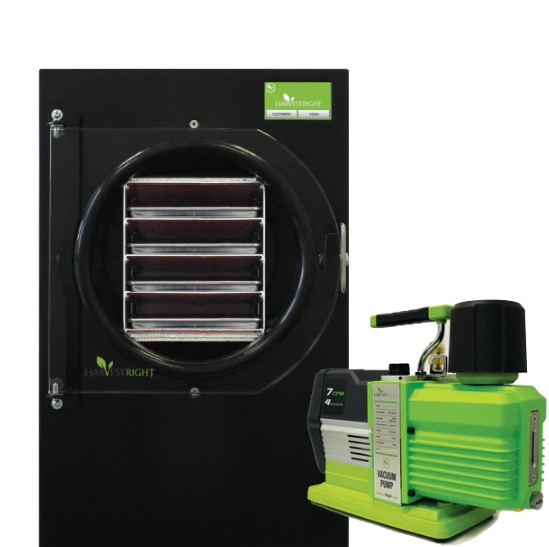 Freeze drying takes an entirely different approach.