Freeze Drying vs. Dehydrating: What’s the Difference? – BLOG 2026-Jun-5

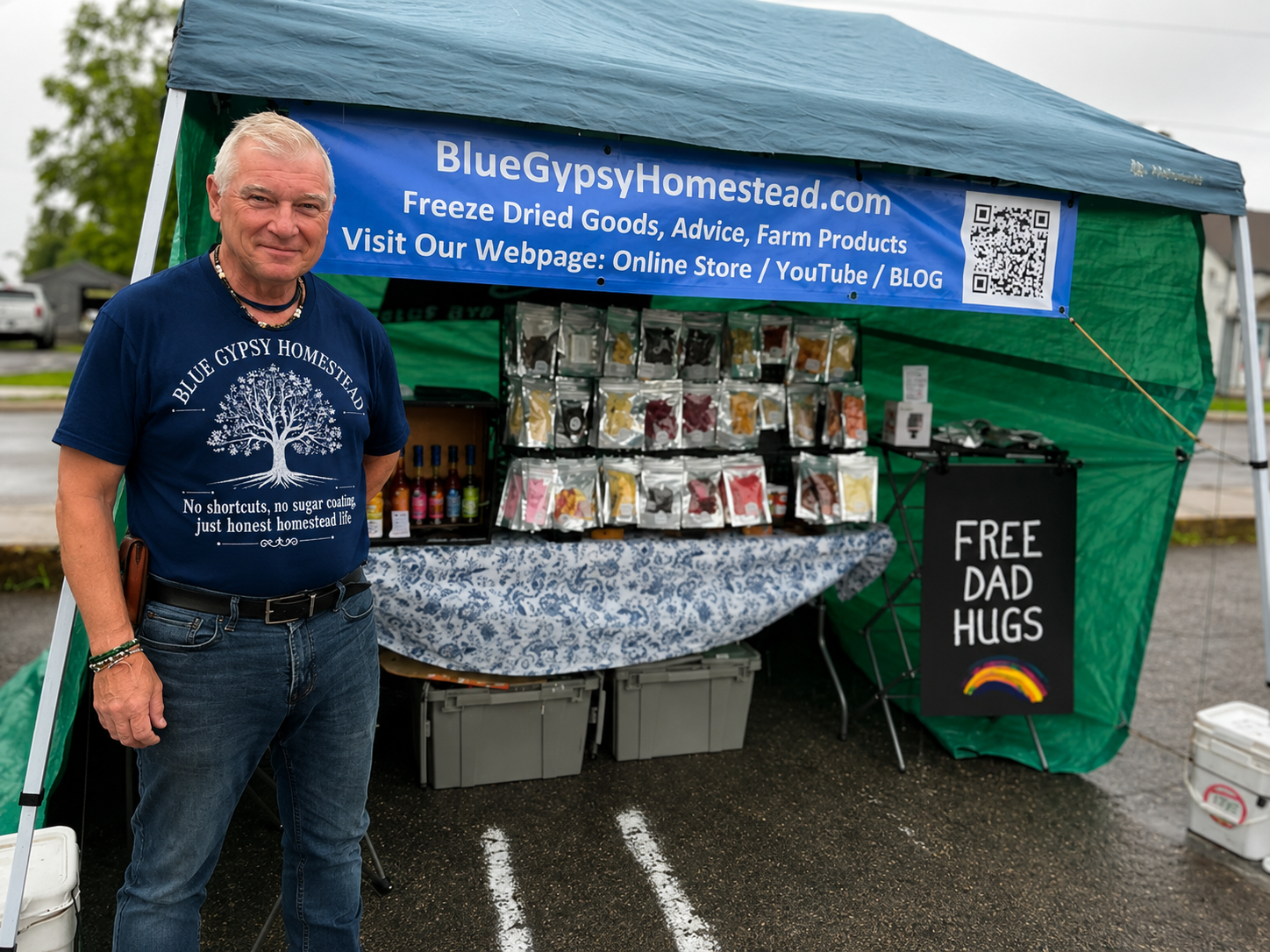
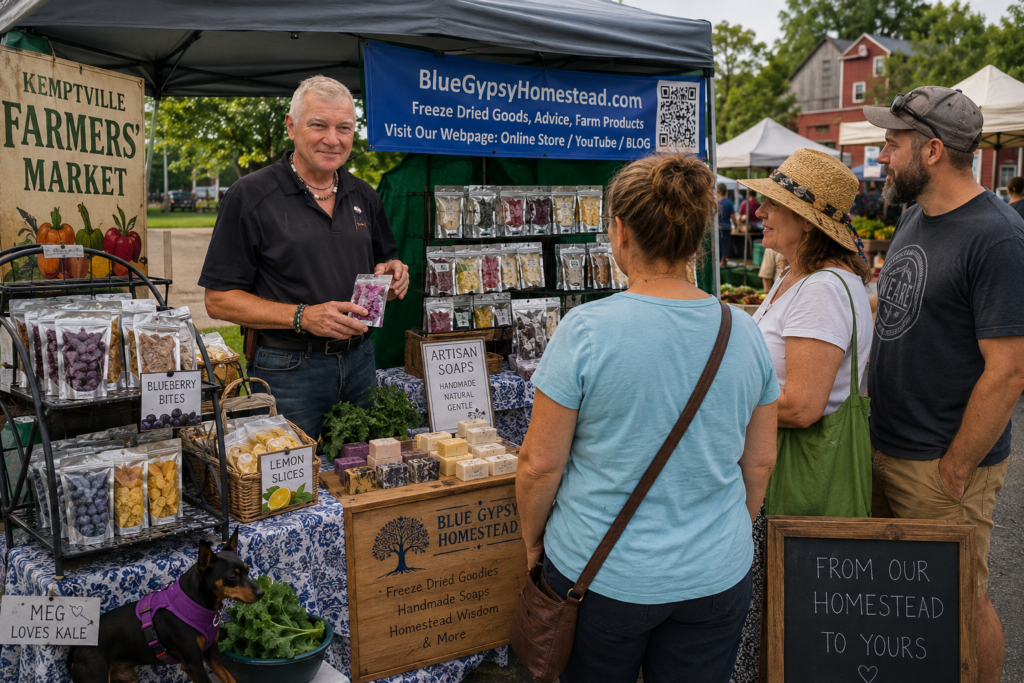
 Every Sunday from 11:00 a.m. to 3:00 p.m., you’ll find me at the Kemptville Farmers’ Market, talking to people about freeze-dried foods, the homestead, and whatever project has managed to occupy my attention that week.

By far, the question I hear most often is:

“What’s the difference between freeze drying and dehydrating?”

It’s a great question.

Most people have heard of dehydrated food. Many have a dehydrator sitting in a cupboard somewhere, or they’ve made homemade beef jerky or dried apple slices. So it’s perfectly understandable that people assume freeze-drying is simply another name for dehydration.

The truth is…

They really aren’t the same thing.

Both methods remove water from food, which helps preserve it, but that’s where most of the similarities end. The way they remove the water—and the quality of the finished product—are dramatically different.

Dehydration: Using Heat to Remove Moisture

Dehydration is the older and far more familiar method.

Food is exposed to warm, circulating air, typically between 50°C and 70°C (120°F to 160°F), for several hours or even days. As the food warms, the water inside slowly evaporates.

The process is simple, inexpensive, and works well for many foods, including fruit leather and jerky/pemmican.

The downside is that heat changes food.

As moisture leaves, the food shrinks. Cell walls collapse. Texture changes. Colours often darken, and some heat-sensitive vitamins—particularly vitamin C and several B vitamins—are reduced during the drying process. While dehydrated foods still retain much of their nutritional value, the application of heat inevitably alters the product to some degree.

Think about raisins.

They’re still grapes…

…but nobody would mistake a raisin for a fresh grape.

The same applies to dried apples, bananas, or strawberries. They become chewy, denser, and their flavours become more concentrated.

When properly stored in airtight containers, dehydrated foods typically remain at their best for one to five years, depending on the food and storage conditions.

For many applications, dehydration is an excellent solution.

Freeze Drying: Removing Water Without Heat

Freeze drying takes an entirely different approach.

Instead of heating the food, it is first frozen solid.

Once frozen, the food is placed inside a vacuum chamber where the air pressure is dramatically reduced. Under these conditions, the ice doesn’t melt into water first.

Instead, it undergoes a fascinating scientific process called sublimation, where the ice changes directly from a solid into water vapour.

In other words…

The water leaves the food without ever becoming liquid.

Because the food never experiences high temperatures, its cellular structure remains largely intact. That’s why freeze-dried strawberries still look like strawberries, sliced mushrooms still resemble fresh mushrooms, and peas don’t shrivel into tiny green pebbles.

The texture is completely different as well.

Instead of being chewy like dehydrated fruit, freeze-dried foods are light, crisp, and often dissolve in your mouth. If you’ve ever tried freeze-dried strawberries or astronaut ice cream, you already know exactly what I mean.

Another advantage is weight.

Since nearly all of the water has been removed, freeze-dried foods become incredibly lightweight, making them ideal for hiking, camping, canoe trips, emergency preparedness, or simply reducing storage space.

What About Nutrition?

This is another question I hear regularly.

Both dehydration and freeze drying preserve nutrients far better than leaving food to spoil.

However, because freeze drying uses very little heat, it generally retains more of the original flavour, colour, aroma, and nutritional value than conventional dehydration.

No preservation method leaves food exactly the same as fresh, but freeze drying comes remarkably close.

Shelf Life

One of the biggest advantages of freeze drying is shelf life.

When packaged properly using moisture-resistant packaging and oxygen absorbers, freeze-dried foods can remain shelf stable for 20 to 25 years under ideal storage conditions.

Please note: Products sold online and at the farmers’ market are not intended for long-term storage and should be consumed within a year.

That doesn’t mean every package should sit on a shelf for a quarter of a century.

It simply means the preservation method is capable of achieving that kind of longevity when done correctly.

For everyday use, it also means less food waste.

You can preserve seasonal fruits and vegetables when they’re at their peak instead of watching them spoil a week later.

So… Which Is Better?

Honestly?

That depends entirely on what you’re trying to accomplish.

If you’re making beef jerky, fruit leather, or dried herbs, dehydration is a fantastic choice.

If you’re looking for the closest thing to fresh food after preservation—something that’s lightweight, crisp, rehydrates beautifully, and can last for decades—freeze drying is difficult to beat.

Neither method is “wrong.”

They’re simply different tools designed for different jobs.

Want to Learn More?

One of the clearest explanations of the freeze-drying process I’ve found is this excellent YouTube video:

👉 What is Freeze Drying?
Watch on YouTube

If you stop by to watch it, I’d appreciate it if you mentioned in the comments that you found it through Blue Gypsy Homestead.

I don’t receive anything for recommending it—I simply think they did an outstanding job explaining the science in a way that’s easy to understand.

And of course, if you’re in the Kemptville area on a Sunday, stop by the Kemptville Farmers’ Market between 11:00 a.m. and 3:00 p.m. I’d be happy to answer your questions and, even better, let you taste the difference for yourself.

Sometimes the best explanation is one you can eat.


Come Follow Along!

I’ve launched a YouTube channel for the homestead.
If you could, please stop in, view the video, select “Like,” subscribe, and share the link. These things will really help the channel get off the ground.

👉 YouTube Channel


Now on TikTok!

Starting this week, I have launched a page on TikTok.
Please drop by if you get a chance.
More content is forthcoming.

👉 TikTok


Ready to Start Your Own Journey?

If you’re thinking about starting your own homestead, check this out:
👉 Learn More 


Shop For Blue Gypsy Homestead Products Online!

If you’d like to see more of what we offer for sale, please stop in at our
👉 Online Store

Happy Father’s Day, Dad – Blog 2026-Jun-21

Picture of my Dad after he was done crushing grapes

Father’s Day was yesterday, but I was so busy that I never really took the time to stop and reflect.

My father passed away on July 10, 2014, just three days shy of his 78th birthday. Cancer eventually took him from us, but even now, more than a decade later, I find myself thinking about him more often than I would have imagined.

My dad’s story was not an ordinary one.

In 1956, at the age of seventeen, he and his best friend fled Hungary during the Soviet invasion that was intended to crush the Hungarian Revolution. They left behind everything they knew and stepped into an uncertain future with little more than determination and hope. Looking back on it now, I cannot begin to imagine the courage that must have taken.

That willingness to face uncertainty head-on stayed with him for the rest of his life.

My father was a machinist by trade, but that description never quite captured who he was. He was one of those rare people who could look at a problem and immediately start seeing possibilities. He could stare at an object that had been designed for one purpose and somehow envision three others.

He learned by watching.

If something broke, he fixed it.

If something didn’t exist, he built it.

If there wasn’t an obvious solution, he created one.

What he taught me was not simply how to use tools or work with my hands. He taught me to look beyond what something was and consider what it could become. Long before people started talking about “thinking outside the box,” that was simply how he approached life.

Looking back, I suspect he inherited that trait from his own father.

My relationship with my dad was complicated.

There were good times and difficult times.

As I’ve gotten older and learned more about myself, I’ve come to believe that he may have struggled with bipolar disorder as well. At the time, nobody talked about those things. There were no conversations about mental health around our kitchen table. There were simply good days and bad days, and sometimes we all found ourselves trying to navigate the storms that came with them.

My father could be crass, stubborn, rude, and quick-tempered. His outbursts could shake the entire house. Even now, there are moments when memories of those explosions of anger come back to me unexpectedly.

But there is another truth that exists alongside those memories.

He loved us.

Of that, I have never had any doubt.

Like most parents, he wasn’t perfect. He carried his own burdens and fought battles that I don’t think he fully understood himself. Yet through all of it, he showed his love the way many men of his generation did—through hard work, sacrifice, and teaching.

He taught me how to fix things instead of immediately replacing them.

He taught me how to build houses and structures.

He taught me how to work with my hands.

He taught me how to fish.

He taught me how to drive.

He taught me how to make wine.

He taught me that if you don’t know how to do something, you can usually figure it out if you’re willing to learn.

Those lessons have followed me throughout my entire life.

When I look around the homestead today, I see his fingerprints everywhere.

Not literally, of course.

But in every project I tackle, every repair I attempt, every solution I cobble together from materials already on hand, I can see the influence he had on me.

My father was also an avid reader. Every day, he would sit down with the newspaper and read it from the front page to the very last page. Every now and then, he would tell me about some historical event or obscure fact he had come across.

At the time, I probably wasn’t paying nearly as much attention as I should have.

Now I find myself doing exactly the same thing—reading, researching, and disappearing down rabbit holes of curiosity simply because I want to understand how something works or why something happened.

I suspect I inherited that from him too.

My father wasn’t the only curious one in the family. Somewhere along the way, I inherited that trait as well, although I suspect my version occasionally caused him more stress than he would have preferred.

One example still makes me smile.

When I was about ten years old, I became fascinated by how flush toilets worked. Like many childhood experiments, the idea seemed perfectly reasonable at the time. Unfortunately, I failed to consider one very important detail: we lived in a one-bathroom house.

Armed with curiosity and a complete lack of foresight, I proceeded to disassemble our only toilet.

To be fair, the experiment was a success. I learned exactly how it worked.

The problem was that once I had everything spread across the bathroom floor, I discovered that understanding how something comes apart and understanding how to put it back together again are two entirely different skill sets.

By the time my father came home from work, the family toilet was still in pieces.

Needless to say, he was not pleased. In fact, saying he was “not pleased” might be one of the great understatements of my childhood.

Still, after the initial shock and frustration wore off, he did what he always did. He helped solve the problem. Together, we got everything back where it belonged, and in the process I learned something that stayed with me for the rest of my life.

Curiosity is valuable, but it occasionally comes with consequences.

The funny thing is that all these years later, that lesson paid off. Today I can take a toilet apart, repair it, rebuild it, or replace it entirely if necessary. What started as a childhood disaster became another useful skill tucked away in the toolbox.

Looking back, that story feels like a perfect illustration of both my father and me. His curiosity inspired mine, and my curiosity frequently created situations that required his patience, expertise, and occasionally his temper to resolve.

He worked incredibly hard throughout his life. There were times when he held down two or even three jobs simply to make ends meet and provide for his family.

That kind of work ethic leaves an impression.

It certainly left one on me.

Whatever challenges he faced, whatever burdens he carried, he showed up and did what needed to be done. He made the best of what he had available, even when circumstances were less than ideal.

That is a lesson I find myself leaning on more and more these days.

Especially now.

The older I get, the more I realize that many of the skills I rely upon every day came directly from him.

And perhaps the strangest thing is that he still helps me.

Every once in a while, when I am standing in front of a tractor that refuses to start, trying to figure out how to build something by myself, or staring at a problem that seems determined not to cooperate, I can almost hear his voice.

Not the angry voice.

Not the frustrated voice.

The problem-solving voice.

The voice that asks questions.

The voice that points out the thing I haven’t noticed yet.

The voice that quietly walks me through the solution.

Whether that is memory, imagination, or something else entirely, I honestly don’t know.

What I do know is that it still brings me comfort.

I loved my father.

Sometimes that wasn’t easy.

Relationships rarely fit neatly into simple categories of good or bad. The people who shape us most often leave us with a mixture of gratitude, frustration, admiration, and regret.

My father certainly did.

But as the years pass, I find myself thinking less about the difficult moments and more about the lessons, the sacrifices, and the gifts he left behind.

The greatest of those gifts wasn’t a possession.

It was the ability to think, build, solve problems, and persevere.

Those gifts continue to serve me every day.

Happy Father’s Day, Dad.

My greatest wish is that you knew how much of what I have accomplished came from what you taught me.

I’d like to think you’d be proud of the life I’ve built, the homestead I’ve created, and the person I’ve become.

Who knows?

Maybe you are.

Rest peacefully.

You earned it.

The Rabbit Roundup: Bunnies Don’t Care About Your Plans – BLOG 2026-Jun-16

I came home expecting an ordinary evening.

Feed the animals. Check on the gardens. Cross a few things off the ever-growing list that lives permanently in the back of my mind. Maybe sit down for a few minutes and enjoy the quiet that settles over the farm at the end of the day.

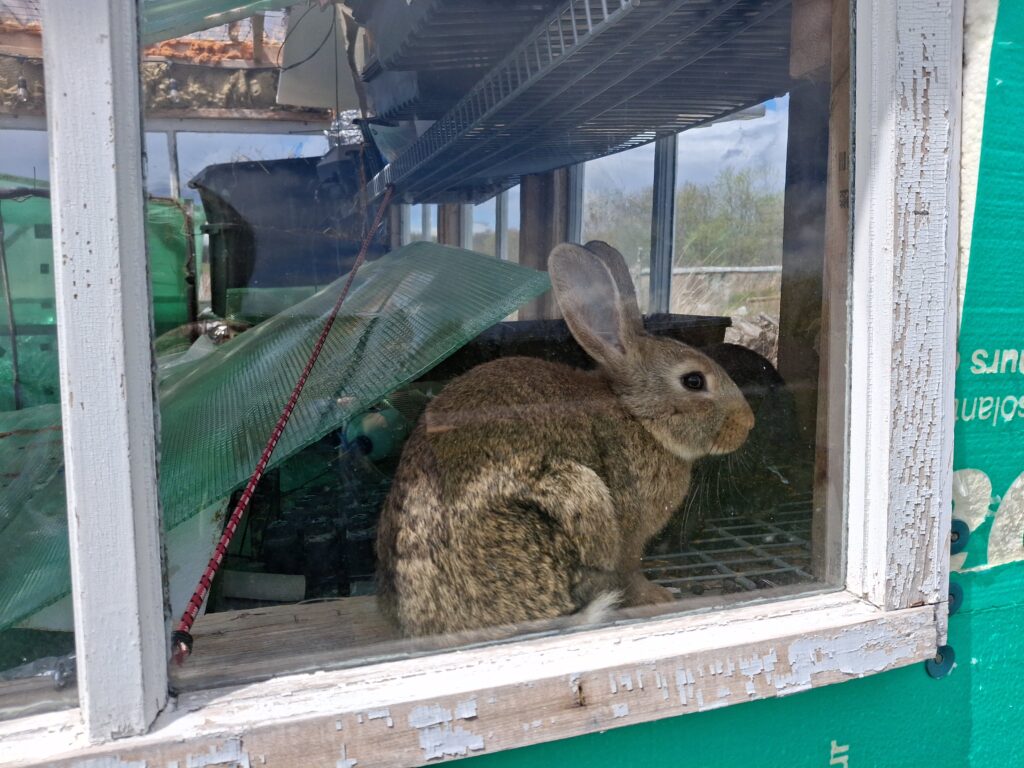
Instead, I looked over toward the Rabbit Palace and immediately felt that sinking sensation that every homesteader eventually comes to recognize.

The door was open.

Not broken. Not forced open by a predator. Just… open.

I must not have latched it properly.

Despite the electric fence, which rabbit are immune to because of their fur, several of the rabbits had escaped.

It’s funny how quickly your mind can travel when you realize you’ve made a mistake. In the space of a few heartbeats, I had already pictured the worst-case scenarios. Predators. Lost breeding stock. Weeks and months of planning were undone because of one small oversight that probably took less than two seconds to happen.

Coming up the driveway, I saw what I thought was a wild rabbit… then I noticed movement in the yard.

Rabbits.

Everywhere.

About half of them had apparently decided that life beyond the Rabbit Palace deserved further investigation. Some were grazing contentedly as if this was the arrangement all along. Others were making a determined effort to test both my patience and my cardio endurance.

There wasn’t time to dwell on the guilt.

Thankfully, I wasn’t facing the situation alone. Snoopy stepped up as my reluctant but invaluable assistant, helping me round up as many escapees as possible. There was a lot of slow walking, gentle coaxing, strategic repositioning, and more than one muttered promise to myself that I would double-check every latch from this day forward.

As the evening wore on, we managed to recover several rabbits. Each one safely returned brought a wave of relief that lasted only until I remembered there were still others unaccounted for.

Eventually, daylight gave way to darkness, and with it came uncertainty.

I wouldn’t know until morning how many are gone for good.

I keep hoping they’re tucked away somewhere nearby, hidden beneath a structure or nestled into long grass, waiting for the world to quiet down before emerging. Rabbits are prey animals. Their instincts tell them to freeze, hide, and survive.

I hope those instincts serve them well tonight.

More than anything, I hope my breeding pair are safe.

As I stood in the yard gathering rabbits, I found myself thinking back to last season and the chickens. They had managed an escape of their own, slipping beyond the boundaries that had been carefully built to keep them safe. At first, I convinced myself they would turn up. Chickens have a way of surprising you, after all. I kept expecting to catch sight of them wandering back toward the coop at dusk, indignant and demanding their supper as though nothing had happened. But they never returned. There was no dramatic ending, no clear explanation, just the quiet realization over days and weeks that they were gone. That experience stayed with me. It taught me that hope and realism often coexist uneasily on a homestead. You hope for the best because there isn’t much else you can do, while quietly preparing yourself for the possibility that not every story will end the way you want it to. Standing there with Snoopy, counting rabbits and recounting them again, I couldn’t help but revisit that earlier loss and wonder what lesson the homestead was trying to teach me this time.

The practical side of homesteading often revolves around planning. You select breeding stock carefully. You think months ahead. You calculate feed costs, housing requirements, and future litters. There’s a rhythm to it, an underlying belief that if you prepare properly, things will unfold more or less according to plan.

And then life reminds you that planning only takes you so far.

The truth is, homesteading has a way of exposing our humanity. The mistakes we make aren’t usually dramatic. More often, they’re ordinary. A gate is not secured. A water bucket was forgotten. A task is postponed because you’re tired and promise yourself you’ll get to it tomorrow.

Most days, those moments pass without consequence.

Sometimes they don’t.

That’s the part of this life that doesn’t fit neatly into carefully curated social media posts. We see the overflowing harvest baskets, the adorable kits, and the beautiful sunsets over the pasture. Those moments are real. They’re part of the story.

But so is this.

So are the evenings spent chasing rabbits around the yard while mentally replaying the exact moment you might have failed them.

So are the sleepless nights spent hoping that a mistake hasn’t cost more than you’re prepared to lose.

I don’t know what tomorrow morning will bring.

Maybe there will be rabbits waiting impatiently outside the Rabbit Palace for breakfast as though none of this ever happened. Maybe there will be difficult realities to face. Right now, all I can do is hope for the best, learn from what happened, and carry that lesson forward. One thing was certain, I needed to purchase a new fishing net with a long handle.

Did you know that rabbits are incredibly fast; several times faster than chickens…?

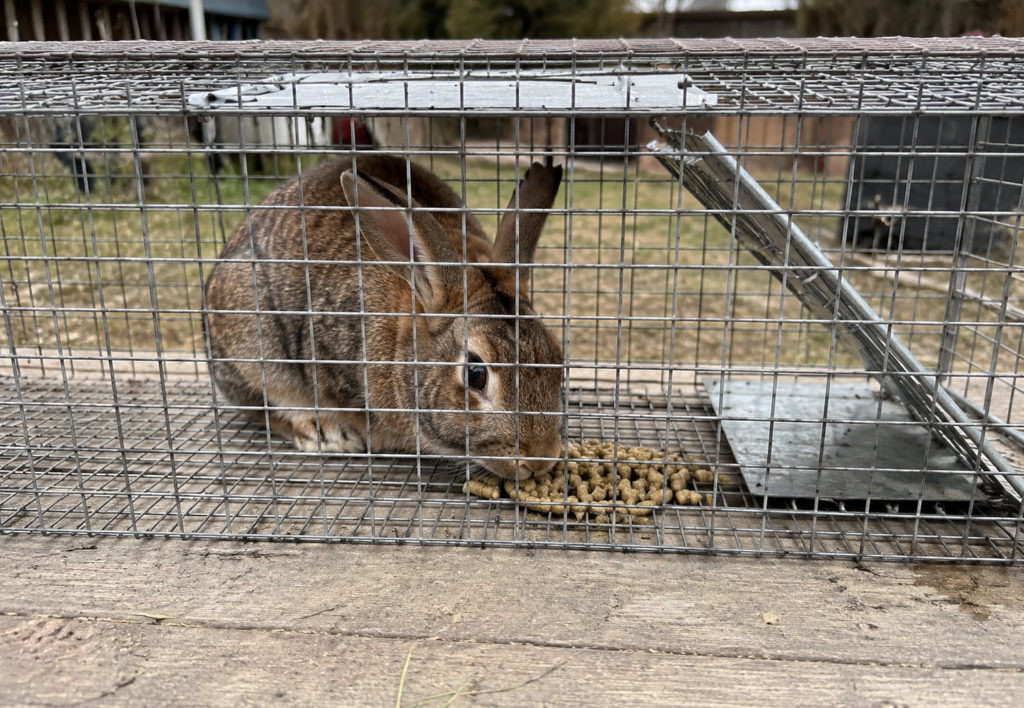
One thing that has worked in my favour through all of this has been having live trap cages tucked away among the assortment of tools and supplies that seem to accumulate on a homestead. They were originally purchased with entirely different intentions in mind, but as is so often the case out here, you learn to appreciate the value of having practical solutions close at hand. Armed with a selection of irresistible rabbit delicacies, I set the traps and hoped curiosity and an empty stomach would succeed where frantic chasing had failed.

To my immense relief, they did. One by one, the escape artists found their way back into custody, no doubt questioning why the forbidden treats had suddenly become so easy to acquire. As of now, all but one rabbit has been recovered. There’s still one holdout somewhere on the property, and while I can’t help but admire its determination and apparent commitment to independence, I’m holding onto the hope that a little patience—and perhaps the promise of another favourite snack—will eventually bring this final wanderer home. After all, if homesteading teaches anything, it’s that ingenuity often matters just as much as hard work, and sometimes the gentlest solutions turn out to be the most effective.

Homesteading has taught me many things over the years, but perhaps one of the hardest is this: responsibility doesn’t mean perfection.

It means showing up.

It means acknowledging when you’ve fallen short.

It means doing everything you can to make things right.

Tonight, that means one final walk around the property before bed, listening for movement in the underbrush and whispering quiet promises into the darkness that tomorrow will be better.

And from this day forward, check the rabbit door twice.

Because this is homesteading.

Not the polished version.

The real version.

Warts and all.


Come Follow Along!

I’ve launched a YouTube channel for the homestead.
If you could, please stop in, view the video, select “Like,” subscribe, and share the link. These things will really help the channel get off the ground.

👉 YouTube Channel


Now on TikTok!

Starting this week, I have launched a page on TikTok.
Please drop by if you get a chance.
More content is forthcoming.

👉 TikTok


Ready to Start Your Own Journey?

If you’re thinking about starting your own homestead, check this out:
👉 Learn More 


Shop For Blue Gypsy Homestead Products Online!

If you’d like to see more of what we offer for sale, please stop in at our
👉 Online Store