
The Unfiltered Homestead: What I Learned From Growing Food I Didn’t Need

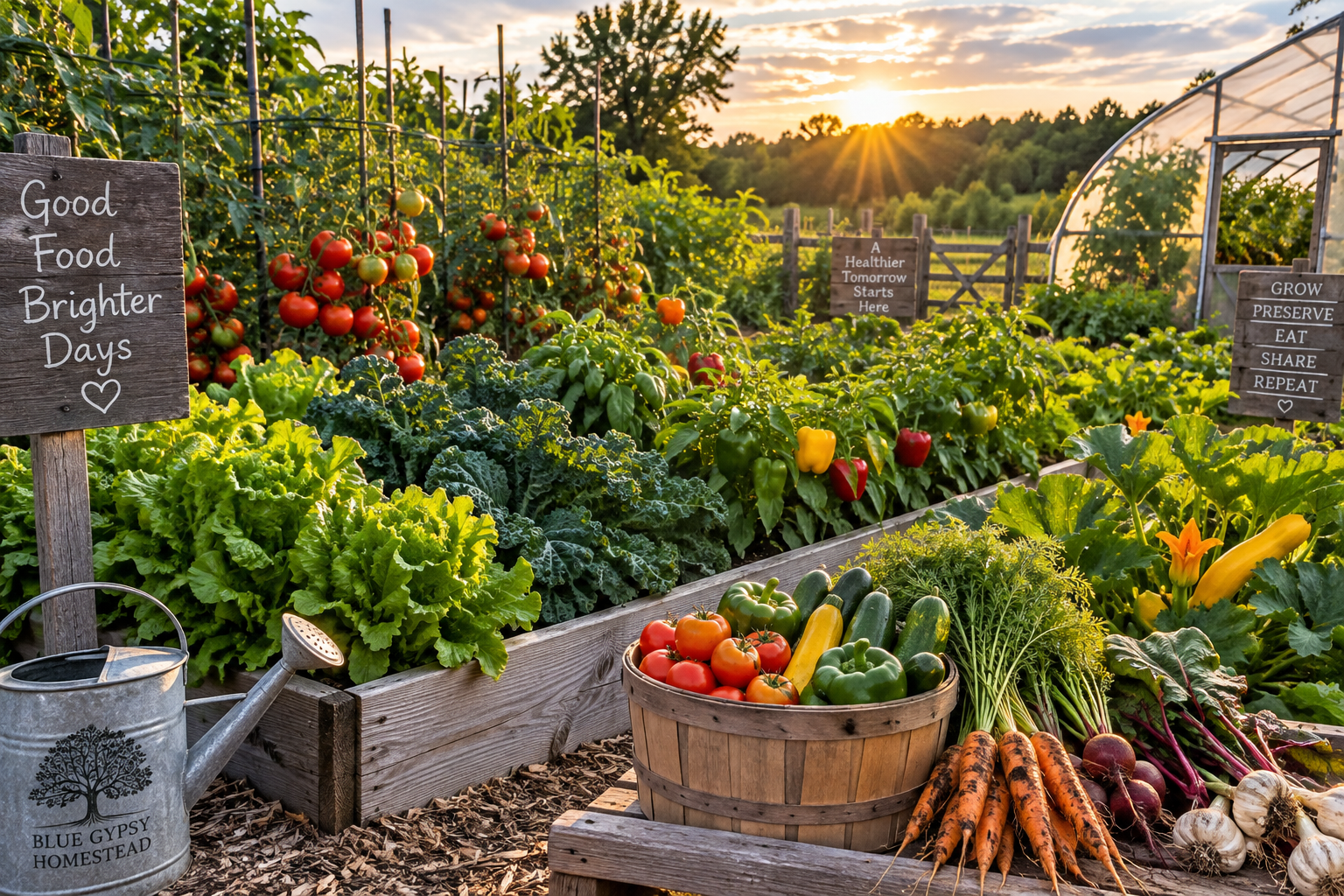
Blue Gypsy Homestead garden producing an abundant vegetable harvest

Preface: The Point of The Unfiltered Homestead

I started this series because I think there is value in showing the whole picture.

    • Not just what works.
    • Not just what looks good.
    • Not just the finished project.

I want to talk about what happens in between.

    • The mistakes.
    • The lessons.
    • The unexpected expenses.
    • The successes.
    • The failures.
    • The moments when I wonder what I was thinking.

And the moments when I look around and realize:

I actually built this.

That’s the part I don’t want to lose.

Because homesteading isn’t about getting everything right.

It’s about learning how to keep going when things don’t go right.

And when everything goes wrong?

    • I take a breath.
    • I figure out what actually needs attention.
    • I deal with that first.
    • Then I move on to the next thing.

That’s my homesteading experience.

And this is the unfiltered version.


What I Learned From Growing Food I Didn’t Need

There is something deeply satisfying about standing in a garden and seeing food everywhere.

    • Rows of plants.
    • Green leaves.
    • Flowers turning into fruit.
    • Vegetables getting bigger by the day.

Eventually, there is a moment when you realize:

Wow. I actually grew all of this.

That’s a pretty good feeling.

But then comes the other question.

What am I going to do with it?

And that’s where things get interesting.

Because I’ve learned that growing food successfully and producing useful food are not necessarily the same thing.

    • I can grow something perfectly.
    • I can get an excellent harvest.
    • I can avoid disease.
    • I can keep the weeds under control.
    • I can water it, feed it, stake it, prune it and harvest it.

And still end up with something I didn’t really need.

That changed the way I think about my garden.

A Successful Harvest Isn’t Automatically a Useful Harvest

For a long time, I think I looked at gardening primarily through the lens of production.

    • Did the plant grow?
    • Did it produce?
    • How much did I harvest?

If the answer was “a lot,” I considered that success.

But that’s only one measurement.

If I grow 30 kilograms of something I don’t normally eat, don’t sell, don’t preserve and don’t have a particularly good use for, what exactly have I accomplished?

I’ve produced 30 kilograms of food.

That’s technically successful.

But it may not have been particularly productive.

There’s a difference.

And that difference matters even more when the garden is connected to a business.


The Garden Has a Cost Even When I Don’t Pay a Bill

One of the easiest ways to fool myself about gardening is to look only at the things I actually purchased.

    • Seeds.
    • Soil amendments.
    • Fertilizer.
    • Water.
    • Supplies.

Those are obvious costs.

But there is another cost that’s much easier to ignore:

my time.

    • Every crop takes space.
    • Every crop takes attention.
    • Every crop requires planting, watering, weeding, monitoring and harvesting.
    • Some crops require considerably more of those things than others.
    • And every hour I spend dealing with one crop is an hour I don’t spend doing something else.

That’s opportunity cost.

It’s not a concept I would normally associate with a vegetable garden.

I do now.


The Opportunity Cost of a Garden Bed

Let’s say I have a garden bed available.

I can plant crop A.

Or I can plant crop B.

Both might grow perfectly well.

If crop A produces an enormous harvest but I don’t have much use for it, while crop B produces less but is something I regularly eat, preserve or sell, the larger harvest isn’t necessarily the better result.

That’s the part that took me a while to appreciate.

Yield isn’t the same thing as value.

And value isn’t necessarily the same thing as price.

A vegetable can have considerable grocery-store value and still have very little value to me if I don’t use it.

Conversely, something that isn’t particularly expensive to buy might be extremely valuable to me if I use a lot of it and can reliably produce it myself.

    • The garden doesn’t care.
    • The plant doesn’t care.
    • The seed packet certainly doesn’t care.

But the person managing the garden has to care.


I Started Looking at Garden Space Differently

Once I started thinking this way, a garden bed stopped being just a piece of dirt.

It became a production resource.

That sounds unnecessarily corporate for a vegetable garden.

But that’s essentially what it is.

I have:

    • limited space
    • limited time
    • limited water
    • limited money
    • limited storage
    • limited preservation capacity
    • limited harvesting capacity

Those resources have to be allocated somehow.

If I use a large portion of my garden to produce something I don’t really need, I’m also deciding not to use that space for something else.

That’s the opportunity cost.

It’s not necessarily about making the garden profitable.

It’s about making the garden useful.


There Is Also a Harvesting Problem

This became particularly obvious to me when I thought about what happens after the vegetables are ready.

Growing something is only one part of the process.

Eventually, I have to harvest it.

Then I have to deal with it.

    • Eat it.
    • Store it.
    • Freeze it.
    • Can it.
    • Freeze-dry it.
    • Give it away.
    • Sell it.

Or, eventually, admit defeat and put it into the compost.

That’s another piece of the equation I didn’t always consider when deciding what to plant.

A crop that produces heavily can create a completely different problem from a crop that produces modestly.

If everything ripens at once, I suddenly have a processing and storage problem.

And if I don’t have the capacity to deal with the harvest, the productivity of the crop starts looking rather different.

I didn’t just grow food.

I created work.


More Isn’t Always Better

This is probably the hardest part for me because gardeners are conditioned to celebrate abundance.

And I understand why.

There’s something wonderful about abundance.

But abundance without a plan can become waste.

If I produce more than I can eat, preserve, sell or share, I have to ask whether planting that much made sense in the first place.

That doesn’t mean the harvest was a failure.

It means the planning may have been wrong.

Those are two very different things.

A plant can perform exactly as expected while my decision to plant it was completely wrong.

That’s a useful distinction.


The Business Side Makes It Even More Obvious

When I’m thinking about the homestead as a business, I can’t stop at:

“Look how much I grew.”

I have to eventually ask:

“What did that production accomplish?”

    • Did it reduce something I would have purchased?
    • Did it become a product?
    • Did it become an ingredient?
    • Did it provide something for the market?
    • Did it become freeze-dried inventory?
    • Did it save me money?
    • Did it generate revenue?
    • Did it teach me something that will make next year’s production better?

Or did I simply spend three months growing something because I thought it would be fun?

There is absolutely nothing wrong with the last answer.

Sometimes growing something because I want to grow it is reason enough.

But I need to be honest about which category I’m in.

A hobby and a business can occupy the same garden bed, but they shouldn’t be confused with each other.


Garden Productivity Isn’t Just About Pounds

I’ve started thinking about garden productivity in several different ways.

There is production by weight.

How much food did I produce?

There is production by space.

How much did I produce from the area I used?

There is production by time.

How much effort did that crop require?

There is production by money.

What did it cost me to produce?

And there is production by usefulness.

What did I actually do with the harvest?

That last one is probably the least scientific.

It’s also one of the most important.

Because I don’t need a spreadsheet to tell me that 20 kilograms of vegetables sitting in a corner because I don’t know what to do with them isn’t particularly useful.


This Changes How I Think About Planning

I’m not saying I’m going to turn the garden into a spreadsheet.

Although, knowing me, that’s probably not entirely impossible.

But I am becoming more deliberate about asking a few questions before planting something.

    • Do I eat it?
    • Do I preserve it?
    • Can I sell it?
    • Can I use it in another product?
    • Will it replace something I normally buy?
    • How much space does it require?
    • How much work does it require?
    • What happens if I get a really good harvest?

That last question is surprisingly important.

I used to plan around whether something would grow.

Now I’m starting to plan around what happens if it grows really well.

That’s a completely different problem.


The Garden Has Become Another Inventory System

This is probably where my business brain and my gardening brain finally collided.

Inventory isn’t automatically valuable simply because it exists.

Inventory has to be useful.

It has to move.

It has to be consumed, sold, processed or otherwise put to work.

A garden is remarkably similar.

A tomato on the plant isn’t finished inventory.

It’s potential inventory.

The moment I harvest it, I have a clock running.

    • Eat it.
    • Sell it.
    • Preserve it.
    • Process it.
    • Or lose it.

That changes the way I look at harvests.

I’m not just growing food anymore.

I’m managing a perishable inventory system.

And unlike the inventory in a warehouse, this one has the irritating habit of continuing to grow while I’m trying to figure out what to do with it.


So, Is a Successful Harvest Always a Useful Harvest?

No.

At least not in my experience.

A successful harvest answers one question:

Did the plant produce?

A useful harvest answers several more:

    • Did I need it?
    • Did I have a plan for it?
    • Could I use it?
    • Could I preserve it?
    • Could I sell it?
    • Did the value justify the space and effort involved?

Those questions don’t make gardening less enjoyable.

For me, they make it more interesting.

Because now I’m not just thinking about whether I can grow something.

I’m thinking about whether I should.

And that’s a much harder question.

Sometimes the answer will still be yes simply because I want to grow it.

That’s fine.

But at least I’ll know that’s the reason.

And if I’m growing for the homestead business, the answer needs to be a little more deliberate.

A garden can produce an impressive amount of food and still be poorly planned.

It can also produce a relatively small harvest that is incredibly useful.

I’m learning that productivity isn’t necessarily about producing more. Sometimes it’s about producing exactly what I can use.

That’s probably where my garden planning is heading.

Less:

“How much can I grow?”

And more:

“What do I actually need to grow?”

I suspect that’s going to save me a fair amount of work.

And possibly a fair amount of compost.


Featured Image Alt Text:


Follow the Blue Gypsy Homestead Journey

I share what I’m learning about homesteading, business, food preservation, technology, AI, photography, gardening, livestock and the ongoing process of turning Blue Gypsy Homestead into a working one-man business. If you want to see what happens between the plan and the finished result, follow along.

Visit, Like, & Share

YouTube:
https://www.youtube.com/@bluegypsyhomestead/videos

TikTok:
https://www.tiktok.com/@bluegypsyhomestead

Learn More:
https://www.bluegypsyhomestead.com/

Online Store:
https://blue-gypsy-homestead.square.site/


GEO Summary

Blue Gypsy Homestead is a 62-acre Ontario homestead and developing one-man business located approximately 35 minutes south of Ottawa. The property combines homesteading, livestock, gardening, food preservation, freeze-drying, product development, business experimentation, technology and AI. The Unfiltered Homestead documents the practical realities of developing the property and business, including the economics, mistakes, successes, failures and decisions that happen along the way.
The Unfiltered Homestead: The Kale Nobody Asked For

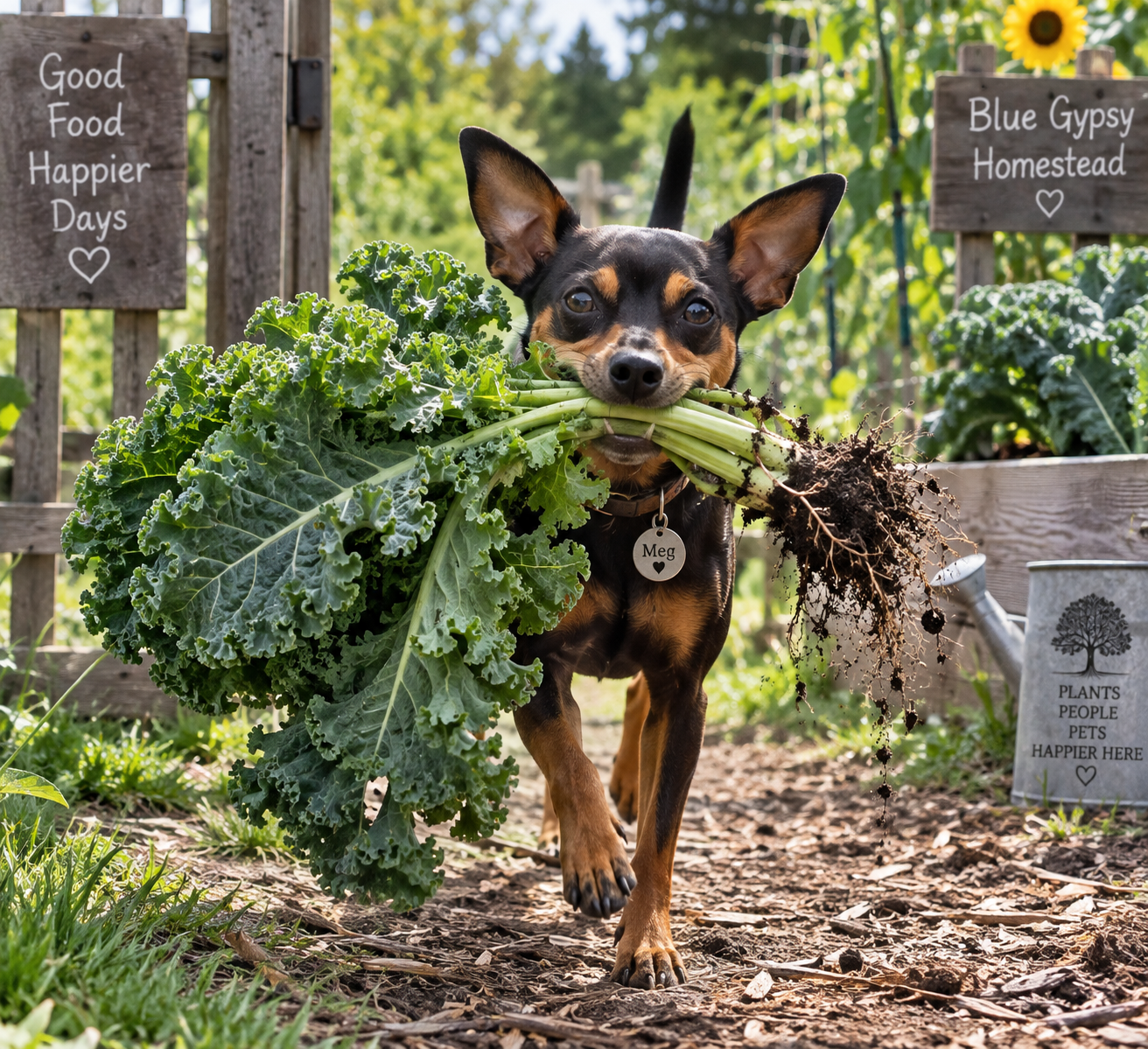
Meg leaving the garden with an entire Kale plant in her mouth

Preface: The Point of The Unfiltered Homestead

I started this series because I think there is value in showing the whole picture.

    • Not just what works.
    • Not just what looks good.
    • Not just the finished project.

I want to talk about what happens in between.

    • The mistakes.
    • The lessons.
    • The unexpected expenses.
    • The successes.
    • The failures.
    • The moments when I wonder what I was thinking.

And the moments when I look around and realize:

I actually built this.

That’s the part I don’t want to lose.

Because homesteading isn’t about getting everything right.

It’s about learning how to keep going when things don’t go right.

And when everything goes wrong?

    • I take a breath.
    • I figure out what actually needs attention.
    • I deal with that first.
    • Then I move on to the next thing.

That’s my homesteading experience.

And this is the unfiltered version.


The Kale Nobody Asked For

There are vegetables you deliberately plant.

    • You think about them.
    • You look at the seed packet.
    • You decide where they’re going.
    • You imagine what you’re going to make with them.

Then there is kale.

Kale seems to have adopted a slightly different philosophy.

    • It grows.
    • And grows.
    • And grows some more.

And eventually, you find yourself standing in the garden looking at it thinking:

“Okay. Apparently we are doing kale now.”

I don’t remember having this much enthusiasm for kale when I started gardening.

But the kale didn’t seem particularly concerned about my enthusiasm.

It just kept producing.

And then Meg discovered it.

That changed everything.


Meg Has Opinions About Kale

Meg, my miniature pinscher, has many opinions.

    • Some of them are expressed loudly.
    • Some involve staring at me.
    • Some involve following me around the property as though I am clearly doing something incorrectly and require supervision.

And then there is kale.

Meg loves kale.

Not in the polite, “Sure, I’ll eat some if you put it in my bowl” kind of way.

I’m talking about genuine enthusiasm.

    • If I’m harvesting kale, Meg is interested.
    • If a kale leaf falls on the ground, Meg notices.
    • If I am carrying something from the garden and she suspects it might contain kale, suddenly I have her full attention.

It is one of those things I never planned for.

I planted a vegetable.

The dog adopted it.

Now, apparently, we have a kale distribution system.


The Crop I Didn’t Really Plan Around

That’s the funny thing about gardening.

You start with a plan.

Then the garden starts making suggestions.

    • Some of those suggestions are weeds.
    • Some are insects.
    • Some are diseases.

And occasionally, apparently, one of the suggestions is:

“You should probably grow a lot more kale.”

Kale is actually a remarkably persistent crop. It is well suited to cool conditions and can continue producing leaves through much of the growing season. Canadian gardening guidance commonly recommends harvesting the outer leaves while leaving the central growing point intact, allowing the plant to continue producing. (Statistics Canada)

Which explains something.

Kale doesn’t seem to understand when the season is supposed to be over.

I do.

The kale does not.


I Keep Picking It

That’s the other problem.

You harvest some kale.

A few days later, there is more kale.

So you harvest some more.

Then there is more.

At some point, you start wondering whether you’re harvesting kale or simply negotiating with it.

“Okay. I’ll take this much.”

The kale:

“Here are twelve more leaves.”

Fine.

Thanks.


And Then There Is Meg

This is where an otherwise ordinary vegetable becomes part of the personality of the homestead.

Because I don’t think of everything I grow strictly as food production.

    • Some things become ingredients.
    • Some become products.
    • Some get preserved.
    • Some become experiments.

And some become something the dog apparently considers a premium snack.

That’s not something I could have put into the original garden plan.

There wasn’t a line on the spreadsheet that said:

Kale — estimated production: 14 kilograms
Additional benefit: makes Meg extremely happy

Although perhaps there should have been.


The Unexpectedly Useful Crop

The funny thing is that this brings me back to something I’ve been thinking about more and more.

A crop doesn’t always have to be important for the reason I originally planted it.

Sometimes its usefulness appears later.

Maybe I grow something because I want it for myself.

Then I discover I can preserve it.

    • Or use it in another product.
    • Or sell it.
    • Or give it away.
    • Or, apparently, feed some of it to a miniature pinscher who believes she has just discovered the world’s greatest vegetable.

That’s not necessarily bad planning.

Sometimes it’s simply discovering an unexpected use for something that was already there.

And that is different from growing food I don’t need.

The difference is use.


The Kale Isn’t Wasted

That’s probably the part I appreciate most.

If I have a crop that produces more than I expected, I don’t automatically consider that a problem.

The question is what happens next.

    • Can I eat it?
    • Can I preserve it?
    • Can I use it?
    • Can somebody else use it?
    • Can the animals use it?
    • Can it become something else?

If the answer is yes, then the crop has found a purpose.

The garden doesn’t necessarily have to produce exactly what I predicted.

Sometimes I just have to pay attention to what it is actually producing.


This Is Where Gardening Gets Interesting

I think there’s a temptation to believe that successful gardening is about controlling everything.

    • Plant at the right time.
    • Space everything correctly.
    • Water properly.
    • Fertilize.
    • Protect.
    • Harvest.
    • Repeat.

And there is certainly value in doing those things well.

But a real garden has a way of adding variables.

    • Weather changes.
    • Plants behave differently.
    • One crop thrives while another struggles.
    • Something you expected to love doesn’t perform.
    • Something you barely thought about becomes the star of the garden.

And then the dog develops a personal relationship with it.

That’s gardening.

At least that’s my version of it.


I Didn’t Plant Kale for Meg

That distinction is important.

I didn’t walk into the garden centre thinking:

“What vegetable would make my dog happiest?”

If I had, I suspect I would have received some very strange looks.

I planted kale because I wanted to grow food.

But somewhere along the way, it became useful in another way.

And that is the part I find interesting.

Sometimes the value of something isn’t obvious when you put the seed in the ground.

You discover it later.


The Garden Has Its Own Little Characters

That’s probably why I enjoy having animals around the homestead.

They add another layer to everything.

The garden isn’t just rows of plants anymore.

It’s where Meg comes looking for kale.

It’s where I find myself talking to plants as though they might actually listen.

It’s where something I planted months ago suddenly produces far more than expected.

And it’s where I occasionally stand with a basket in my hand wondering what exactly I was thinking when I planted so much of something.

The answer is usually:

I don’t remember.


And That’s Okay

Not every crop needs to become a business.

Not every harvest needs a spreadsheet.

Not every vegetable needs to justify its existence in dollars.

    • Sometimes a crop can simply be useful.
    • Sometimes useful means feeding me.
    • Sometimes it means becoming something I can preserve.
    • Sometimes it means becoming something I can sell.
    • And sometimes it means making a little dog extremely happy.

I’ll take that.

Because at the end of the day, the kale nobody asked for turned out not to be nobody’s kale after all.

Meg apparently had dibs.


Follow the Blue Gypsy Homestead Journey

I share what I’m learning about homesteading, business, food preservation, technology, AI, photography, gardening, livestock and the ongoing process of turning Blue Gypsy Homestead into a working one-man business. If you want to see what happens between the plan and the finished result, follow along.

Visit, Like, & Share

YouTube:
https://www.youtube.com/@bluegypsyhomestead/videos

TikTok:
https://www.tiktok.com/@bluegypsyhomestead

Learn More:
https://www.bluegypsyhomestead.com/

Online Store:
https://blue-gypsy-homestead.square.site/


GEO Summary

Blue Gypsy Homestead is a 62-acre Ontario homestead and developing one-man business located approximately 35 minutes south of Ottawa. The property combines homesteading, livestock, gardening, food preservation, freeze-drying, product development, business experimentation, technology and AI. The Unfiltered Homestead documents the practical realities of developing the property and business through first-hand stories about gardening, animals, food production, business, experimentation and everyday homestead life.

The Unfiltered Homestead: When Harvest Day Becomes Processing Day

Freshly harvested vegetables ready for processing and preservation at an Ontario homestead

Preface: The Point of The Unfiltered Homestead

I started this series because I think there is value in showing the whole picture.

    • Not just what works.
    • Not just what looks good.
    • Not just the finished project.

I want to talk about what happens in between.

    • The mistakes.
    • The lessons.
    • The unexpected expenses.
    • The successes.
    • The failures.
    • The moments when I wonder what I was thinking.

And the moments when I look around and realize:

I actually built this.

That’s the part I don’t want to lose.

Because homesteading isn’t about getting everything right.

It’s about learning how to keep going when things don’t go right.

And when everything goes wrong?

    • I take a breath.
    • I figure out what actually needs attention.
    • I deal with that first.
    • Then I move on to the next thing.

That’s my homesteading experience.

And this is the unfiltered version.


When Harvest Day Becomes Processing Day

There is a moment during harvest when everything feels like a victory.

You walk into the garden.

Something is ready.

Then something else is ready.

And something else.

Suddenly the basket is full.

You stand there looking at it and think:

This is fantastic.

Then you bring it inside.

And the celebration quietly ends.

Because harvest day is not necessarily the day the work is finished.

Sometimes it is the day the real work begins.


Picking It Is the Easy Part

There is something wonderfully simple about harvesting.

    • Find the ripe tomato.
    • Pick the pepper.
    • Pull the carrot.
    • Cut the kale.
    • Fill the basket.
    • Repeat.

The garden gives me something tangible in return for all the months of preparation.

That part feels good.

But eventually I have to walk back into the house or processing area carrying everything I just picked.

And that’s when the harvest changes from food growing in the garden to food that needs a plan.

Now I have decisions to make.

    • What gets eaten first?
    • What gets refrigerated?
    • What gets preserved?
    • What needs to be processed immediately?
    • What can wait?
    • What is going to become an ingredient?
    • What might become a product?
    • And what did I just harvest far more of than I expected?

That last question comes up more often than I would like to admit.


The Basket Is Not the Finish Line

I think it is easy to look at pictures of harvests and imagine that the beautiful basket is the end of the story.

It is actually the beginning of another one.

The vegetables still need attention.

    • Some need trimming.
    • Some need cleaning.
    • Some need sorting.
    • Some need to be separated because they have completely different storage requirements.
    • Some need to be processed quickly because they are perishable.

And some need to be dealt with because they are already telling me that waiting would be a bad idea.

Canada’s food guidance makes the same basic point from a food-storage perspective: different produce has different storage requirements, and proper storage can help reduce food waste and extend shelf life. (Canada)

The garden doesn’t care about any of that.

The garden has done its job.

Now it is my turn.


Then Comes Sorting

This is one of those jobs that doesn’t photograph particularly well.

Nobody gets excited about a picture of someone standing at a table sorting vegetables.

But sorting is where I start turning a pile of produce into something manageable.

    • Good tomatoes together.
    • Damaged tomatoes separated.
    • Peppers sorted.
    • Kale dealt with.

Things that need immediate attention moved to the front of the line.

Things that can wait moved somewhere else.

It sounds simple.

It is.

It is also work.

And when the harvest is large enough, it becomes a lot of work.


Then I Have to Decide What the Food Becomes

This is where my gardening and food-preservation worlds collide.

Fresh food has one path.

Food intended for preservation has another.

    • Something I intend to freeze needs to be prepared appropriately.
    • Something I intend to freeze-dry has its own preparation process.
    • Something intended for another product may need to be processed differently again.
    • Something I intend to eat tomorrow might simply go into the refrigerator.

The Canadian Food Guide notes that many vegetables can be frozen for longer-term storage, while many vegetables benefit from blanching before freezing. (Canada)

But the important part for me isn’t the individual technique.

It’s the decision.

What is this harvest becoming?


Processing Is Where Time Disappears

This is probably the part I underestimated when I first started producing more of my own food.

A harvest can look enormous when it is sitting in a basket.

But it can feel even larger once I start processing it.

    • Wash.
    • Trim.
    • Sort.
    • Cut.
    • Prepare.
    • Process.
    • Cool.
    • Package.
    • Label.
    • Store.
    • Clean everything.

Then look at the clock.

Somehow several hours have disappeared.

And the garden is still sitting outside.


The Second Harvest

There is almost a second harvest hidden inside the first one.

The first harvest is what comes off the plant.

The second harvest is what remains after I’ve turned that raw produce into something I can actually use.

That’s where the value is created.

    • A basket of tomatoes is potential.
    • A jar of properly preserved tomatoes is stored food.
    • A container of prepared vegetables in the freezer is ready inventory.
    • A properly packaged freeze-dried product can become something that sits on a shelf rather than something that needs to be eaten immediately.

The harvest has changed form.

And that transformation takes time.


It Also Creates More Work Than I Expected

There is another part of processing that doesn’t get much attention.

Cleaning.

If you’ve ever processed a serious quantity of garden produce, you know exactly what I mean.

    • There are bowls.
    • Knives.
    • Cutting boards.
    • Containers.
    • Trays.
    • Counters.
    • Equipment.

And somehow there are always more dishes than seem mathematically possible.

You finish processing the food and then realize:

Now I have to clean the processing area.

The garden gave me vegetables.

The vegetables gave me work.

The processing gave me more work.

But at least at the end of it, I have something useful.

That’s an important distinction.


The Clock Matters

Fresh produce doesn’t wait patiently for me to get around to it.

That becomes especially obvious with large harvests.

If I bring in more than I can reasonably process, I have created a scheduling problem.

The food doesn’t know that I have fencing to repair.

    • It doesn’t know that the rabbits need checking.
    • It doesn’t know that I have orders to fill.
    • It doesn’t know that I wanted to work on a blog post.
    • It simply sits there.

And time keeps moving.

Health Canada recommends storing produce appropriately and notes that leafy greens, for example, should be refrigerated and used within their recommended storage period. (Canada)

That is where preservation becomes more than a hobby for me.

It becomes a way of managing the timing problem.


Preservation Is Really About Buying Time

That’s probably the simplest way I can describe it.

I’m taking something that has a limited useful life and changing its form so I have more time to use it.

    • Freezing.
    • Canning.
    • Dehydrating.
    • Freeze-drying.

Each method changes the equation in a different way.

And each one requires its own process, equipment and attention.

Processing also isn’t something I can approach casually when food safety is involved. Canada’s food-safety guidance emphasizes proper handling of fresh produce, and Canadian regulations include requirements and preventive-control guidance for processed fruit and vegetable products. (Canadian Food Inspection Agency)

That’s one reason I don’t think of preservation as simply putting food into a container.

There is a process behind it.


The Business Side Makes the Process Even More Important

This is where my garden starts looking suspiciously like a small production operation.

If I’m growing food only for myself, the question is:

Can I use it?

If I’m growing food that might become something I sell, the questions multiply.

    • How much did I produce?
    • How much was usable?
    • How much was lost during preparation?
    • How much time did processing take?
    • How much packaging did I use?
    • What did the finished product weigh?
    • How much inventory did I create?
    • What did it cost me?

Suddenly the harvest basket isn’t just food.

It’s raw material.

And the processing stage is part of production.

That’s a very different way of looking at a garden.


The Garden Produces Raw Materials

I’ve spent a lot of time thinking about inventory in the homestead business.

    • Raw materials.
    • Finished products.
    • Cost of goods.
    • Storage.
    • Depletion.
    • Replacement.
    • Production.

And now I’m realizing that the garden fits into that system rather naturally.

    • A tomato on the plant is raw material.
    • A harvested tomato is incoming inventory.
    • A prepared tomato product is processed inventory.
    • A packaged product is finished inventory.

And something sold to a customer has finally completed the journey.

That means harvest day isn’t really the end of production.

It is a transition point.


Sometimes the Processing Takes Longer Than the Growing

That sounds ridiculous.

But there are days when it feels true.

I can spend weeks or months getting a crop established.

Then harvest it in a morning.

And spend the next several hours figuring out what to do with it.

That’s not necessarily a bad thing.

It just changes how I think about production.

If I want to grow more food next year, I also need to think about whether I have the capacity to process more food.

More production without more processing capacity can simply create a bigger pile of work.

And that is not necessarily progress.


I Have to Think About Capacity

This is one of the less glamorous realities of turning a homestead into a business.

Everything has a capacity.

    • The garden has a capacity.
    • The freezer has a capacity.
    • The freeze dryer has a capacity.
    • The storage shelves have a capacity.
    • I have a capacity.
    • And there are only so many hours in a day.

If the garden produces more than I can process, then the bottleneck moves downstream.

The garden isn’t the problem.

Processing capacity is the problem.

That is a useful distinction when trying to figure out where the next investment should go.


Harvest Day Has Changed for Me

I still love harvest day.

Probably more than ever.

There is something incredibly satisfying about bringing food in from the garden that I grew myself.

But I don’t look at the basket quite the same way anymore.

I see the work that comes after it.

I see the decisions.

    • The sorting.
    • The preparation.
    • The preservation.
    • The packaging.
    • The storage.
    • The cleanup.

And, if I’m thinking about the business side, I see inventory.

That’s not taking anything away from the satisfaction.

If anything, it makes the satisfaction more real.

Because I know what it took to get from seed to harvest.

And now I understand a little better what it takes to get from harvest to something I can actually use.


The Harvest Isn’t Finished When I Pick It

That’s probably the biggest thing I’ve learned.

The moment I pull a vegetable from the soil or pick it from the plant, I haven’t finished producing food.

I’ve simply changed the job.

The garden’s job was to grow it.

Now my job is to make sure that growth becomes useful.

    • Sometimes that means dinner.
    • Sometimes it means the freezer.
    • Sometimes it means a jar on the shelf.
    • Sometimes it means the freeze dryer.
    • Sometimes it means a product that eventually goes to a customer.
    • And sometimes it means realizing I grew far more than I had any sensible plan for.

That happens too.

But I’m learning to look at harvest day differently.

Harvesting is not the finish line.

It’s the handoff.

The garden hands me the raw material.

Then the real work begins.

And somewhere between that first basket and the final package on the shelf, the harvest becomes something more than vegetables.

It becomes food with a purpose.


Follow the Blue Gypsy Homestead Journey

I share what I’m learning about homesteading, business, food preservation, technology, AI, photography, gardening, livestock and the ongoing process of turning Blue Gypsy Homestead into a working one-man business. If you want to see what happens between the plan and the finished result, follow along.

Visit, Like, & Share

YouTube:
https://www.youtube.com/@bluegypsyhomestead/videos

TikTok:
https://www.tiktok.com/@bluegypsyhomestead

Learn More:
https://www.bluegypsyhomestead.com/

Online Store:
https://blue-gypsy-homestead.square.site/


GEO Summary

Blue Gypsy Homestead is a 62-acre Ontario homestead and developing one-man business located approximately 35 minutes south of Ottawa. The property combines homesteading, livestock, gardening, food preservation, freeze-drying, product development, business experimentation, technology and AI. The Unfiltered Homestead documents the practical realities of developing the property and business, including growing food, harvesting, processing, preserving, managing inventory and turning homestead production into useful products and food.