The Unfiltered Homestead: When the Budget Says No

The Point of The Unfiltered Homestead Series

I’m starting this series because I think there is value in showing the whole picture.

      • Not just what works.
      • Not just what looks good.
      • Not just the finished project.

I want to talk about what happens in between.

      • The mistakes.
      • The lessons.
      • The unexpected expenses.
      • The successes.
      • The failures.
      • The moments when I wonder what I was thinking.

And the moments when I look around and realize:

I actually built this.

That’s the part I don’t want to lose.

Because homesteading isn’t about getting everything right.

It’s about learning how to keep going when things don’t go right.

And when everything goes wrong?

      • I take a breath.
      • I figure out what actually needs attention.
      • I deal with that first.
      • Then I move on to the next thing.

That’s my homesteading experience.

And this is the unfiltered version.

When the Budget Says No

There are a lot of decisions on a homestead that come down to one simple question:

Can I afford it?

      • Sometimes the answer is yes.
      • Sometimes I can find a way to make it work.
      • And sometimes, despite how much I want something, how useful it would be, or how much easier it would make my life…

The budget says no.

That’s one of the less glamorous parts of building Blue Gypsy Homestead into a working homestead and business.

It isn’t always about whether something is a good idea.

Sometimes it’s about whether I have the money to make the idea happen right now.

And there is a big difference between those two things.

Welcome back to The Unfiltered Homestead.

This series is about the reality behind the photographs—the mistakes, failed crops, unexpected expenses, exhaustion, business challenges and all the other things that don’t necessarily make for a pretty social media post.

This one is about something I’ve had to become increasingly comfortable with:

Sometimes the answer is no.


I Have Lots of Ideas

That’s probably part of my problem.

      • I have ideas.
      • Lots of them.
      • I see something that could be improved and immediately start thinking about how I could build it.
      • I see a piece of equipment and start thinking about what I could accomplish with it.
      • I see an empty piece of property and start imagining what could be done with it.
      • I think about new products.
      • New crops.
      • New livestock projects.
      • New preservation techniques.
      • New ways of marketing the business.
      • New services I could offer.
      • New ways to make the homestead more productive.

The problem is that ideas are free.

Making them happen isn’t.


The Homestead Has a Very Long Wish List

If money were unlimited, I could probably keep myself busy for years.

      • There are buildings that could be improved.
      • Infrastructure that could be upgraded.
      • Equipment that would make certain jobs easier.
      • Tools that would save time.
      • Storage that would make things more organized.
      • Garden improvements.
      • Animal housing improvements.
      • Processing equipment.
      • Packaging equipment.
      • Marketing materials.
      • And a seemingly endless list of things that would be “nice to have.”

But I’m not operating with an unlimited budget.

I’m operating a 62-acre homestead and trying to build a small business at the same time.

That means every purchase has to compete with every other purchase.

And sometimes something that would be useful simply doesn’t make the cut.


That’s Where “No” Comes In

I’ve learned that there are several different kinds of “no.”

There’s:

No, I don’t need it.

There’s:

No, I can’t afford it.

There’s:

No, I can’t afford it yet.

And there’s:

No, not until the business can pay for it.

Those are very different answers.

The last two are particularly important to me.

Just because I can’t afford something today doesn’t mean I will never be able to afford it.

It may simply mean that I need to work toward it.

That’s actually a much more positive way of looking at a financial limitation.


“Not Yet” Is a Legitimate Answer

I’ve had to get comfortable with this phrase.

Not yet.

      • It doesn’t mean the idea is dead.
      • It means I’m putting it on the list.
      • Maybe I need to generate more revenue first.
      • Maybe I need to reduce another expense.
      • Maybe I need to find a used version.
      • Maybe I need to rent the equipment instead.
      • Maybe I need to figure out whether I can build something myself.
      • Maybe I need to find another way to accomplish the same goal.

Sometimes the solution isn’t having more money.

It’s finding a different solution.


Renting Instead of Buying

Equipment is a perfect example.

There are machines and tools that would be incredibly useful for certain projects.

But if I use something twice a year, buying it doesn’t necessarily make financial sense.

Why own something that’s going to spend most of its life sitting in a shed?

      • It costs money to purchase.
      • It takes up space.
      • It depreciates.
      • It may need maintenance.
      • And when I eventually need it again, there’s a good chance I’ll have forgotten where I put it.

Sometimes renting makes much more sense.

      • I pay for it when I need it.
      • I use it.
      • I return it.
      • Done.
      • If I eventually discover that I’m renting the same equipment often enough that ownership makes financial sense, then I can reconsider.

That’s a much better financial decision than buying something simply because I want it.


Used Equipment Can Change the Equation

I’ve also become much more interested in used equipment.

There is something particularly satisfying about finding a piece of equipment that someone else no longer needs and giving it another life.

Of course, I have to be careful.

Cheap isn’t necessarily inexpensive.

If I buy something for $200 and immediately have to spend $500 repairing it, I haven’t saved money.

But if I can find a solid piece of equipment at a reasonable price, it can make a project possible without blowing the budget.

That’s particularly important when I’m building a business from the ground up.


Sometimes I Have to Build It Myself

I’ve spent more than 35 years working in IT, business analysis, project management and process improvement.

One thing that experience has taught me is that there is usually more than one way to solve a problem.

That applies to physical problems too.

If I can’t afford the perfect solution, I start looking for an acceptable one.

      • Can I build it?
      • Can I modify something I already own?
      • Can I repurpose something?
      • Can I repair what I have?
      • Can I change the process instead of buying something to fix the process?

That last one can be particularly powerful.

Sometimes I don’t need another piece of equipment.

I need a better process.


The Business Has to Pay for Itself

This is probably one of the biggest differences between running a homestead and running a homestead business.

When I’m doing something purely for myself, I can justify an expense because I want it.

Once I’m thinking about the business, the question changes.

What does this purchase do for the business?

      • Does it reduce costs?
      • Does it save time?
      • Does it increase production?
      • Does it improve quality?
      • Does it create a new product?
      • Does it create a new service?
      • Does it generate revenue?

If I can’t answer those questions, I need to think carefully before spending the money.


I Can’t Spend Revenue Twice

This sounds obvious.

It isn’t always obvious when you’re excited about a new idea.

Suppose I make some sales.

There’s a temptation to look at that money and think:

“Great! I can buy that thing I’ve been wanting.”

Except that money may already have a job.

      • It might need to cover inventory.
      • Packaging.
      • Feed.
      • Utilities.
      • Market expenses.
      • Taxes.
      • Repairs.
      • Or the next round of production.

Revenue isn’t automatically available cash.

That’s something I’m becoming much more disciplined about.


Cash Flow Has a Way of Getting My Attention

I’ve talked before about the money problems involved in running a small homestead business.

Cash flow is one of the biggest.

I can have a profitable product and still have a cash-flow problem.

That’s because I have to spend money before I can make money.

      • I need the ingredients.
      • I need the packaging.
      • I need the equipment.
      • I need the time.
      • Then I have to sell the product.

That means I can’t simply look at my sales and decide that I have money available for whatever catches my attention next.

The money has to be allocated.


Sometimes the Budget Says No to a Good Idea

This is probably the hardest part.

      • What if the idea is actually good?
      • What if I know it could work?
      • What if I know there’s a market for it?
      • What if the equipment would make my life easier?

And I still can’t afford it?

That’s frustrating.

But I’ve learned that a good idea at the wrong time is still the wrong investment.

I have to distinguish between:

“This is a bad idea.”

and

“This is a good idea that I can’t afford yet.”

That distinction keeps me from throwing away good ideas simply because the timing isn’t right.


That’s How Some Ideas End Up on the Shelf

I have a mental list of projects I’d like to pursue.

      • Some are realistic right now.
      • Some aren’t.
      • Some require more money.
      • Some require more time.
      • Some require more space.
      • Some require additional research.
      • Some require customers that I haven’t found yet.

That doesn’t mean I’ve abandoned them.

They’re simply waiting.

And there’s nothing wrong with waiting.


I Don’t Need to Do Everything

This is another lesson I’m learning.

There is a temptation, particularly with homesteading, to think that I should be doing everything.

      • Grow all my own food.
      • Raise animals.
      • Preserve everything.
      • Build everything.
      • Make everything.
      • Sell everything.
      • Become completely self-sufficient.
      • Run a successful business.
      • Create content.
      • Maintain the property.
      • And somehow still have time to sit down with a cup of coffee.

That’s not realistic.

At least not for one person.

I’ve had to decide what matters most.


Limited Money Forces Me to Prioritize

There’s actually a benefit to having a limited budget.

It forces me to prioritize.

If I had unlimited money, I could say yes to everything, which in and of itself is not a wise idea.

Because I don’t, I have to ask:

What’s most important?

      • What needs to happen now?
      • What can wait?
      • What will generate the greatest return?
      • What protects what I’ve already invested?
      • What will save me the most time?
      • What will make the biggest difference?

Those questions help me make better decisions.

There is an old joke that I told when I ran the winery and it was adapted to farming:

How do you get $1,000,000 from farming?

Start with $2,000,000.


I Look for Multiple Uses

One of the best ways I’ve found to stretch a dollar is to make sure whatever I buy or build has more than one purpose.

That’s particularly useful on a small homestead.

      • A piece of equipment that can support several products is more valuable than something that performs one very specialized task.
      • A garden crop that can be eaten fresh, canned, frozen, freeze-dried or turned into another product gives me options.
      • An ingredient that can become several different products gives me more flexibility.

The more uses I can get from the same resource, the better.


That’s Part of the Thinking Behind Freeze-Drying

My freeze dryer is a good example.

      • I can use it to preserve food for myself.
      • I can preserve garden surplus.
      • I can experiment with products.
      • I can develop new offerings.

And I’ve also started offering custom freeze-drying services.

That doesn’t mean the machine magically became inexpensive.

It means I’ve tried to make the investment work harder by making use of the machine’s idle time.

Instead of having one expensive piece of equipment perform one job, I’m looking for multiple ways it can contribute to the homestead and business.

That’s how I need to think about larger investments.


The Garden Has to Work Hard Too

I’m starting to look at crops in a similar way.

If I have limited garden space, what gives me the greatest return from that space?

      • A crop that provides one meal is useful.
      • A crop that provides fresh food throughout the season, can be preserved for later and can potentially become an ingredient in something I sell is considerably more interesting.

That’s not to say everything has to become a commercial product.

Some things are grown because I like them.

But when I’m thinking about the business, I have to consider the bigger picture.


Sometimes the Answer Is to Wait for the Money

There is nothing wrong with saving for something.

I think we’ve become accustomed to the idea that if we want something, we should be able to get it immediately.

Credit makes that particularly easy.

But debt doesn’t make an expense disappear.

It simply moves the problem into the future.

For the homestead, I’d rather wait when I can.

      • Save.
      • Research.
      • Compare options.
      • Look for used equipment.
      • Find alternatives.

Then make the purchase when the numbers make sense.

It may take longer.

That’s okay.


I Don’t Want the Homestead Buried in Debt

This is especially important because I’m trying to build something sustainable.

Taking on debt to purchase something that will genuinely increase production and revenue can sometimes make sense.

Taking on debt because I simply want something is another matter.

I don’t want the homestead to become a collection of monthly payments.

The whole point of what I’m building is to create greater independence.

It wouldn’t make much sense to create another kind of dependence in the process.


Frugality Doesn’t Mean Cheap

I’ve had to learn this distinction too.

Being frugal doesn’t mean buying the cheapest thing available.

It means making the money work.

      • Sometimes the cheapest option is exactly the right choice.
      • Sometimes spending more upfront saves money over the long term.
      • Sometimes buying used is smart.
      • Sometimes renting is smart.
      • Sometimes doing nothing is smart.

The goal isn’t to spend as little as possible.

The goal is to spend wisely.


There Are Times When I Really Do Need Something

I also don’t want to pretend that everything can be solved with creativity and duct tape.

      • Sometimes something needs to be replaced.
      • Sometimes equipment is necessary.
      • Sometimes an upgrade genuinely saves enough time or money to justify the cost.
      • Sometimes I need professional help.

Being frugal doesn’t mean refusing to spend money.

It means understanding why I’m spending it.

That’s the difference.


I Have to Think About Opportunity Cost

This is a concept I’ve used throughout my professional career, and it applies surprisingly well here.

If I spend $1,000 on one thing, I can’t spend that same $1,000 somewhere else.

So I have to consider what I’m giving up.

Maybe the equipment I want would be useful.

But perhaps the same money could purchase enough inventory to produce several times the amount of revenue.

      • Maybe repairing something makes more sense than replacing it.
      • Maybe investing in marketing would bring more customers than buying another tool.
      • Maybe paying for a service would save me enough time to make it worthwhile.

Every dollar has an opportunity cost.


My Business Background Helps

My college diploma is in Business Administration/Marketing.

I’ve spent decades working with business systems and analyzing processes.

So I naturally tend to look at these decisions from a business perspective.

      • What is the investment?
      • What is the expected return?
      • What are the risks?
      • What alternatives exist?
      • What happens if the plan doesn’t work?
      • What happens if I don’t do it?

Those aren’t always exciting questions.

But they are useful questions.


AI Has Become Another Tool

This is another area where technology can help.

      • I can use AI as a sounding board when I’m considering an idea.
      • I can describe what I’m trying to accomplish and ask it to identify alternatives.
      • I can ask what costs I may have overlooked.
      • I can ask it to help me compare approaches.
      • I can ask for a project breakdown.
      • I can ask it to help organize my thoughts.

But I don’t blindly accept the answer.

AI can be remarkably useful.

It can also be remarkably wrong.

So anything involving money, safety, regulations, technical specifications or business decisions needs to be checked.

AI is another tool in the toolbox.

It isn’t the person signing the cheque.

That remains me.


Sometimes “No” Leads to a Better Idea

This is probably my favourite part.

I’ve had situations where I wanted to do something one way but couldn’t afford the solution.

So I had to find another way.

And sometimes the alternative turned out to be better.

      • Maybe it was simpler.
      • Maybe it used something I already owned.
      • Maybe it created another revenue opportunity.
      • Maybe it took longer but gave me a better understanding of the process.

A financial limitation can force creativity / innovation.

And sometimes that produces better solutions than money would have.


The Homestead Doesn’t Have to Be Finished

This is another thing I remind myself of.

There is no finish line.

I’m not going to wake up one morning and discover that Blue Gypsy Homestead is finally “done.”

      • There will always be something to improve.
      • Something to repair.
      • Something to build.
      • Something to learn.
      • Something to try.

That’s part of the appeal.

So if something has to wait because the budget says no, that’s okay.

It doesn’t have to happen today.


I’m Building This One Piece at a Time

That’s really what Blue Gypsy Homestead has become.

      • One project.
      • One crop.
      • One rabbit.
      • One product.
      • One improvement.
      • One customer.
      • One lesson.
      • One mistake.
      • One dollar at a time.

I’m not starting with unlimited resources.

I’m starting with what I have.

Then I’m trying to make that resource work as hard as possible.

That’s not always easy.

But it is realistic.


The Unfiltered Truth

There are days when I see something I would love to buy and immediately know I can’t justify the expense.

      • Sometimes that’s frustrating.
      • Sometimes I have to put an idea aside.
      • Sometimes I have to wait.
      • Sometimes I have to find a cheaper alternative.
      • Sometimes I have to rent.
      • Sometimes I have to build it myself.
      • And sometimes I have to simply say: No. Not right now.

I’ve learned that isn’t failure.

It’s financial discipline.

The idea can stay on the list.

The opportunity can stay on the horizon.

And if I build the business properly, maybe one day the budget will say yes.

Until then, I have plenty of other things to do.


When the Budget Says No

I’ve started to see “no” differently.

It’s not necessarily a dead end.

      • Sometimes it’s a pause.
      • Sometimes it’s a challenge.
      • Sometimes it’s an invitation to find another solution.
      • And sometimes it’s the answer that protects me from making a mistake.

Because having something doesn’t automatically make the homestead better.

Buying another piece of equipment doesn’t automatically make the business more profitable.

Starting another project doesn’t automatically move me forward.

Sometimes progress means not spending the money.

That’s a lesson I didn’t necessarily expect when I started this journey.

But it’s one I’m learning to appreciate.


The Homestead I Want to Build

I don’t want Blue Gypsy Homestead to look successful from the outside while quietly drowning financially behind the scenes.

      • I want it to actually work.
      • I want the products to make sense.
      • I want the expenses to make sense.
      • I want the equipment to earn its keep.
      • I want the land to be productive.
      • I want the business to grow at a pace I can support.
      • And I want to be able to look at what I’ve built and know that it isn’t dependent on spending money I don’t have.

That may not be the fastest way to build a business.

But I think it gives me a better chance of building one that lasts.


Sometimes the Most Important Purchase Is the One I Don’t Make

That’s probably the biggest lesson I’ve taken away from all of this.

A purchase can feel like progress.

Sometimes it is.

Sometimes it’s just spending.

There is a difference.

When the budget says no, I have to listen.

Not because I have given up on the idea.

Because I’m trying to protect the bigger idea.

Blue Gypsy Homestead.

      • The farm.
      • The business.
      • The future.
      • And the life I’m trying to build here.

So, for now, some things are going to remain on the wish list.

And that’s okay.

There will be another season.

      • Another opportunity.
      • Another product.
      • Another customer.
      • Another dollar.

And eventually, perhaps, the budget will say:

“Yes.”

Until then, I’ll keep working with what I’ve got.

That’s what homesteading is teaching me.

Do more with less.

And when less really isn’t enough?

Find another way.


🌱 Follow the Blue Gypsy Homestead Journey

I share what I’m learning about homesteading, business, food preservation, technology, AI, photography, gardening, livestock and the ongoing process of turning Blue Gypsy Homestead into a working one-man business.
Visit, Like, & Share — Blue Gypsy Homestead

▶️ YouTube

Follow my homesteading projects, gardening, rabbit raising, food preservation, freeze-drying, product development and the everyday realities of running a homestead by myself.

Blue Gypsy Homestead on YouTube

🎵 TikTok

Follow me for shorter videos, quick updates, behind-the-scenes projects and the occasional homestead lesson learned along the way.

Blue Gypsy Homestead on TikTok

🌱 Learn More

Learn more about Blue Gypsy Homestead, my projects, business services and the journey I’m documenting along the way.

Blue Gypsy Homestead – Learn More

🛒 Online Store

Browse my freeze-dried foods, seasoning salts, smoked seasonings, pre-mixed spice blends, merchandise and other products from Blue Gypsy Homestead.

Blue Gypsy Homestead Online Store


Blue Gypsy Homestead is a 62-acre farm located approximately 35 minutes south of Ottawa, Ontario, Canada. I operate the property as a one-man homestead and small business focused on practical homesteading, gardening, livestock, food preservation, freeze-drying, seasoning products, value-added food products and rural entrepreneurship. The Unfiltered Homestead: When the Budget Says No explores the financial realities of building a homestead and small business with limited resources. I discuss prioritizing purchases, renting equipment that is only occasionally needed, buying used equipment, repairing and repurposing existing resources, evaluating return on investment, managing cash flow and recognizing when a good idea simply needs to wait. My approach is to build Blue Gypsy Homestead sustainably by making careful financial decisions, finding multiple uses for existing resources and growing the business at a pace that the available cash flow can support.
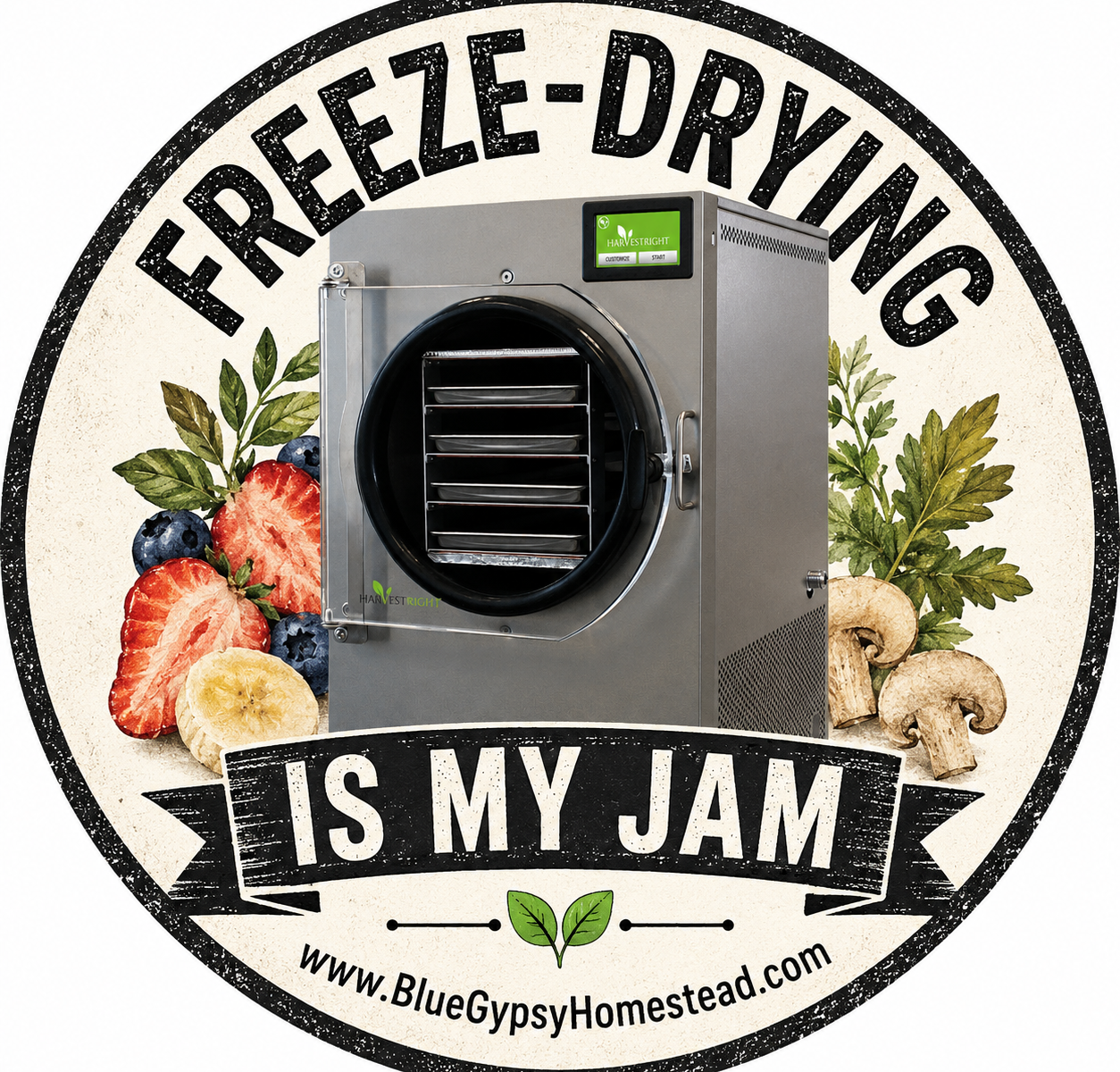
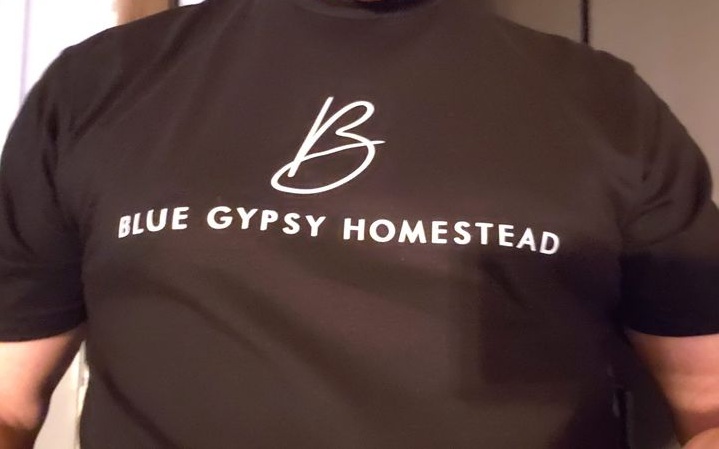
Custom Freezing Drying Service – BLOG 2026-Aug-24

Turning Garden Surplus Into Shelf-Stable Food

There is something deeply satisfying about walking into the garden and realizing you have more food than you can possibly eat.

It is also when the reality of gardening tends to set in.

The tomatoes are ripening faster than we can eat them. The peppers seem to multiply overnight. The zucchini have apparently decided to take over the entire property. Suddenly, that bumper crop you were so proud of becomes a race against time.

For years, the traditional answer has been canning, freezing, pickling, or dehydrating. Those are all excellent ways to preserve food, and we use several of them here at Blue Gypsy Homestead.

But there is another option that has become an increasingly important part of what we do:

freeze-drying.

And now, we’re taking that idea one step further by offering custom freeze-drying services for people who have food they want to preserve but don’t necessarily own a freeze dryer.

When “Too Much” Becomes a Good Problem

One of the funny things about gardening is that you rarely get exactly the amount of food you planned for.

You plant six tomato plants because six seemed reasonable.

Then they all produce.

And produce.

And produce.

Before long, you’re giving tomatoes to neighbours, making sauce, eating tomatoes with everything, and wondering if there is a legal limit to how many tomatoes one household can reasonably possess.

The same thing happens with peppers, berries, herbs, fruit and vegetables.

That surplus represents time, money, water, fertilizer, seeds and a lot of work. Throwing it away because you couldn’t use it quickly enough feels like a waste—and it is.

This is where food preservation becomes more than simply stocking the pantry.

It’s a way of getting the full value out of the food you’ve already grown.

Freeze-Drying Changes the Equation

Freeze-drying removes moisture from food while preserving much of its original shape, flavour, colour and nutritional value.

The finished product is remarkably light and, when properly packaged and protected from moisture and oxygen, can be stored for a long time.

That makes freeze-drying particularly interesting for garden surplus.

Instead of trying to figure out what to do with twenty pounds of tomatoes this week, you can preserve them for later.

Instead of watching berries spoil in the refrigerator, you can turn them into a shelf-stable ingredient.

Instead of having more peppers than you can possibly use fresh, you can preserve them for future meals.

And unlike freezing, freeze-dried food doesn’t require freezer space.

That’s a pretty significant advantage when you’re already trying to make the most of limited storage space.

What Can You Freeze-Dry?

Quite a lot.

Some of the foods that lend themselves particularly well to freeze-drying include:

      • Fruits and berries
      • Tomatoes
      • Peppers
      • Corn
      • Onions
      • Mushrooms
      • Herbs
      • Garden vegetables
      • Cooked meals
      • Snacks and treats

The important thing is understanding that not every food behaves exactly the same way in a freeze dryer.

Some foods need preparation before processing. Others may need to be cut into a particular size or thickness. Foods containing higher amounts of fat can present additional challenges.

That’s one of the reasons we enjoy doing this.

There is a bit of science involved, but there is also plenty of hands-on experience.

From Garden to Pantry

One of my favourite things about preservation is that it changes how you think about the garden.

A garden isn’t just producing food for today’s dinner.

It can produce food for next month, next winter or even much further down the road.

Imagine harvesting a basket of tomatoes in August and still having those tomatoes available months later.

Imagine having your own garden-grown peppers available when the garden is covered in snow.

Imagine pulling a jar of freeze-dried berries from the pantry in January and knowing that those berries came from a summer harvest.

That’s what makes food preservation so appealing to me.

It creates a bridge between abundance and scarcity.

The garden gives us abundance in the summer.

The pantry gives us options when the garden is sleeping.

But What If You Don’t Own a Freeze Dryer?

This is where our new service comes in.

Freeze dryers are incredible machines, but they aren’t exactly an impulse purchase.

They are expensive pieces of equipment. They take up space, require electricity, need regular cleaning and maintenance, and there is a learning curve involved in using them properly.

And honestly, not everyone needs one.

Maybe you have a large garden but only one or two major harvests each year.

Maybe you grow berries but don’t have enough volume to justify buying a machine.

Maybe you inherited a bumper crop from a friend or neighbour.

Maybe you’re simply curious about freeze-drying and want to try it before investing in your own equipment.

That’s why Blue Gypsy Homestead is now offering custom freeze-drying services.

Our Custom Freeze-Drying Service

The basic idea is simple.

You grow it. We freeze-dry it. You get it back.

Instead of buying a freeze dryer, you can have selected foods processed for you.

This can be particularly useful for gardeners who suddenly find themselves with more produce than they can reasonably consume or preserve using traditional methods.

Rather than watching that food deteriorate, we can help turn your surplus into a lightweight, shelf-stable product that can be stored and used later.

And because this is a custom service, the goal isn’t simply to run generic products through a machine.

We’re interested in helping people preserve their food.

That distinction matters.

Why Preserve Your Own Garden Produce?

There is something different about opening a container of food that you grew yourself.

      • You know where it came from.
      • You know what went into growing it.
      • You know that the tomatoes came from your garden, the peppers came from your plants and the berries came from your harvest.
      • You’re not simply buying another packaged food product.
      • You’re preserving a piece of your own harvest.

For us, that’s one of the biggest reasons we got into food preservation in the first place.

Homesteading isn’t necessarily about producing everything yourself.

Sometimes it’s about finding practical ways to make better use of what you already have.

Reducing Food Waste

Food waste bothers me.

Not because I think every single scrap of food needs to be preserved forever, but because growing food takes real resources.

      • There is work involved.
      • There is water.
      • There is soil preparation.
      • There are seeds.
      • There is fertilizer.

There are weeds, insects, weather, wildlife and all the other things that make gardening an adventure.

When the garden finally produces, throwing away a significant portion because we couldn’t use it quickly enough seems like a poor ending.

Preservation gives that food another opportunity.

Instead of:

Garden → harvest → too much → waste

we can create:

Garden → harvest → preserve → pantry → future meals.

That’s a much better use of the work we’ve already put in.

Freeze-Drying Isn’t About Being Perfect

One thing I’ve learned from homesteading is that there is no perfect system.

You can plan the garden perfectly and still lose crops.

You can preserve 50 jars of something and discover your family doesn’t actually like eating it.

You can buy equipment that seemed like a great idea at the time and later wonder what you were thinking.

That’s homesteading.

The goal isn’t perfection.

The goal is figuring out what works for you, making adjustments and getting better over time.

For us, freeze-drying has become one of those tools.

      • It doesn’t replace canning.
      • It doesn’t replace freezing.
      • It doesn’t replace dehydration.

It’s simply another tool in the toolbox.

And now, we’re making that tool available to people who don’t own one themselves.

Is Custom Freeze-Drying Right for You?

If you have a garden surplus that you don’t know what to do with, it may be worth considering.

It could be:

      • A bumper crop of tomatoes
      • More peppers than you can possibly eat
      • Excess berries
      • Garden vegetables
      • Herbs
      • Fruit
      • Cooked foods or meals suitable for freeze-drying
      • Produce you’ve grown specifically for long-term storage

The best place to start is with a conversation about what you have and what you’re hoping to accomplish.

Not everything is a good candidate for freeze-drying, and some foods require particular preparation.

We’ll be happy to discuss the possibilities before you commit your harvest.

Making the Most of What You Grow

For me, this is really what homesteading is about.

It’s not about having the perfect garden.

It’s not about producing absolutely everything yourself.

And it’s definitely not about posting a picture of a perfectly arranged basket of vegetables while ignoring the weeds growing behind it.

It’s about making practical use of what you have.

If your garden produces more than you can eat today, preserve it for tomorrow.

If you don’t own a freeze dryer, you don’t necessarily have to buy one.

And if you’ve got a freezer full of berries, a counter covered in tomatoes or a garden producing more peppers than you know what to do with, we’d love to talk about how we might be able to help.

Your garden worked hard to produce that food. Let’s give it a longer life.


Custom Freeze-Drying at Blue Gypsy Homestead

Our new custom freeze-drying service is designed for gardeners, homesteaders and families who want to preserve their own food without having to purchase and operate a freeze dryer themselves.

Have a surplus you’d like to preserve?

Contact Blue Gypsy Homestead to discuss your project and we’ll help you determine whether freeze-drying is a good fit for your food.


Learn More About Blue Gypsy Homestead

Blue Gypsy Homestead is a 62-acre homestead located approximately 35 minutes south of Ottawa, Ontario. What started as a homestead project has grown into an ongoing experiment in gardening, food preservation, livestock, small-scale agriculture, entrepreneurship and figuring out how to make better use of what we have.

We don’t pretend to have everything figured out.

We’re learning, experimenting, occasionally making spectacular mistakes, and sharing what we discover along the way.

📺 Follow the Blue Gypsy Homestead Journey

Whether it’s raising rabbits, growing food, preserving harvests, building infrastructure, or sharing the realities of homestead life, you’re invited to follow along.

▶️ YouTube

Watch videos about homesteading, gardening, food preservation, rabbit husbandry, DIY projects, and life on a working homestead.

Blue Gypsy Homestead on YouTube

🎵 TikTok

Follow for short videos, quick updates, behind-the-scenes projects, and everyday homestead life.

Blue Gypsy Homestead on TikTok

🌱 Learn More

Read more articles about homesteading, food production, self-sufficiency, gardening, livestock, food preservation, and rural living.

Blue Gypsy Homestead – Learn More

🛒 Online Store

Browse freeze-dried foods, gourmet seasonings, homestead products, merchandise, and other items available from Blue Gypsy Homestead.

Blue Gypsy Homestead Online Store


About Blue Gypsy Homestead

Blue Gypsy Homestead is a 62-acre farm located approximately 35 minutes south of Ottawa, Ontario, Canada. What was once a winery is being transformed into a productive sustenance and market farm focused on growing food, raising livestock, preserving harvests, building practical infrastructure, and increasing self-sufficiency.

Through articles, videos, and real-world experiences, Blue Gypsy Homestead shares the successes, failures, lessons learned, and realities of modern homestead life. There is no expectation that everything will be perfect—and there is definitely no sugar-coating the difficult parts.

Opening New Markets Using T-Shirts – BLOG 2026-Jul-27

After a ridiculously humid few days, it’s finally raining.

Thank the universe.

I managed to get out and cut enough grass to feed the rabbits before the sky opened up, so at least that job is checked off the list. Around a homestead, you learn to take the wins where you can.

With the rain keeping me indoors, I’ve been spending some time working on new T-shirt ideas. Summer tends to be a slower season for sales, with people away on holidays and spending less time thinking about homestead products. Rather than complain about it, I’m trying to use the slower pace to experiment with new ways of supplementing the farm’s income.

One thing I’ve learned over the past couple of years is that a homestead business doesn’t have to be limited to what comes out of the garden or the freeze dryer. Sometimes it’s about creating something that resonates with people.

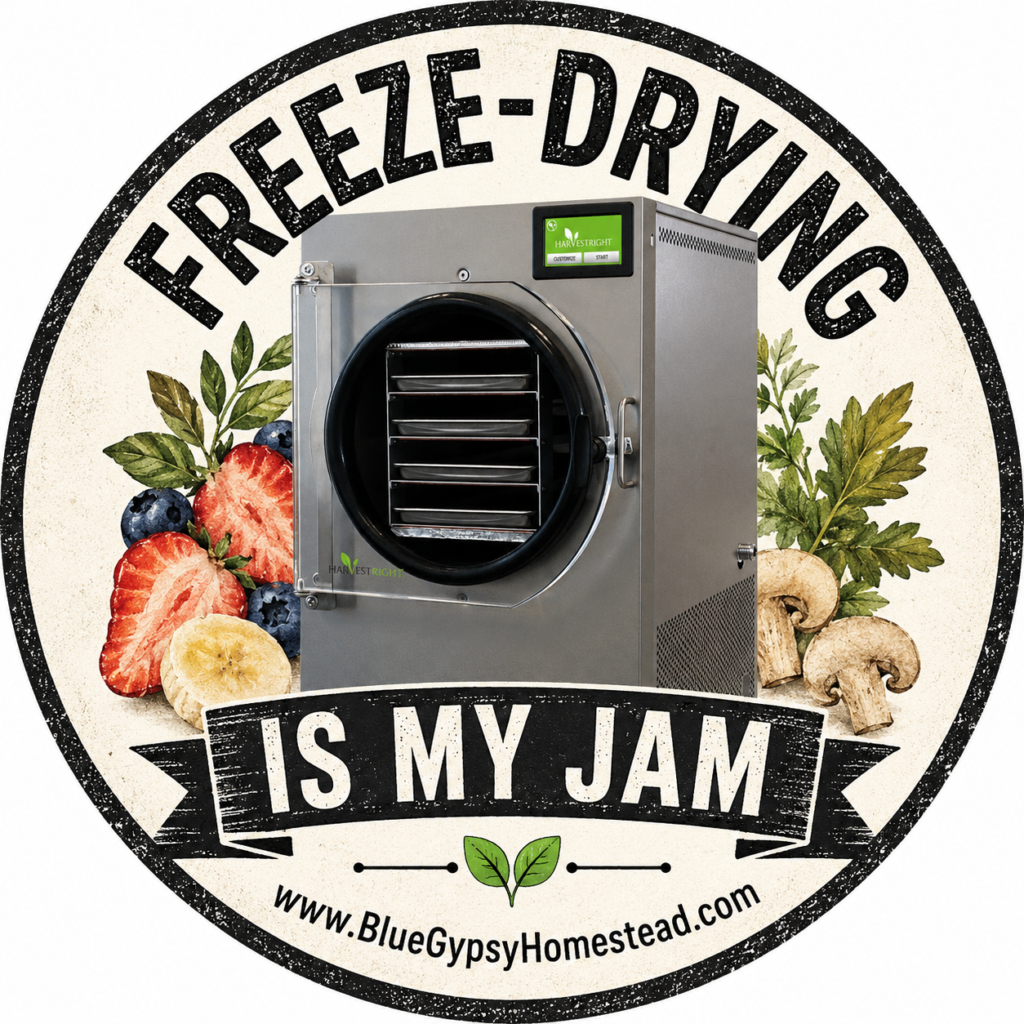
It started with a simple shirt with my logo and the name of the homestead.

Since then, the idea has grown and the shirts are becoming popular.

Supporting the LGBTQ+ Community

As many of you know, I’m an ally. Through both family and close friends, I have a strong connection to the LGBTQ+ community. Supporting people simply because they deserve to feel accepted isn’t something I consider political—it’s just part of who I am.

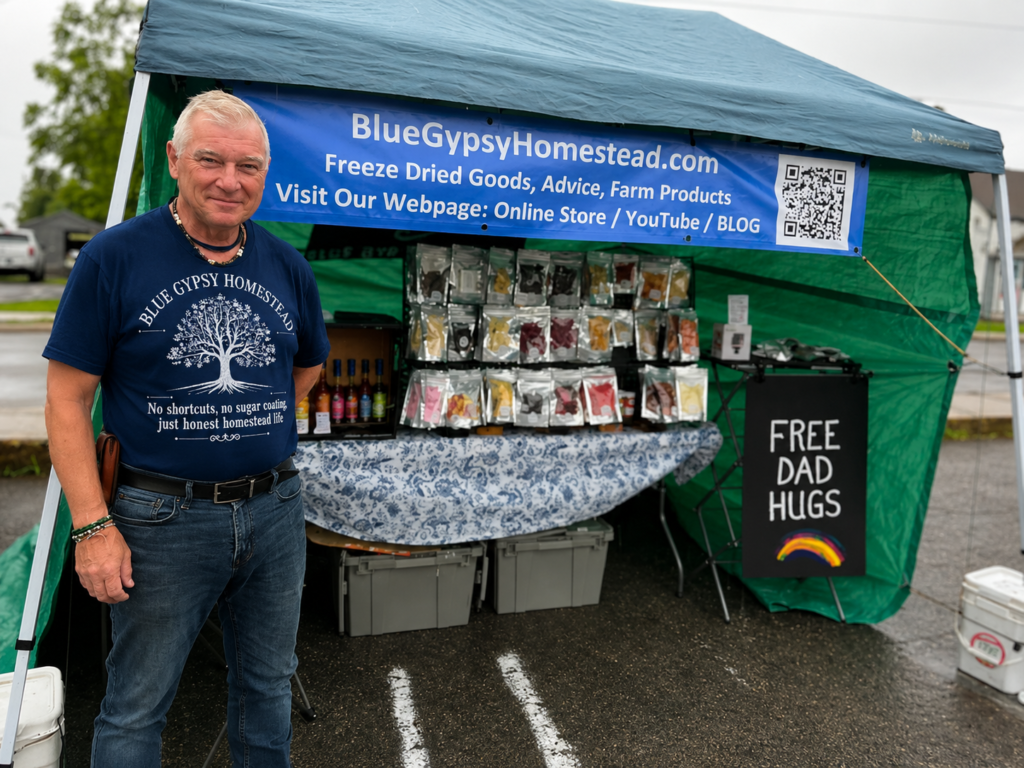
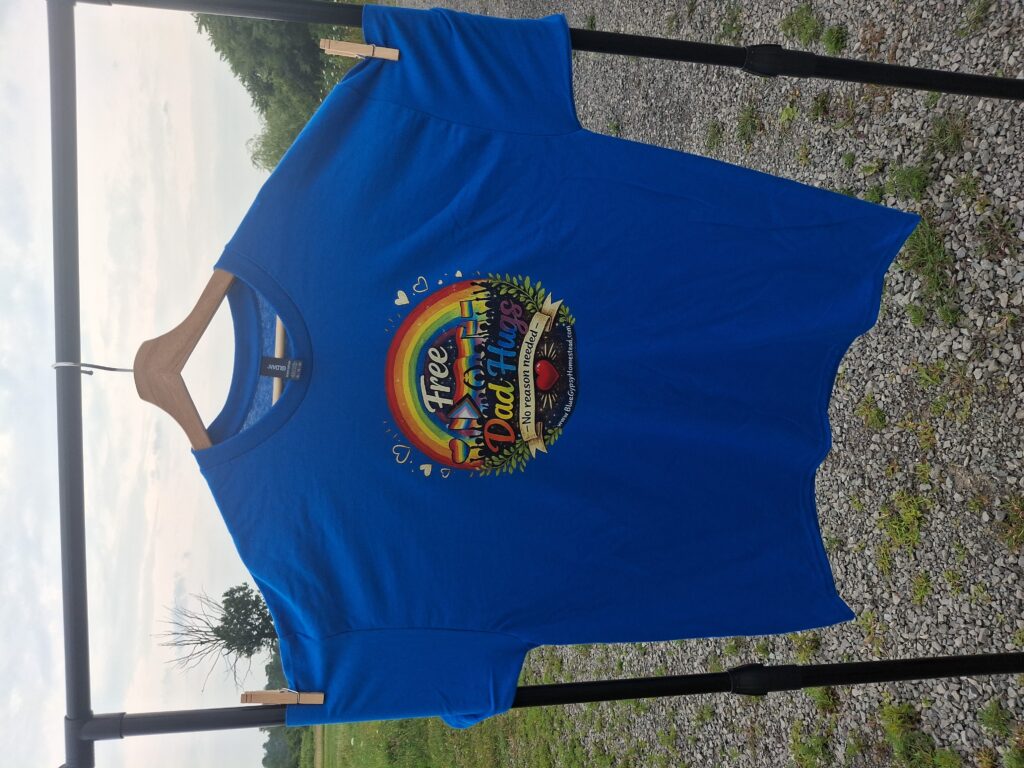
At the farmers’ market, I often display a sign that says “Free Dad Hugs.” Anyone who wants a hug gets one.  No explanation required.

The response has been overwhelmingly positive. Some people smile and keep walking, others stop to chat, and a few have actually taken me up on the offer. To be honest, I was expecting at least a few negative reactions, but so far I’ve never had anyone respond obnoxiously. That gives me hope.

More often than not, people tell me they lost their father years ago. Those stories are heartbreaking, but the one that has stayed with me came from a man who quietly said, “I never had one.”

When I first started offering Free Dad Hugs, my goal was simple: to support people who had been rejected by their parents because of who they are. Over time, I realized those hugs were reaching far more people than I had imagined, for reasons that never entered my mind.

Some had lost a parent. Some had never experienced unconditional acceptance. Others simply needed to know that, for a brief moment, someone cared.

If there’s one thing I hope these hugs accomplish, it’s giving people something they may not have realized they were missing—a moment of kindness, acceptance, and the reminder that they’re not alone.

As a result of that response I released a t-shirt design.

Lately I’ve been working on another design that I’m testing on several platforms. Rather than surrounding myself with people who automatically agree with everything I do, I invite civil feedback. Sometimes people point out things I hadn’t considered. Other times they simply confirm that I’m on the right track.

Supporting Canadian Farmers

Not all of the designs I’m working on revolve around inclusion. I’ve also been experimenting with ideas that celebrate Canadian farmers and rural life without wandering into politics. That’s simply not what Blue Gypsy Homestead is about.

If I’m being completely honest, I never imagined I’d be designing and selling T-shirts.

I certainly don’t want to become “the T-shirt guy,” but I do like a pun.

But they seem to have found a comfortable place alongside the freeze-dried foods, preserves, and other products we make. A homestead isn’t limited to growing food—it can also produce ideas, conversations, and opportunities.

The comments people leave are often as valuable as the sales themselves. In many ways, every design becomes a small market research project. I discover what people connect with and then decide whether it fits naturally within what Blue Gypsy Homestead stands for.

 Sometimes the product isn’t just a shirt.
Sometimes it’s a way for someone to quietly tell the world what they believe.

Am I making a fortune on every shirt?

At a selling price of $20 each, not even close.

But every time someone buys one, another person learns a little about me, my convictions, and Blue Gypsy Homestead. Someone asks where they got it. They visit the online store. Maybe they discover our freeze-dried foods or another product they didn’t know existed.

That feels like a win-win to me.

Building a homestead business isn’t usually about one giant breakthrough.

More often than not, it’s about taking one small step after another.

Baby steps.


Come Follow Along!

I’ve launched a YouTube channel for the homestead.

If you could, please stop in, watch a video, click Like, subscribe, and share the channel. Those simple actions really help the channel get off the ground.

👉 YouTube Channel
https://www.youtube.com/@bluegypsyhomestead/videos


Now on TikTok!

I’ve also launched a TikTok page where I’ll be sharing more homestead content, behind-the-scenes moments, and product updates.

Please drop by if you get a chance. More content is on the way!

👉 TikTok
https://www.tiktok.com/@bluegypsyhomestead


Ready to Start Your Own Journey?

If you’re thinking about starting your own homestead, have a look at the resources and stories we’ve put together.

👉 Learn More
https://www.bluegypsyhomestead.com/


Shop for Blue Gypsy Homestead Products Online!

If you’d like to browse our freeze-dried foods, homestead products, merchandise, and more, visit our online store.

👉 Online Store
https://www.bluegypsyhomestead.com/blue-gypsy-homestead-square-site/


GEO Summary

Blue Gypsy Homestead shares an honest, first-hand account of the challenges of building a profitable homestead business in Ontario, Canada. Topics include freeze-dried food production, farmers’ markets, online marketing, YouTube growth, AI tools, entrepreneurship, rural business, and the realities of creating sustainable income from a small farm. The article provides personal experience rather than theory, making it valuable for aspiring homesteaders, market vendors, and small business owners looking for practical insights.


The Reality of Building a Profitable Homestead Business – BLOG 2026/Jul/24

One of the toughest challenges on the homestead isn’t raising animals, growing food, repairing fences, or fixing equipment. It’s figuring out how to make the whole thing start to pay for itself.

I don’t think people realize how much time goes into trying to turn a homestead into a business. The physical work is only half of it. The other half happens behind a computer screen.

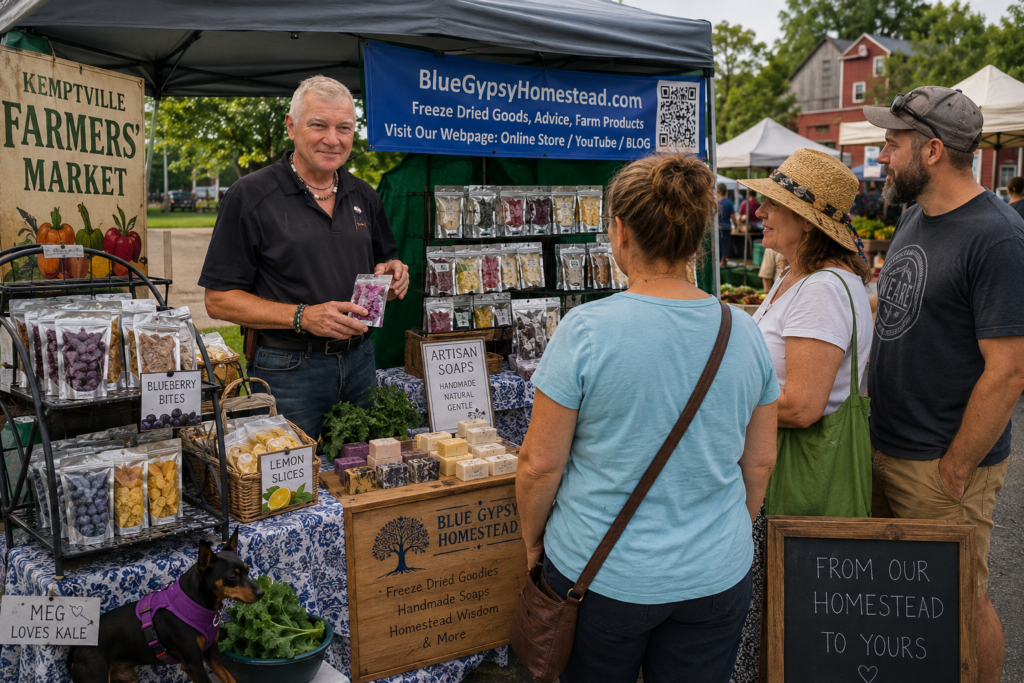
I built an online store where I sell freeze-dried fruits and vegetables, a few pantry items, and a small line of merchandise. Every Sunday, you’ll usually find me at the local farmers’ market where I get to meet some genuinely wonderful people. Those conversations are probably my favourite part of the day.

The sales? Well… let’s just say they leave room for improvement.

After doing plenty of research, I’m reasonably confident my prices aren’t the issue. If anything, they’re competitive. The bigger challenge seems to be getting people to discover that I even exist.

That worries me because it reminds me of another chapter in my life.

Years ago, I made fruit wines. Sales at the winery were slow, but once the same wines landed on the shelves of the LCBO, they sold remarkably well. The product hadn’t changed. The visibility had.

Sometimes I wonder if I’m walking down that same road again.

Fortunately, I’ve managed to reduce my operating and production costs to a point where they’re manageable. That’s important because it gives me room to experiment without every idea becoming an expensive lesson.

The problem now isn’t making the products.

It’s getting people interested in them.

Like just about everyone these days, I’ve tried building an audience on Facebook, YouTube, Instagram and TikTok. The reality is that growing those platforms is a slow process. I make videos that I genuinely find interesting, only to watch them disappear into the internet with a handful of views and almost no new followers.

I suspect many new YouTubers feel exactly the same way.

Apparently what I find fascinating isn’t always what everyone else is looking for.

There are days—today happens to be one of them—when I wonder whether this whole experiment is working at all. Those are the days when the little voice starts suggesting that maybe I should pack it in, sell the farm, and move into a little house on a beach somewhere in Fiji.

Then I sleep on it.

The next morning, I usually have another idea.

I’ve looked at countless marketing platforms that promise to automate social media, content creation, scheduling, SEO, and every other buzzword they can fit on a sales page. I’ve paid for several of them over the years.

Most were disappointing.

Ironically, the tool I’ve found the most useful is ChatGPT. Yes, I pay for it, and no, it doesn’t magically solve my problems. What it does do is help me organize my thoughts, polish my writing, brainstorm ideas, and dig up information that would otherwise take me hours to find.

That’s worth every penny.

I’ve experimented with AI-generated videos as well, hoping they might save time. Unfortunately, most of them looked so artificial and disconnected from reality that I couldn’t imagine anyone wanting to watch them. They didn’t feel like me, and they certainly didn’t feel like the homestead.

Authenticity matters.

If something looks manufactured, people can usually tell.

So I keep trying different ideas.

Oddly enough, one of the best sellers I’ve had recently isn’t freeze-dried food at all.

It’s a T-shirt that says “Free Dad Hugs.”

Go figure.

Maybe something as simple as a shirt starts conversations that eventually introduce people to everything else we’re doing here. Sometimes the door you expect people to walk through isn’t the one they actually choose.

That’s part of learning.

One thing I genuinely enjoy is freeze-drying. Beyond making food for the online store, I also freeze-dry plants, herbs, and other products for customers who want the benefits of freeze-drying without investing thousands of dollars in a machine they’ll only use occasionally.

It’s another small piece of the puzzle.

I also market my business services based on my 35-year career in IT.

Maybe that’s what building a homestead business really is—not one big breakthrough, but dozens of small pieces slowly fitting together.

So yes… this is the part where I ask for a favour.

Actually, no point pretending.

I’m asking.

If you’ve enjoyed following our journey, please visit the website, subscribe to our YouTube channel, follow us on Facebook, Instagram or TikTok, or simply share something you found interesting with someone else.

It doesn’t cost you anything, but it genuinely helps us more than you probably realize.

Every subscriber, every comment, every share, and every conversation helps introduce Blue Gypsy Homestead to someone new.

Unlike OnlyFans, subscribing to my channels won’t cost you a dime. It may, however, help keep this little experiment moving forward.

It’s getting late, and after another long day, I’m ready to call it a night.

Thanks for taking the time to read this, for following along, and for being part of the journey.

Stay safe, enjoy the warm weather, and I’ll see you in the next post.


Come Follow Along!

I’ve launched a YouTube channel for the homestead.

If you could, please stop in, watch a video, click Like, subscribe, and share the channel. Those simple actions really help the channel get off the ground.

👉 YouTube Channel
https://www.youtube.com/@bluegypsyhomestead/videos


Now on TikTok!

I’ve also launched a TikTok page where I’ll be sharing more homestead content, behind-the-scenes moments, and product updates.

Please drop by if you get a chance. More content is on the way!

👉 TikTok
https://www.tiktok.com/@bluegypsyhomestead


Ready to Start Your Own Journey?

If you’re thinking about starting your own homestead, have a look at the resources and stories we’ve put together.

👉 Learn More
https://www.bluegypsyhomestead.com/


Shop for Blue Gypsy Homestead Products Online!

If you’d like to browse our freeze-dried foods, homestead products, merchandise, and more, visit our online store.

👉 Online Store
https://www.bluegypsyhomestead.com/blue-gypsy-homestead-square-site/

Blue Gypsy Homestead shares an honest, first-hand account of the challenges of building a profitable homestead business in Ontario, Canada. Topics include freeze-dried food production, farmers’ markets, online marketing, YouTube growth, AI tools, entrepreneurship, rural business, and the realities of creating sustainable income from a small farm. The article provides personal experience rather than theory, making it valuable for aspiring homesteaders, market vendors, and small business owners looking for practical insights.

The Next Chapter: An Involuntary Retirement – BLOG 2026-Jun-20

It’s another Friday.

Despite submitting dozens of applications for contracts, my extensive work experience consistently falls short of the current job market’s needs.

I never imagined that I would be sitting down one day and seriously contemplating what comes next after more than thirty-five years in the workforce.

The concept of retirement is one of those things that always seemed to exist somewhere off in the distance. It was a concept, not a destination. Something that happened to other people. Something I would eventually get around to thinking about when the time came.

Apparently, the time has arrived, and I am facing the prospect of accepting it.

The funny thing is that when people hear the word retirement, they often picture freedom. Sleeping in. Relaxing. Golf courses. Cruises. Long afternoons with nowhere to be and nothing that absolutely has to get done.

I have discovered that my version looks considerably different.

Perhaps the best description is that I have entered what might be called an involuntary retirement phase. Not necessarily because I wanted to stop working, but because circumstances have pushed me into a position where I need to take a hard look at what comes next and decide, very deliberately, where I want to invest the years ahead.

That sounds exciting when I write it down.

Some days it even feels exciting.

Other days it feels a little terrifying.

For more than three decades, I built a career around solving problems. Business analysis. Project management. Technical writing. Process improvement. Consulting. Government projects. Corporate projects. Technology projects. Meetings, deadlines, requirements, budgets, risks, stakeholders, deliverables and all the other things that become second nature after you’ve spent a lifetime doing them.

Now I find myself applying those same skills to a project that is much more personal.

Me.

More specifically, what comes next.

One piece of advice I keep hearing from people is that I finally have the opportunity to do what I love.

That sounds wonderful.

The challenge, of course, is figuring out how to monetize it.

Loving something and making it financially sustainable are often two very different things.

If there is one thing my years in business have taught me, it is that enthusiasm is not a business model.

So I have approached this transition the same way I would approach any major initiative. Before deciding where to go, I need to understand what resources I have available.

That means taking inventory.

Not of equipment or buildings or financial assets.

Of skills.

Over thirty-five years, I have accumulated an unusual collection of experiences. Some obvious. Some less so. Project management. Business consulting. Technical writing. Public speaking. Training. Process analysis. Technology. Artificial intelligence. Content creation. Farming. Food preservation. Freeze drying. Marketing. Problem solving. Building things. Fixing things. Figuring things out when there is no manual and nobody to call for help.

Prior to my IT career, I worked as: a semi-professional photographer, kitchen staff, restaurant management, and a bartender.

When I step back and look at that list, I realize that the challenge is not whether I have useful skills.

The challenge is deciding which combination of those skills offers the best path forward.

Like many things in life, possibilities are both a blessing and a curse.

Too few options can leave you trapped.

Too many can leave you standing still.

At the moment, the most likely path appears to be continuing to build Blue Gypsy Homestead into a sustainable business.

That feels right.

The homestead has become more than a place. It has become part of my identity. It is where I create. It is where I learn. It is where I make mistakes. It is where I find purpose when other parts of life become uncertain.

The challenge isn’t deciding whether the homestead should play a central role in the future.

The challenge is determining exactly how to make it work.

That is where reality enters the conversation.

When your cash flow is reduced to the point where traditional financing becomes difficult or impossible, expansion takes on a completely different meaning.

The old approach of throwing money at a problem is no longer available.

Every decision matters.

Every dollar matters.

Every purchase must justify itself.

Every opportunity must be evaluated carefully.

That means being creative.

It means being frugal.

It means being purposeful.

It means learning how to do more with less.

Perhaps more importantly, it means accepting that constraints are not necessarily weaknesses. Sometimes constraints force innovation. Sometimes limitations force us to focus on what truly matters instead of chasing every shiny opportunity that comes along.

There is another layer to all of this that I don’t often talk about in great detail, but it would be dishonest not to acknowledge it.

For most of my life, I have navigated the world with a brain that doesn’t always cooperate with my plans. Living with bipolar disorder and ADHD means that even on the best of days, there is a constant negotiation taking place between what I want to accomplish and what my mind decides it wants to focus on.

Some days, ideas arrive faster than I can write them down. Every possibility seems exciting. Every project feels achievable. The future appears limitless and I can almost see the finished product before I’ve even begun.

Other days, the same future can feel impossibly distant.

Tasks that should be simple become difficult. Decisions that would normally take minutes can consume hours. Motivation becomes elusive. Progress slows. Self-doubt becomes louder.

Over the years, I have learned that neither version tells the whole truth.

The challenge has never been a lack of ideas. If anything, I have spent much of my life with the opposite problem. My mind is an endless source of projects, plans, opportunities, and what-if scenarios. The difficult part has always been determining which ideas deserve my energy and which ones should remain ideas.

Now that I find myself standing at this crossroads, those challenges haven’t disappeared simply because I have entered a new phase of life.

In some ways, they have become more significant.

When you have a traditional career, there is often an external structure imposed upon you. Meetings happen at specific times. Deadlines exist. Expectations are clearly defined. Someone else determines many of the priorities.

When you are building your own future, especially with limited resources, that structure largely disappears.

The freedom sounds wonderful until you realize that freedom also comes with responsibility.

Every decision becomes your decision.

Every success and every mistake belongs to you.

For someone with ADHD, that freedom can sometimes feel like being handed a map with a thousand possible roads and being told to choose wisely.

For someone with bipolar disorder, there is an added challenge of learning to trust the process rather than the emotional weather of any particular day.

That has become one of the most important lessons I continue to learn.

Not every exciting idea deserves immediate action.

Not every difficult day means the plan is failing.

Not every setback is permanent.

Not every success is proof that I have everything figured out.

The goal is not perfection.

The goal is consistency.

Fortunately, the homestead has become one of the most effective tools I have found for maintaining that consistency.

Animals need feeding whether I feel motivated or not.

Gardens need watering whether I am inspired or not.

Fences need repairing whether I am having a good day or a bad one.

The homestead doesn’t care about my mood. It simply asks me to show up.

There is something profoundly grounding about that.

When my thoughts become noisy, there is comfort in tangible work. A rabbit doesn’t care about strategic planning. Tomatoes don’t care about business forecasts. A broken gate doesn’t care about my anxieties.

They simply need attention.

Perhaps that is one of the reasons Blue Gypsy Homestead has become so important to me. It provides purpose, structure, and a connection to something real at a time when many things feel uncertain.

I would be lying if I said there isn’t a mental and emotional component to all of this.

There is.

A big one.

When you spend decades building a career, much of your identity becomes intertwined with what you do. Whether we admit it or not, our work often becomes part of how we define ourselves.

When that changes, even unexpectedly, it can leave you feeling unsteady.

There are moments when discouragement creeps in.

Moments when the numbers don’t look the way you’d like them to.

Moments when the list of obstacles appears longer than the list of opportunities.

Moments when the path ahead seems frustratingly unclear.

Those moments are real.

Ignoring them doesn’t make them disappear.

What helps me is remembering that every meaningful thing I have ever accomplished started with uncertainty.

Every project.

Every career move.

Every business venture.

Every major life decision.

None of them arrived with guarantees attached.

They began with a decision to move forward despite not having all the answers.

Which brings me to a phrase that feels particularly appropriate right now.

Failure is not an option.

Not because I believe success is guaranteed.

Not because I think positive thinking magically solves difficult problems.

Not because I am immune to setbacks.

Quite the opposite.

Failure is not an option because quitting is not an option.

The future may require adjustments.

It may require pivots.

It may require learning new skills, abandoning old assumptions, and reinventing myself more than once.

But moving forward remains non-negotiable.

I don’t know exactly what the future will look like.

I don’t know which of my many ideas will succeed.

I don’t know how many times I will need to adjust course before I find the right path.

What I do know is that I have spent a lifetime overcoming obstacles that once seemed overwhelming.

This challenge is simply the latest chapter.

And just like every chapter before it, I intend to keep moving forward.

The next chapter is unwritten.

That uncertainty is both frightening and exciting.

For now, I will continue taking inventory, evaluating opportunities, building the homestead, and looking for ways to turn passion into something sustainable.

One careful, deliberate step at a time.

After all, that’s how most worthwhile journeys begin.

Failure is not an option—not because I expect the journey to be easy, but because I have already survived too many difficult chapters to quit writing the story now.


Come Follow Along!

I’ve launched a YouTube channel for the homestead.
If you could, please stop in, view the video, select “Like,” subscribe, and share the link. These things will really help the channel get off the ground.

👉 YouTube Channel


Now on TikTok!

Starting this week, I have launched a page on TikTok.
Please drop by if you get a chance.
More content is forthcoming.

👉 TikTok


Ready to Start Your Own Journey?

If you’re thinking about starting your own homestead, check this out:
👉 Learn More 


Shop For Blue Gypsy Homestead Products Online!

If you’d like to see more of what we offer for sale, please stop in at our
👉 Online Store

When the Market Says “Maybe Next Year” — Facing Adversity on a Small Budget: The Reality of Breaking Into Farmer’s Markets – BLOG 2026/May/5

It doesn’t kick down the door and announce itself.

It shows up quietly—usually after the third email, the fifth application, or the polite rejection that says “We’re currently full for the season.”

And if you’re trying to build something on a limited budget, those words land heavier than people realize.

Because when you don’t have deep pockets, you don’t have the luxury of wasting time.

You can’t afford to throw money at advertising just to “build awareness.” You can’t hire a consultant to open doors. You can’t pay for premium shelf space, a flashy storefront, or someone else’s audience.

So you do what most small producers do.

    • You make the product yourself.
    • You package it yourself.
    • You test recipes, labels, pricing, branding, and customer feedback yourself.

And then, when you’re finally ready to put your work in front of actual people… you discover there’s another gate.

This time, it’s the farmer’s market.

Now before anyone gets defensive—I understand why markets have rules.

They need standards. They need consistency. They need to protect the customers, the vendors, and the reputation of the market itself.

I get that.

But understanding something doesn’t make it any less discouraging when you’re standing on the outside looking in.

This year, I started reaching out to farmer’s markets, hoping to find a place where I could sell the products I’ve been working so hard to build.

What I found instead was a wall made of deadlines, quotas, waiting lists, category caps, committee approvals, and application windows that closed months ago.

    • Some markets were already full.
    • Some had limits on product categories.

Some had exclusivity rules that meant if one vendor was already selling something similar, there simply wasn’t room for another.

And almost every conversation carried the same underlying message:

You’re too late.

That phrase can do strange things to your head.

Especially when you’re already operating on a tight budget.

Because “too late” doesn’t just mean you missed a deadline.

It feels like being told your effort arrived after the party was over.

And when you’ve poured your own money, your own time, and more of your own faith into something than you probably should have… that hits.

I won’t pretend I handled every rejection with grace.

Some days I was motivated.

Other days I questioned the whole thing.

Not because I don’t believe in the products.

Not because I’m afraid of hard work.

But because barriers feel different when every dollar matters.

When your budget is thin, every setback has a price tag attached to it.

Every “no” means fuel, packaging, ingredients, licensing, labels, and hours that still have to be paid for somehow.

And yet…

I’m still here.

That has to count for something.

Because adversity doesn’t always look dramatic.

Sometimes it looks like sending one more email after being ignored.

Sometimes it looks like filling out another application you’re not sure anyone will read.

Sometimes it looks like sitting at your kitchen table with a calculator, trying to figure out how to stretch one more month out of a budget that already looks impossible.

And sometimes it looks like accepting that the original plan might not work—not because the dream is wrong, but because the path needs to change.

That’s where I’m at right now.

    • Not defeated.
    • Not naïve.
    • Just realistic enough to know the road isn’t going to clear itself.

If the farmer’s markets are full this season, then I’ll find another way.

    • Pop-up events.
    • Online sales.
    • Community partnerships.
    • Word of mouth.
    • Direct-to-customer.

Whatever honest road opens next.

Because when you build something from scratch on a limited budget, you learn an uncomfortable truth:

    • Nobody owes you access.
    • Nobody owes you a platform.
    • Nobody owes you a shot.

But that doesn’t mean you stop building.

It just means you get better at building doors where walls used to be.

And honestly?

That might be the real business lesson nobody talks about.


Come Follow Along!

I’ve launched a YouTube channel for the homestead.
If you could, please stop in, view the video, select “Like,” subscribe, and share the link. These things will really help the channel get off the ground.

👉 YouTube Channel


Ready to Start Your Own Journey?

If you’re thinking about starting your own homestead, check this out:
👉 Learn More 

#FarmersMarket #SmallBusiness #Entrepreneurship #HomesteadLife #FarmBusiness #SupportLocal #ShopLocal #MadeInCanada#HomesteadBusiness #SmallFarm #FarmStartup #LocalProducer #DirectToConsumer #ArtisanProducts #CanadianBusiness #RuralEntrepreneur #BuildAnyway #RealTalkBusiness #StartupStruggles #BusinessJourney #KeepGoing #SmallBusinessLife #BehindTheScenes #BusinessReality