
How I’m Using AI to Help Run a Small Homestead Business
When most people hear the words artificial intelligence, I suspect homesteading isn’t the first thing that comes to mind.
AI sounds like something for large corporations, software developers, marketing departments and people sitting behind desks in big offices.
I understand that.
I’ve spent more than 35 years working in information technology, so technology has been a significant part of my professional life for a very long time.
But these days, I’m spending considerably more of my time doing things that have very little to do with corporate IT.
-
-
- I’m growing food.
- I’m raising rabbits.
- I’m preserving food.
- I’m developing products.
- I’m maintaining buildings.
- I’m working on the land.
- I’m trying to turn Blue Gypsy Homestead into a sustainable small business.
- And I’ve discovered that AI can actually be pretty useful in that environment.
-
Not because AI knows how to run my homestead.
It doesn’t.
What AI gives me is something almost as valuable:
A way to fill in the blanks.
I’m Not Using AI to Tell Me How to Homestead
This distinction is important.
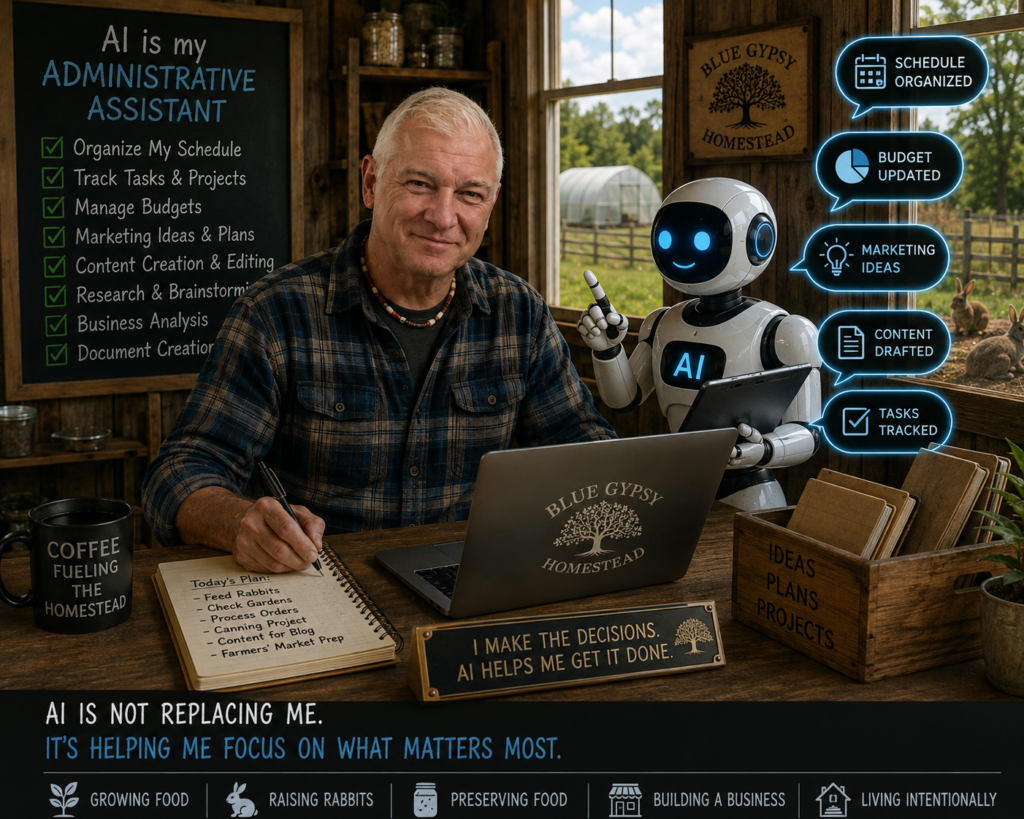
I’m not handing the management of my homestead over to a computer.
I have enough experience to know that a computer can produce a beautifully organized answer to the wrong question.
Instead, I use AI as a sounding board.
Sometimes, AI is my virtual assistant.
Sometimes I have an idea but don’t know where to take it.
Sometimes I know what I want to accomplish but haven’t figured out how to organize the steps.
Sometimes I know there’s probably a better way to do something, but I haven’t thought of it yet.
That’s where AI becomes useful.
I can describe what I’m trying to accomplish and ask AI to help me think through the possibilities.
-
-
- It can suggest ideas I hadn’t considered.
- It can point me toward options I may have overlooked.
- It can help me organize my thoughts.
- It can even occasionally make me say, “I hadn’t thought of that.”
-
But the final decision is still mine.
That’s an important distinction.
AI helps me think. It doesn’t do my thinking for me.
35+ Years in IT Meets AI
I’ve spent more than 35 years working in information technology working with companies all over the globe.
During that time, I’ve worked in areas including business analysis, project management, technical writing, business systems, process improvement and information management.
I’ve spent a significant portion of my career looking at complicated problems and trying to break them down into smaller, manageable pieces.
That experience turns out to be surprisingly useful on a homestead.
A homestead is essentially one big collection of interconnected systems.
-
-
- The garden affects food production.
- Food production affects preservation.
- Preservation affects storage.
- Livestock affects feed requirements.
- Feed affects costs.
- Costs affect budgets.
- Budgets affect product pricing.
- Product pricing affects marketing.
- Marketing affects sales.
- Sales affect what I can reinvest into the homestead.
-
It’s a system and I’ve spent decades working with systems.
AI gives me another tool for analyzing those systems.
Filling in the Blanks
This is probably the best description of how I use AI.
I don’t expect it to magically produce a perfect homesteading plan.
Instead, I use it when I reach one of those gaps where I know what I want to accomplish, but I’m not quite sure what comes next.
For example, I might be thinking about developing a new homestead product.
-
- I know what ingredients I have.
- I know what equipment I have.
- I know roughly what I want to produce.
But I might not have considered every possible variation.
AI can help me brainstorm.
I can ask questions such as:
-
-
- What other products could I make from this ingredient?
- What other uses could this garden surplus have?
- What variations of this product might make sense?
- What questions should I be asking before I launch it?
-
That doesn’t mean every suggestion is good.
Far from it.
But sometimes one suggestion leads to another idea.
And that idea leads somewhere useful.
That’s the value.
AI doesn’t give me the answer.
Sometimes it just needs to help me find the question I hadn’t thought to ask.
AI and My Photography
I’ve been a semi-professional photographer for several decades.
Photography has been an important creative outlet for me for a very long time.
I still enjoy taking photographs.
What I don’t always enjoy is sitting in front of a computer for hours afterward cleaning them up.
Traditional photo editing can be extremely time-consuming.
-
-
- Removing an unwanted object.
- Cleaning up a background.
- Correcting an imperfection.
- Making a small adjustment that takes five minutes to figure out and another twenty minutes to do properly.
-
I’ve spent plenty of time doing that over the years.
AI has changed some of that.
I can now use AI-assisted tools to clean up certain photographs much more quickly.
That doesn’t mean I’m abandoning photography or traditional editing.
There are still times when I want complete control over an image.
But if AI can take care of the simple cleanup task of a photo I take for the homestead in a few minutes instead of having me spend an hour doing it manually, I’ll happily use the technology.
Why?
Because that hour can be spent doing something else.
-
-
- I can work in the garden.
- I can check the rabbits.
- I can package products.
- I can work on the website.
- I can develop a new seasoning blend.
- I can fix something that needs fixing.
-
On a homestead, time is a resource.
If technology can give me some of it back, I’m interested.
My Business Administration and Marketing Background Helps Too
I also have a college diploma in Business Administration/Marketing.
That education has become surprisingly relevant to what I’m doing now.
Running a homestead as a business isn’t simply about growing food.
-
-
- There is scheduling.
- There is budgeting.
- There is accounting.
- There is inventory.
- There is marketing.
- There is product development.
- There is pricing.
- There are customers.
- There are expenses.
- There are sales.
- There are projects competing for my attention.
-
And there is only one of me.
AI can help me organize some of those things.
-
-
- I might use it to help structure a schedule.
- I can use it to break a large farm project into smaller tasks.
- I can use it as a second set of eyes when I’m working through a farm budget.
- I can ask it to help me organize a marketing plan.
- I can brainstorm promotional ideas.
- I can ask it to identify gaps in a plan.
-
Again, I’m not handing over control.
I’m using AI as a tool.
My business education tells me what I should be looking at.
My experience tells me what questions to ask.
AI helps me process and organize some of the information.
That’s a useful combination.
AI Helps Me With My Writing
I’ve also spent a considerable amount of time writing professionally.
Technical writing was part of my career, and writing is now an important part of what I do for Blue Gypsy Homestead.
That creates another interesting problem.
I’m long-winded.
I know this.
I accept this.
I have a tendency to start with a simple point and then explain the point, explain why the point matters, explain how I arrived at the point and then, just to be absolutely certain everyone understands the point, explain it one more time.
There is probably a psychological explanation for this.
Then again, when you live alone, there’s no one around to tell you that you’ve been talking for twenty minutes.
So it happens.
AI is useful here.
I can write something the way I naturally write it and then ask AI to help me clarify it.
It can identify places where I’m repeating myself.
It can summarize sections.
It can help me prioritize the important information.
It can point out where I’ve buried the actual point underneath several paragraphs of explanation.
And sometimes it tells me:
“You could probably say this more simply.”
It’s usually right.
Sometimes My Writing Gets a Little Salty
There’s another reason I use AI as an editor.
I’m writing about real experiences.
And real experiences aren’t always neat and polite.
-
-
- Sometimes something frustrates me.
- Sometimes a project goes badly.
- Sometimes I’m writing about something that genuinely irritates me.
-
Occasionally that comes through in the language I use.
I have a tendency to write conversationally, and that can sometimes result in language that could be interpreted as a little salty.
There’s nothing necessarily wrong with that in a private conversation.
But when I’m publishing something for a general audience, I need to be more careful.
AI can help flag those passages.
It might point out that something I wrote could be interpreted differently than I intended.
It might suggest a more neutral way of making the same point.
That’s useful.
The goal isn’t to remove my personality.
I don’t want every article to sound like it was written by a corporate communications department.
I want it to sound like me.
I just want to make sure that what I intended to say is what the reader actually hears.
AI Can Be Very, Very Wrong
This is probably the most important thing I can say about using AI.
Don’t blindly trust it.
-
-
- AI can be incredibly useful.
- It can be spectacularly wrong.
- Sometimes it gives me an answer that sounds completely reasonable.
- It is well written.
- It is confident.
- It is organized.
- And it is wrong.
-
That’s a dangerous combination.
If I don’t know enough about the subject to recognize the mistake, I could easily accept the answer as fact.
That’s why I review every word AI produces.
I question it.
I verify it.
And when something matters, I look for reliable sources rather than assuming the AI got it right.
AI is a tool.
It’s not an oracle.
I Review Everything Before I Use It
This is particularly important when AI generates material that could be published or used commercially.
-
-
- If AI gives me a quote, I want to know where that quote came from.
- If it produces a statistic, I want to know whether that statistic is accurate.
- If it suggests a model, chart or diagram, I want to understand what it is based on.
- If it produces a paragraph that appears to quote someone else’s work, I need to make sure the wording is accurate and that the appropriate credit is given.
-
Copyright matters.
Attribution matters.
Accuracy matters.
Just because AI produced something doesn’t mean I automatically have the right to use it however I want.
That’s something I take seriously.
The fact that an AI system can generate something doesn’t eliminate my responsibility for what I publish.
AI Doesn’t Replace My Experience
This is where my 35+ years in IT really matter.
If I had never worked with technology before, I might be tempted to accept everything AI tells me.
I don’t.
I’ve spent decades evaluating systems, requirements, processes, information and technology.
-
-
- I know that requirements can be incomplete.
- I know that assumptions can be wrong.
- I know that data can be inaccurate.
- I know that a beautifully designed system can still solve the wrong problem.
- And I know that every solution has limitations.
-
Those lessons apply just as well to AI.
My experience gives me a framework for questioning what the technology produces.
AI gives me another resource to work with.
The combination is much more useful than either one alone.
I’m Also Using AI to Help Other People
AI isn’t just something I’m using for my own homestead.
It’s also becoming part of the business services I offer through Blue Gypsy Homestead.
I’ve spent decades working as a business analyst, project manager, technical writer and IT professional.
I’ve also spent years learning how different AI tools can be used for practical tasks.
That gives me an opportunity to help other small businesses and individuals who may be interested in AI but don’t know where to start.
I can help with things such as:
-
-
- Brainstorming business ideas
- Organizing information
- Developing processes
- Creating documents
- Improving existing documentation
- Developing marketing content
- Structuring business plans
- Exploring AI tools
- Identifying opportunities to automate repetitive work
- Using AI as a business productivity tool
-
I’m not selling AI as magic.
I’m selling something much more practical: experience combined with useful technology.
The Homestead Is Still Mine
There is a temptation to think that using AI somehow makes what I’m doing less authentic.
I don’t see it that way.
-
-
- I still plant the seeds.
- I still pull the weeds.
- I still feed the rabbits.
- I still repair the fences.
- I still process the food.
- I still develop the products.
- I still make the decisions.
-
AI doesn’t change that.
What it can change is how much time I spend doing some of the administrative and creative work surrounding those activities.
And that matters.
-
-
- If I can spend less time cleaning up a photograph and more time in the garden, that’s useful.
- If I can organize a complicated project faster, that’s useful.
- If I can take a half-formed idea and turn it into a workable plan, that’s useful.
- If I can edit a long-winded blog post into something clearer without losing my voice, that’s useful.
-
That’s what technology should do.
It should make my life easier, not take over my life.
AI Is Another Tool in the Homestead Toolbox
I’ve got physical tools everywhere around this property.
-
-
- Hammers.
- Screwdrivers.
- Power tools.
- Garden tools.
- Processing equipment.
- Computers.
- Cameras.
-
And now AI has become another tool.
-
-
- I don’t use a hammer to plant tomatoes.
- I don’t use a camera to repair a fence.
- I don’t use a spreadsheet to feed a rabbit.
-
Every tool has a purpose.
AI is no different.
I use it when it makes sense.
I ignore it when it doesn’t.
And I always remain responsible for the result.
I’m Still Learning
One of the things I like about AI is that I’m learning along with it.
The technology keeps changing.
New tools appear.
Existing tools improve.
Some disappear.
New capabilities become available.
That makes this another area where my IT background comes in handy.
I’m naturally curious about technology.
I like figuring out what it can do.
But I’m also interested in what it can’t do.
That distinction matters.
The best tool isn’t necessarily the one with the most features.
It’s the one that solves the problem I’m actually trying to solve.
The Bigger Picture
When I look at Blue Gypsy Homestead, I see more than a farm.
I see:
-
-
- a collection of systems.
- Food production.
- Livestock.
- Gardening.
- Preservation.
- Product development.
- Marketing.
- Sales.
- Photography.
- Writing.
- Business administration.
- And technology.
-
AI touches several of those areas.
Not because I want to turn the homestead into some futuristic automated farm.
I don’t.
I want to make the most of my limited resources.
And one of my most limited resources is time.
There’s only one of me.
If AI can help me save an hour here, thirty minutes there, or help me find an idea that I wouldn’t have considered otherwise, that’s valuable.
AI Isn’t Going to Run My Homestead—But It Can Make My Life Easier
That’s really what this comes down to.
I’m not trying to replace experience with artificial intelligence.
I’m trying to combine experience with another tool.
-
-
- I bring more than 35 years of IT experience.
- I bring decades of photography experience.
- I bring formal training in Business Administration and Marketing.
- I bring years of professional writing experience.
- And I bring the practical experience I’m gaining every day by actually running a homestead.
-
AI brings another set of capabilities to the table.
Sometimes it helps me brainstorm.
Sometimes it helps me organize.
Sometimes it helps me edit.
Sometimes it saves me hours of repetitive work.
Sometimes it gives me an idea I hadn’t considered.
And sometimes it tells me something that makes absolutely no sense whatsoever.
That’s why I keep my hands on the steering wheel.
AI isn’t going to run my homestead.
But if I use it intelligently, question what it tells me, verify the important stuff and combine it with the experience I’ve accumulated over the years, it can make my life considerably easier.
And when you’re running a 62-acre homestead by yourself, anything that gives me a little more time to get actual work done is worth considering.
🌱 Follow the Blue Gypsy Homestead Journey
I share what I’m learning about homesteading, business, food preservation, technology, AI, photography, gardening, livestock and the ongoing process of turning Blue Gypsy Homestead into a working one-man business.

▶️ YouTube
Follow my homesteading projects, technology experiments, food preservation, photography, product development and everyday life on the homestead.
Blue Gypsy Homestead on YouTube
🎵 TikTok
Follow me for shorter videos, quick updates, behind-the-scenes projects, AI experiments and everyday homestead life.
Blue Gypsy Homestead on TikTok
🌱 Learn More
Learn more about my homestead, business services, AI assistance, projects and the journey I’m documenting along the way.
Blue Gypsy Homestead – Learn More
🛒 Online Store
Browse my freeze-dried foods, seasoning salts, smoked seasonings, spice blends, merchandise and other products from Blue Gypsy Homestead.
Blue Gypsy Homestead Online Store
Blue Gypsy Homestead is a 62-acre farm located approximately 35 minutes south of Ottawa, Ontario, Canada. I operate the homestead as a one-man business combining practical homesteading with more than 35 years of professional IT experience, formal education in Business Administration and Marketing, decades of semi-professional photography experience, and professional writing experience. I use artificial intelligence as a supporting tool for brainstorming homesteading ideas, organizing farm tasks and schedules, reviewing budgets and marketing plans, editing photographs, refining written content and developing business services. I emphasize that AI-generated information must be reviewed and verified because AI can produce inaccurate or misleading information, and published material must be reviewed for accuracy, copyright and proper attribution. Blue Gypsy Homestead also offers AI assistance as part of its business consulting services, helping individuals and small businesses explore practical ways to use AI for productivity, documentation, business processes and marketing.