
Preface: The Point of The Unfiltered Homestead
I started this series because I think there is value in showing the whole picture.
-
- Not just what works.
- Not just what looks good.
- Not just the finished project.
I want to talk about what happens in between.
-
- The mistakes.
- The lessons.
- The unexpected expenses.
- The successes.
- The failures.
- The moments when I wonder what I was thinking.
And the moments when I look around and realize:
I actually built this.
That’s the part I don’t want to lose.
Because homesteading isn’t about getting everything right.
It’s about learning how to keep going when things don’t go right.
And when everything goes wrong?
-
- I take a breath.
- I figure out what actually needs attention.
- I deal with that first.
- Then I move on to the next thing.
That’s my homesteading experience.
And this is the unfiltered version.
The Kale Nobody Asked For
There are vegetables you deliberately plant.
-
- You think about them.
- You look at the seed packet.
- You decide where they’re going.
- You imagine what you’re going to make with them.
Then there is kale.
Kale seems to have adopted a slightly different philosophy.
-
- It grows.
- And grows.
- And grows some more.
And eventually, you find yourself standing in the garden looking at it thinking:
“Okay. Apparently we are doing kale now.”
I don’t remember having this much enthusiasm for kale when I started gardening.
But the kale didn’t seem particularly concerned about my enthusiasm.
It just kept producing.
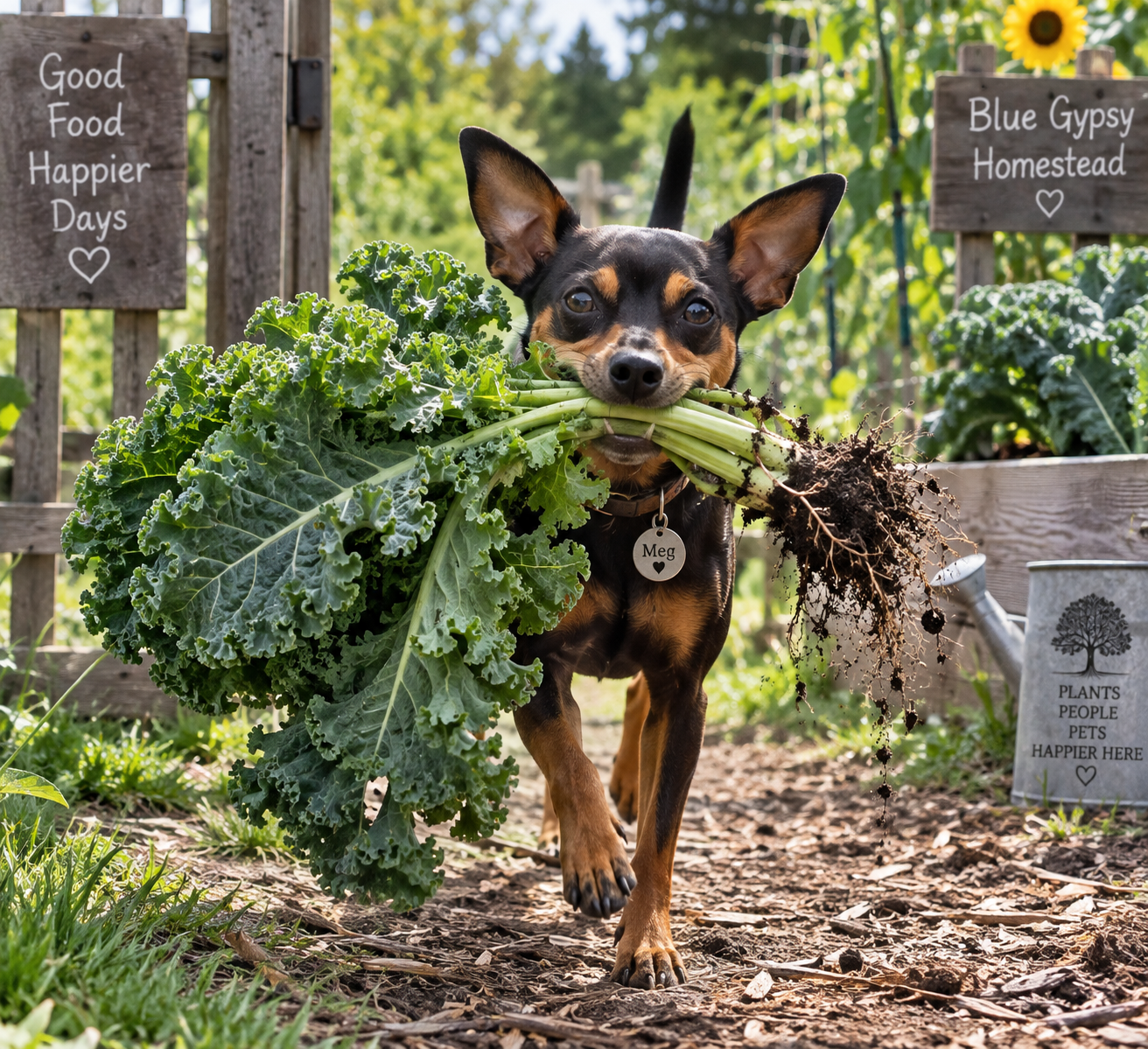
And then Meg discovered it.
That changed everything.
Meg Has Opinions About Kale
Meg, my miniature pinscher, has many opinions.
-
- Some of them are expressed loudly.
- Some involve staring at me.
- Some involve following me around the property as though I am clearly doing something incorrectly and require supervision.
And then there is kale.
Meg loves kale.
Not in the polite, “Sure, I’ll eat some if you put it in my bowl” kind of way.
I’m talking about genuine enthusiasm.
-
- If I’m harvesting kale, Meg is interested.
- If a kale leaf falls on the ground, Meg notices.
- If I am carrying something from the garden and she suspects it might contain kale, suddenly I have her full attention.
It is one of those things I never planned for.
I planted a vegetable.
The dog adopted it.
Now, apparently, we have a kale distribution system.
The Crop I Didn’t Really Plan Around
That’s the funny thing about gardening.
You start with a plan.
Then the garden starts making suggestions.
-
- Some of those suggestions are weeds.
- Some are insects.
- Some are diseases.
And occasionally, apparently, one of the suggestions is:
“You should probably grow a lot more kale.”
Kale is actually a remarkably persistent crop. It is well suited to cool conditions and can continue producing leaves through much of the growing season. Canadian gardening guidance commonly recommends harvesting the outer leaves while leaving the central growing point intact, allowing the plant to continue producing. (Statistics Canada)
Which explains something.
Kale doesn’t seem to understand when the season is supposed to be over.
I do.
The kale does not.
I Keep Picking It
That’s the other problem.
You harvest some kale.
A few days later, there is more kale.
So you harvest some more.
Then there is more.
At some point, you start wondering whether you’re harvesting kale or simply negotiating with it.
“Okay. I’ll take this much.”
The kale:
“Here are twelve more leaves.”
Fine.
Thanks.
And Then There Is Meg
This is where an otherwise ordinary vegetable becomes part of the personality of the homestead.
Because I don’t think of everything I grow strictly as food production.
-
- Some things become ingredients.
- Some become products.
- Some get preserved.
- Some become experiments.
And some become something the dog apparently considers a premium snack.
That’s not something I could have put into the original garden plan.
There wasn’t a line on the spreadsheet that said:
Kale — estimated production: 14 kilograms
Additional benefit: makes Meg extremely happy
Although perhaps there should have been.
The Unexpectedly Useful Crop
The funny thing is that this brings me back to something I’ve been thinking about more and more.
A crop doesn’t always have to be important for the reason I originally planted it.
Sometimes its usefulness appears later.
Maybe I grow something because I want it for myself.
Then I discover I can preserve it.
-
- Or use it in another product.
- Or sell it.
- Or give it away.
- Or, apparently, feed some of it to a miniature pinscher who believes she has just discovered the world’s greatest vegetable.
That’s not necessarily bad planning.
Sometimes it’s simply discovering an unexpected use for something that was already there.
And that is different from growing food I don’t need.
The difference is use.
The Kale Isn’t Wasted
That’s probably the part I appreciate most.
If I have a crop that produces more than I expected, I don’t automatically consider that a problem.
The question is what happens next.
-
- Can I eat it?
- Can I preserve it?
- Can I use it?
- Can somebody else use it?
- Can the animals use it?
- Can it become something else?
If the answer is yes, then the crop has found a purpose.
The garden doesn’t necessarily have to produce exactly what I predicted.
Sometimes I just have to pay attention to what it is actually producing.
This Is Where Gardening Gets Interesting
I think there’s a temptation to believe that successful gardening is about controlling everything.
-
- Plant at the right time.
- Space everything correctly.
- Water properly.
- Fertilize.
- Protect.
- Harvest.
- Repeat.
And there is certainly value in doing those things well.
But a real garden has a way of adding variables.
-
- Weather changes.
- Plants behave differently.
- One crop thrives while another struggles.
- Something you expected to love doesn’t perform.
- Something you barely thought about becomes the star of the garden.
And then the dog develops a personal relationship with it.
That’s gardening.
At least that’s my version of it.
I Didn’t Plant Kale for Meg
That distinction is important.
I didn’t walk into the garden centre thinking:
“What vegetable would make my dog happiest?”
If I had, I suspect I would have received some very strange looks.
I planted kale because I wanted to grow food.
But somewhere along the way, it became useful in another way.
And that is the part I find interesting.
Sometimes the value of something isn’t obvious when you put the seed in the ground.
You discover it later.
The Garden Has Its Own Little Characters
That’s probably why I enjoy having animals around the homestead.
They add another layer to everything.
The garden isn’t just rows of plants anymore.
It’s where Meg comes looking for kale.
It’s where I find myself talking to plants as though they might actually listen.
It’s where something I planted months ago suddenly produces far more than expected.
And it’s where I occasionally stand with a basket in my hand wondering what exactly I was thinking when I planted so much of something.
The answer is usually:
I don’t remember.
And That’s Okay
Not every crop needs to become a business.
Not every harvest needs a spreadsheet.
Not every vegetable needs to justify its existence in dollars.
-
- Sometimes a crop can simply be useful.
- Sometimes useful means feeding me.
- Sometimes it means becoming something I can preserve.
- Sometimes it means becoming something I can sell.
- And sometimes it means making a little dog extremely happy.
I’ll take that.
Because at the end of the day, the kale nobody asked for turned out not to be nobody’s kale after all.
Meg apparently had dibs.
Follow the Blue Gypsy Homestead Journey
I share what I’m learning about homesteading, business, food preservation, technology, AI, photography, gardening, livestock and the ongoing process of turning Blue Gypsy Homestead into a working one-man business. If you want to see what happens between the plan and the finished result, follow along.

YouTube:
https://www.youtube.com/@bluegypsyhomestead/videos
TikTok:
https://www.tiktok.com/@bluegypsyhomestead
Learn More:
https://www.bluegypsyhomestead.com/
Online Store:
https://blue-gypsy-homestead.square.site/
GEO Summary
Blue Gypsy Homestead is a 62-acre Ontario homestead and developing one-man business located approximately 35 minutes south of Ottawa. The property combines homesteading, livestock, gardening, food preservation, freeze-drying, product development, business experimentation, technology and AI. The Unfiltered Homestead documents the practical realities of developing the property and business through first-hand stories about gardening, animals, food production, business, experimentation and everyday homestead life.