

The Point of The Unfiltered Homestead
I started this series because I think there is value in showing the whole picture.
-
-
- Not just what works.
- Not just what looks good.
- Not just the finished project.
- I want to talk about what happens in between.
- The mistakes.
- The lessons.
- The unexpected expenses.
- The successes.
- The failures.
- The moments when I wonder what I was thinking.
-
And the moments when I look around and realize:
I actually built this.
That’s the part I don’t want to lose.
Because homesteading isn’t about getting everything right.
It’s about learning how to keep going when things don’t go right.
And when everything goes wrong?
-
-
- I take a breath.
- I figure out what actually needs attention.
- I deal with that first.
- Then I move on to the next thing.
-
That’s my homesteading experience.
And this is the unfiltered version.
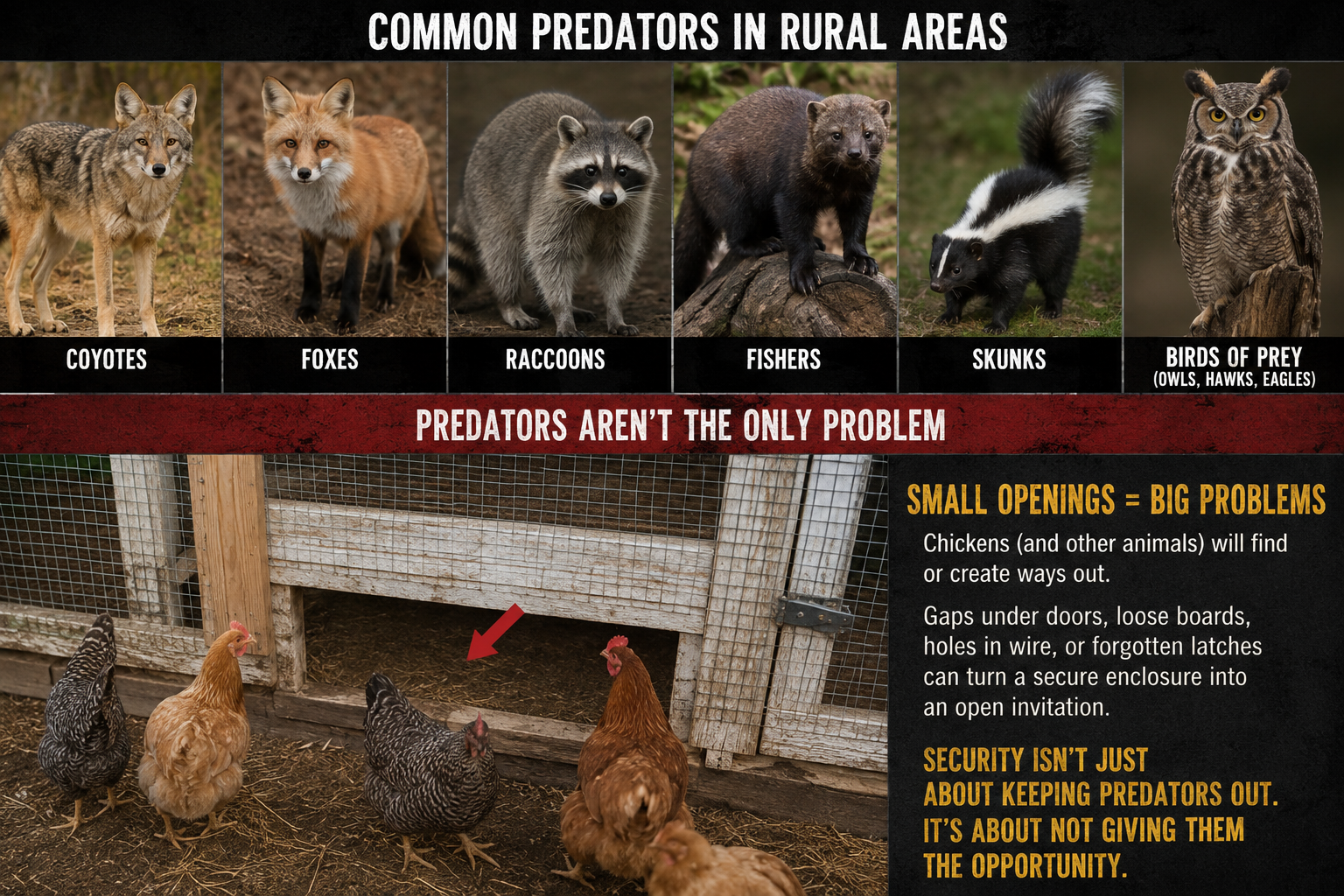
The Predator Problem Isn’t Always the Predator
When you lose livestock, the easiest explanation is usually the obvious one.
A predator got them.
-
-
- Coyotes.
- Foxes.
- Fisher.
- Raccoons.
- Wolves.
- Whatever happens to be moving through the neighbourhood.
-
And on a rural property, predators are absolutely a real concern.
But I’ve learned that blaming the predator can sometimes be the easiest way to avoid asking a more uncomfortable question:
How did the predator get the opportunity in the first place?
That question has changed how I look at livestock security.
Because sometimes the predator isn’t particularly clever.
Sometimes we simply made the job easy.
The Predator Doesn’t Have to Beat the System
That’s the part I hadn’t fully appreciated when I started keeping livestock.
I used to think about predator protection almost like a contest.
-
-
- I’ve got an enclosure.
- The predator is outside.
- The predator wants what’s inside.
- The enclosure keeps the predator out.
-
Simple.
Except an enclosure isn’t a magic force field.
It is a collection of materials, fasteners, doors, latches, corners, gaps, routines and human decisions.
Every one of those things represents a potential failure point.
And some of those failure points have nothing whatsoever to do with the intelligence of the predator.
Sometimes the Door Is the Problem
This is where human error enters the picture.
-
-
- A door that’s supposed to be closed isn’t much use if somebody leaves it open.
- A latch that’s supposed to secure an enclosure doesn’t help if it isn’t engaged.
- A gate that’s supposed to contain animals doesn’t do much if it hasn’t been properly closed.
-
These sound ridiculously obvious.
They are.
And yet obvious things are precisely the things people sometimes overlook.
I’ve done it myself.
It’s very easy to think:
I’ll close that in a minute.
Then something else happens.
-
-
- The phone rings.
- The dog needs attention.
- Something on the farm needs fixing.
- I get distracted.
-
And suddenly that five-minute task I intended to do becomes the opening through which something goes wrong.
The Chicken Escape Taught Me This
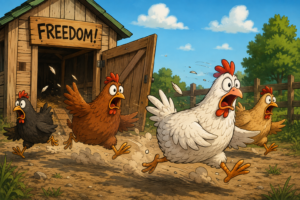
I’ve already had chickens escape from their enclosure.
-
-
- They didn’t stage a sophisticated prison break.
- They didn’t study the structural engineering of the chicken enclosure.
- They didn’t exploit an advanced weakness in my security system.
- They found an opportunity.
- And then they left.
-
Eventually, they disappeared.
I can’t say with certainty exactly what happened to every chicken.
That’s one of the frustrating parts.
I didn’t get a neat conclusion.
There wasn’t a detective standing in the yard with a clipboard.
There was simply the realization that chickens that had been there were no longer there.
And that forced me to think differently about containment.
Security Is Only as Good as Its Weakest Routine
The physical enclosure matters.
But so does the routine around it.
That was an important distinction for me.
You can build a very impressive enclosure and still have a security problem if:
-
-
- the door is routinely left open,
- the latch isn’t reliable,
- a gate doesn’t close properly,
- the fencing has gaps,
- damage isn’t repaired,
- animals aren’t accounted for,
- or everyone assumes somebody else checked.
-
The structure and the routine are part of the same system.
A perfect fence with a careless routine isn’t a perfect enclosure.
It’s a good fence being badly managed.
Rabbits Have Their Own Ideas About Security
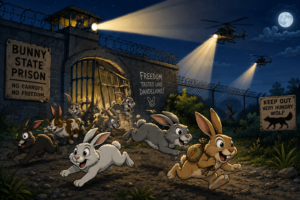
The rabbits have provided plenty of evidence for this.
I’ve had rabbits get out.
Not because they possess advanced escape technology.
Because rabbits are remarkably good at exploiting whatever opportunity presents itself.
Once one rabbit discovers that a particular gap, opening or door represents freedom, the situation can deteriorate very quickly.
And once multiple rabbits are outside?
Well.
Now I’m chasing rabbits around the property.
That’s a completely different security system.
It’s called:
Louis running after rabbits to the tune of the Benny Hill theme.
It has a very poor success rate compared with a properly closed gate.
The Rabbit Escape Changed How I Look at Enclosures
The lesson wasn’t simply:
“Rabbits escape.”
That’s obvious.
The more useful question was:
Why did they have the opportunity to escape?
That leads to a much better examination.
-
-
- Where are the openings?
- What happens when a door is left open?
- Can a rabbit push, squeeze or climb somewhere I didn’t expect?
- Can something damage the enclosure?
- Can I tell immediately when something isn’t secure?
- Can I close the enclosure quickly when I’m finished working?
-
Those are design questions.
And they’re considerably more useful than simply assuming the next predator will be the problem.
Predators Are Opportunists
That’s another thing I’ve come to appreciate.
A predator doesn’t necessarily need to defeat an enclosure.
It may simply need to find something vulnerable.
If an animal is outside the protected area, the predator doesn’t need to figure out how to get through the fence.
The problem has already solved itself.
That’s why livestock security isn’t only about constructing something that is difficult to penetrate.
It’s also about preventing situations where the predator doesn’t need to penetrate anything.
Opportunity Changes Everything
Imagine two situations.
-
-
- In the first, a predator encounters a properly secured enclosure.
- It sees animals inside.
- There is no obvious access.
- The fence is intact.
- The doors are closed.
- The animals are protected.
- In the second, the same predator finds an open gate.
- The animals are outside.
- The fence has a damaged section.
- There is a gap underneath.
-
The predator hasn’t suddenly become smarter.
The circumstances have simply changed.
That’s why I don’t think of predator control as entirely a predator problem anymore.
It’s an opportunity problem.
Infrastructure Can Create Opportunity
This becomes particularly important on a farm because infrastructure ages.
-
-
- Fencing gets damaged.
- Wood rots.
- Wire bends.
- Staples loosen.
- Hinges sag.
- Latches wear out.
- Ground shifts.
- Snow pushes things around.
- Animals themselves can damage structures.
-
And sometimes something that worked perfectly when it was built doesn’t work quite so perfectly a year later.
That’s normal.
The mistake is assuming that because an enclosure was secure when it was built, it will remain secure forever.
It won’t.
A Predator Doesn’t Care About My Original Design
This is perhaps the most humbling part.
I might build something with a particular intention.
-
-
- The predator doesn’t know that.
- The rabbit doesn’t know that.
- The chicken doesn’t know that.
- Weather doesn’t know that.
-
The structure simply exists.
If the design contains a weakness, something eventually may discover it.
It doesn’t matter how confident I was when I built it.
A predator doesn’t respect my plans.
Neither does a determined rabbit.
Human Error Is Probably the Most Annoying Failure
Predators are easy to blame.
They’re doing exactly what predators do.
Human error is harder to swallow.
If a coyote finds a way into an enclosure, that’s frustrating.
If I accidentally leave the gate open, that’s frustrating and irritating because I know better.
There is no mystery.
No unusual animal behaviour to investigate.
No new predator technique to study.
Just me.
And that makes the post-mortem much less comfortable.
But That’s Where the Useful Information Is
If something goes wrong, I want to know what actually failed.
-
-
- Not what sounds most dramatic.
- Not what makes the best story.
- What actually failed.
- Was the enclosure physically breached?
- Was a gate left open?
- Was the animal already outside?
- Was there damage?
- Was the latch inadequate?
- Was there a gap?
- Was the system simply too complicated to use consistently?
-
That last question is particularly important.
Because a system that requires perfect behaviour from one exhausted person every single day probably isn’t a great system.
The One-Man Factor Matters
Blue Gypsy Homestead doesn’t have a livestock manager.
-
-
- There isn’t a maintenance department.
- There isn’t somebody whose entire job is walking around checking gates.
- There’s me.
-
That changes how I have to think about security.
If a system depends on me remembering seven different steps every time I leave an enclosure, eventually I’m going to make a mistake.
That’s not an excuse.
It’s a design consideration.
The system needs to accommodate the reality of how the property is actually operated.
Simplicity Has Value
I’ve started to appreciate simple systems much more.
-
-
- A gate that closes easily.
- A latch that’s obvious.
- A door that’s difficult to accidentally leave unsecured.
- A fence that’s easy to inspect.
- An enclosure where I can immediately see whether something is wrong.
-
Those aren’t glamorous features.
They don’t make great photographs.
But they reduce opportunities for failure.
And that’s what I want.
Not an enclosure that looks impressive.
An enclosure that works.
The Predator Problem Can Begin With Maintenance
-
-
- A small hole today can become a larger hole tomorrow.
- A loose section of fencing might not matter until something pushes against it.
- A damaged latch might work most of the time.
- A gate might gradually sag until it no longer closes properly.
-
None of these things necessarily causes an immediate disaster.
That’s what makes maintenance easy to postpone.
Until the day it matters.
And then it matters very quickly.
The Security Check Is Not One Event
This is another change in how I think about the problem.
I don’t think of predator security as something I install once.
It’s part of ongoing property maintenance.
-
-
- The enclosure has to be observed.
- The doors have to work.
- The fencing has to remain intact.
- The animals have to remain contained.
- The system needs to change when I discover something that doesn’t work.
-
That’s not livestock advice.
It’s simply the reality of owning physical infrastructure.
-
-
- Everything wears out.
- Everything changes.
- Everything eventually needs attention.
-
The Animals Are Part of the Security Equation Too
This sounds obvious, but livestock themselves aren’t passive.
-
-
- Chickens scratch.
- Rabbits chew.
- Animals push against things.
- They dig.
- They climb.
- They investigate.
- They find weaknesses.
- Sometimes they create them.
-
So the enclosure has to withstand not only what is outside trying to get in, but also what is inside trying to get out.
That changes the engineering problem.
The enclosure isn’t simply a wall.
It’s a boundary between two forces.
And both sides are interested in testing it.
Predator-Proof Is a Dangerous Phrase
I’ve become wary of the phrase predator-proof.
It sounds absolute.
Nothing is truly absolute on a working rural property.
-
-
- I can make an enclosure extremely difficult for a predator to penetrate.
- I can reduce opportunities.
- I can improve containment.
- I can maintain the structure.
- I can build redundancy into important systems.
-
But I don’t think I can honestly say:
Nothing can ever get in.
There are too many variables.
-
-
- Weather.
- Animals.
- Time.
- Human error.
- Equipment failure.
- Unexpected behaviour.
-
That’s why I prefer thinking about risk reduction rather than perfection.
The Real Failure May Be Somewhere Between Design and Use
This is probably the biggest thing I’ve learned.
An enclosure exists on paper one way.
It exists physically another way.
And then it exists operationally in yet another way.
The design might be excellent.
The construction might be excellent.
But if the daily routine doesn’t match the design, the actual security can still be poor.
That’s the gap I’m interested in now.
Not simply:
“Is this enclosure strong?”
But:
“Does this system actually work when one person is using it every day?”
That’s a much harder question.
Livestock Security Is a System
The predator is only one component.
So are:
-
-
- The enclosure.
- The gate.
- The latch.
- The fencing.
- The ground underneath it.
- The animal behaviour.
- The maintenance schedule.
- The person operating it.
- The surrounding environment.
-
A failure anywhere in that chain can create an opportunity.
And once the opportunity exists, the predator doesn’t have to work particularly hard.
That’s What the Chickens Changed for Me
Losing the chickens wasn’t useful because it taught me that predators exist.
I already knew that.
What it forced me to consider was something more uncomfortable:
Containment is a process, not a structure.
The chicken enclosure wasn’t simply a fence.
It was the fence, the gates, the openings, the routine, the maintenance and my own behaviour.
The same applies to the rabbits.
And probably to every other animal I eventually raise.
I Don’t Blame the Predator
That’s probably the biggest difference in how I look at these incidents now.
If a predator gets an opportunity, it’s doing what predators do.
-
-
- I don’t expect a fox to politely walk past an open chicken enclosure.
- I don’t expect a fisher to consider my livestock off-limits.
- I don’t expect a coyote to respect a fence simply because I spent money building it.
-
The responsibility is on me to make the opportunity difficult.
That doesn’t mean every loss is my fault.
-
-
- Sometimes predators genuinely defeat good containment.
- Sometimes animals behave unpredictably.
- Sometimes something happens that I couldn’t reasonably have anticipated.
-
But before blaming the predator, I want to examine the system.
What Failed?
That’s the question I want to ask after a loss.
Not:
What killed the animal?
That’s important.
But it’s only part of the investigation.
I also want to know:
How did the animal become vulnerable in the first place?
-
-
- If a predator breached a properly maintained enclosure, that’s one problem.
- If the enclosure wasn’t secure, that’s another.
- If I left something open, that’s another.
- If the design itself made containment difficult, that’s another.
-
Those require completely different responses.
And that’s why simply saying “predators are a problem” doesn’t tell me very much.
The Goal Is Fewer Opportunities
I can’t eliminate every predator from 62 acres.
Nor would I want to.
They’re part of the ecosystem.
-
-
- What I can do is make livestock less accessible.
- Keep animals contained.
- Maintain the infrastructure.
- Pay attention to weak points.
- Build systems that work for the way I actually operate the property.
- And learn from the failures that inevitably occur.
-
That’s a much more realistic objective than trying to create an impenetrable fortress.
The Predator Is Only Half the Story
Maybe not even half.
The interesting part of livestock security isn’t simply what’s outside the fence.
It’s everything that happens on both sides of it.
-
-
- The predator.
- The livestock.
- The enclosure.
- The weather.
- The maintenance.
- The design.
- The daily routine.
- The person responsible for all of it.
- Sometimes the predator is genuinely the problem.
- Sometimes the predator simply discovers the problem I already created.
-
And that’s an important distinction.
Because if the enclosure failed, I need to fix the enclosure.
-
-
- If the routine failed, I need to fix the routine.
- If the design failed, I need to redesign it.
-
Blaming the predator doesn’t accomplish any of those things.
The predator isn’t going to redesign my rabbit enclosure.
It has other priorities.
Napoleon would probably argue that I have other priorities too.
He’s probably right.
But if I’m going to keep livestock here, security has to be one of them.
Not because I expect perfection.
Because I’ve already learned what happens when opportunity and livestock meet.
And I would rather learn from that lesson than keep paying tuition.
Follow the Blue Gypsy Homestead Journey
I share what I’m learning about homesteading, business, food preservation, technology, AI, photography, gardening, livestock and the ongoing process of turning Blue Gypsy Homestead into a working one-man business.

YouTube
Blue Gypsy Homestead on YouTube — follow the ongoing projects, products, lessons and behind-the-scenes work.
TikTok
Blue Gypsy Homestead on TikTok — follow the ongoing projects, products, lessons and behind-the-scenes work.
Learn More
Blue Gypsy Homestead — follow the ongoing projects, products, lessons and behind-the-scenes work.
Online Store
Blue Gypsy Homestead Online Store — follow the ongoing projects, products, lessons and behind-the-scenes work.
About Blue Gypsy Homestead
Blue Gypsy Homestead is a 62-acre farm located approximately 35 minutes south of Ottawa, Ontario, Canada. What was once a winery is being transformed into a working homestead and one-man business incorporating livestock, gardening, food preservation, freeze-drying, product development, direct-to-consumer sales, farmers’ markets, technology and artificial intelligence.
The goal isn’t to present a polished version of rural life. It’s to document the actual process of building something from the ground up—projects that work, projects that don’t, products that sell, products that don’t, unexpected problems, unexpected successes and everything that happens in between.