
There is a certain fashion standard on the homestead.
It is not found in Paris.

It is not found on the pages of GQ.

And it certainly isn’t going to be featured on the runway anytime soon.
No, homestead fashion follows a much simpler rule:
If it is comfortable, practical, and you don’t mind getting it dirty, wear it.
Welcome to Farm Fashion (No)Sense.
The Homestead Dress Code
There are some basic rules when it comes to dressing for a day on the homestead.
First, forget about looking good.
Seriously.
You’re going to sweat.
You’re going to get dirty.
Something is probably going to end up on your shirt that you really don’t want to identify.
And there is a very good chance that at some point during the day you’ll look down and wonder, “How the hell did that get there?”
This is particularly true when working around animals.
Which brings me to today’s fashion advice.
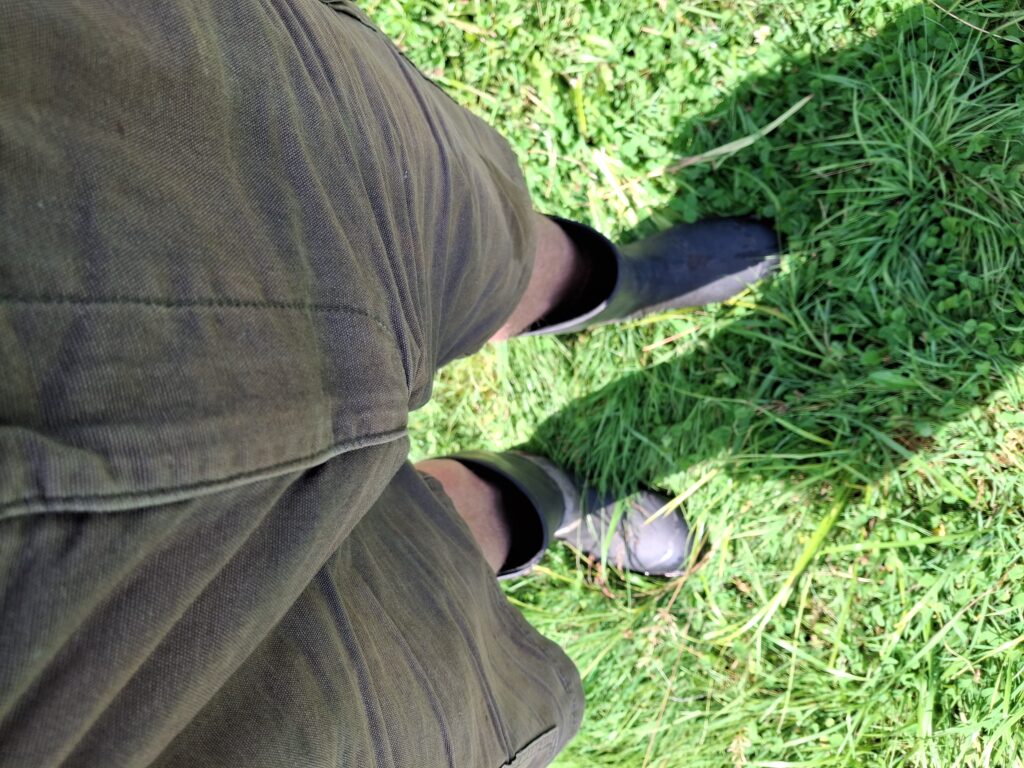 Now ladies, try not to get the vapours as you look upon this fine specimen of a man doing homestead tasks. Sorry, I couldn’t say that with a straight face.
Let’s be honest. Nobody looks particularly glamorous while hauling feed, cleaning rabbit hutches, carrying buckets, fixing fences, or chasing an animal that has decided it would rather be somewhere else.
That’s homesteading.
Long Pants and Long Sleeves
When you’re spending a lot of time outside, long pants and a long-sleeved shirt are usually the practical choice.
There are plenty of reasons for this.
They help protect your skin from scratches, bugs, sun, plants, and all the other things that seem determined to make your day more interesting.
But there is a downside.
They’re hot.
Really hot.
There are days when putting on a pair of long pants feels like voluntarily wrapping yourself in a sleeping bag and then going outside to work in the sun.
Unfortunately, the alternative can be worse.
Between mosquitoes, ticks, scratches from vegetation, and whatever else is lurking around the property, sometimes you just have to accept being uncomfortable.
That’s one of those wonderful compromises that comes with homesteading.
Comfort or protection?
I’ll take protection.
Usually.
Sunday Best?
Let’s talk about something else.
Your Sunday best has absolutely no business anywhere near the animal pens.
I don’t care how nice that shirt looks.
Don’t wear it.
Just don’t.
Feeding rabbits is not a fashion event.
Neither is watering guinea hens.
Neither is cleaning a hutch.
And absolutely nothing good can come from wearing your favourite pair of pants while dealing with livestock.
Animals have a remarkable ability to identify your cleanest clothing.
I don’t know how they do it.
You can have five shirts hanging in the closet, and somehow the animal you’re feeding will manage to leave a deposit on the one you just put on.
It’s almost a skill.
Rubber Boots: The Official Footwear of Wet Homesteading
This year has been particularly wet around the homestead.
And when I say wet, I mean wet.
At some point, the grass stops being grass and starts becoming a giant outdoor sponge.
That’s where rubber boots become almost mandatory.
Traditional steel-toed work shoes are great in many situations.
But wet grass?
Not so much.
Walk through wet grass for a while in regular work shoes and you quickly discover that your feet have become participants in an experiment involving water absorption.
Rubber boots, on the other hand, don’t care.
Mud?
Fine.
Wet grass?
No problem.
Standing in a puddle while wondering why you are standing in a puddle?
They’ve got you covered.
And there is another advantage.
The Inverted Duct Tape Trick
One of the problems with working outside is ticks.
They are small.
They are sneaky.
And apparently, they have nothing better to do than climb onto you.
I’ve found that rubber boots can provide another layer of protection when combined with a simple trick: inverted duct tape around the base of the boot.
The idea is simple.
Create a section of tape with the sticky side facing outward around the boot near the top.
It can help catch ticks before they make their way farther up your clothing.
It’s not a replacement for checking yourself for ticks, but it’s another practical barrier when you’re working in areas where ticks are a concern.
And frankly, if a tick wants to climb up my leg, I’d rather have it encounter a sticky strip of duct tape and reconsider its life choices.
The Official Homestead Wardrobe
My homestead wardrobe is not complicated.
I’ve got old shirts.
I’ve got old pants.
I’ve got work clothes that have seen better days.
And I’ve got clothing that has reached that magical point in its life where it no longer matters if something happens to it.
That’s important.
Because something will happen to it.
Animal waste has a way of finding clothing.
Mud has a way of finding clothing.
Grease has a way of finding clothing.
And whatever substance was hiding underneath that board you just moved?
Yep.
That’s going on your clothing too.
So why wear something expensive?
The best homestead clothing is often clothing that has already had a good life.
Something comfortable.
Something durable.
Something you don’t mind destroying.
If it comes out of the chicken coop, rabbit area, barn, or garden looking worse than when it went in, that’s not a fashion failure.
That’s a successful workday.
The Homestead Supermodel
Of course, all of this has me thinking.
Perhaps there is an untapped market here.
The Blue Gypsy Homestead Supermodel Calendar.
Think about it.
-
- Twelve months.
- Twelve stunning homestead outfits.
January could feature me standing beside a woodpile wearing three layers of clothing, rubber boots, a toque, and an expression suggesting that I have made several poor life choices.
February?
Same thing, but with more snow.
June could be particularly exciting.
-
- Long pants.
- Long sleeves.
- Rubber boots.
- Sweat.
- Mosquitoes.
What more could a fashion-conscious audience possibly want?
And let’s not forget the glamour shots.
Perhaps August could feature me leaning casually against a fence while holding a bucket of rabbit feed.
September might involve a tasteful pose beside the garden.
And December?
Obviously, me standing beside a pile of firewood while looking thoughtfully into the distance.
“Homesteading: Where fashion meets function… and function wins every time.”
I can already hear the orders rolling in.
Or maybe that’s just the sound of someone laughing.
Fashion Isn’t Really the Point
The truth is that homesteading changes your priorities.
You start caring less about what something looks like and more about whether it works.
That applies to clothing just as much as it applies to tools, buildings, equipment, and everything else around the farm.
I don’t need my work clothes to look good.
I need them to protect me.
I need them to be comfortable enough to work in.
And most importantly, I need to be able to throw them in the wash without having a nervous breakdown when I discover what ended up on them.
Because at the end of the day, the homestead isn’t a fashion show.
It’s a working property.
-
- There are animals to feed.
- Gardens to maintain.
- Repairs to make.
- Wood to move.
- Projects to finish.
- And occasionally, there is an animal standing somewhere it absolutely should not be.
So I’ll continue wearing my old clothes, pulling on my rubber boots, grabbing whatever hat happens to be closest, and getting on with the work.
Will I look like a supermodel?
Probably not.
But if I get the work done without ruining a good pair of pants, I’ll consider the day a fashion success.
On the homestead, practical always beats pretty.
And honestly?
I’m perfectly fine with that.
📺 Follow the Blue Gypsy Homestead Journey
If you enjoy following the real-life ups, downs, projects, mistakes, and occasional questionable fashion choices of homesteading, come along for the ride.

▶️ YouTube
Watch videos about homesteading, animals, gardening, DIY projects, food preservation, farm life, and the everyday adventures of building a working homestead.
Blue Gypsy Homestead on YouTube
🎵 TikTok
Follow along for shorter videos, quick tips, project updates, and some of the less-than-glamorous moments of homestead life.
Blue Gypsy Homestead on TikTok
🌱 Learn More
Explore more articles, projects, and practical information about homesteading at Blue Gypsy Homestead.
🛒 Visit the Online Store
Check out our selection of freeze-dried foods, gourmet seasonings, homestead products, merchandise, and other items produced or offered through Blue Gypsy Homestead.
Blue Gypsy Homestead Online Store
About Blue Gypsy Homestead
Blue Gypsy Homestead is a 62-acre homestead located approximately 35 minutes south of Ottawa, Ontario, Canada. The property is being transformed into a productive sustenance and market farm focused on growing food, raising animals, preserving food, building useful infrastructure, and learning how to become more self-sufficient.
The Blue Gypsy Homestead approach is simple: real homesteading, real projects, real problems, and real solutions. There’s no expectation that everything will be perfect—and there certainly isn’t a requirement to look fashionable while doing it.
Whether you’re an experienced homesteader, thinking about starting a homestead, or simply curious about what modern homestead life is really like, Blue Gypsy Homestead shares practical experiences from the farm—warts, muddy boots and all.