

The Point of The Unfiltered Homestead
I started this series because I think there is value in showing the whole picture.
-
-
- Not just what works.
- Not just what looks good.
- Not just the finished project.
-
I want to talk about what happens in between.
-
-
- The mistakes.
- The lessons.
- The unexpected expenses.
- The successes.
- The failures.
- The moments when I wonder what I was thinking.
-
And the moments when I look around and realize:
I actually built this.
That’s the part I don’t want to lose.
Because homesteading isn’t about getting everything right.
It’s about learning how to keep going when things don’t go right.
And when everything goes wrong?
-
-
- I take a breath.
- I figure out what actually needs attention.
- I deal with that first.
- Then I move on to the next thing.
-
That’s my homesteading experience.
And this is the unfiltered version.
The Parts of Homesteading Nobody Photographs
I take a lot of photographs.
That’s probably obvious.
There are photographs of products.
-
-
- Photographs of animals.
- Photographs of the garden.
- Photographs of projects.
- Photographs from the farmers’ market.
- Photographs of things I’m building.
-
Photography is part of how I document Blue Gypsy Homestead, and it’s also part of how I tell the story of what I’m doing.
But photography has a limitation.
A photograph captures a moment.
It doesn’t necessarily capture everything that happened five minutes before the shutter clicked.
And it certainly doesn’t capture what happens after.
That’s where the interesting stuff often is.
The Photograph Is Usually the Cleanest Five Minutes
Take a farmers’ market table.

I can photograph the finished table.
-
-
- Everything is arranged.
- The products are lined up.
- The signs are in place.
- The tablecloth is straight.
- It looks pretty good.
-
That’s the photograph.
What the photograph doesn’t show is everything that happened before it.
-
-
- The products had to be made.
- They had to be packaged.
- Labels had to be printed.
- Inventory had to be counted.
- Boxes had to be packed.
- Equipment had to be loaded.
- The vehicle had to be loaded.
- Then everything had to get transported to the market.
- Then the table had to be assembled.
-
Only then does somebody take the photograph.
The photograph isn’t dishonest.
It’s just incomplete.
Some Things Just Don’t Photograph Well
-
-
- Neither does mud.
- Neither does manure.
- Neither do muddy boots sitting beside a door.
- Neither does a wheelbarrow containing something I’d rather not discuss over breakfast.
-
Those things are part of the working homestead.
They’re just not particularly photogenic.
There is a lot of dirt at Blue Gypsy Homestead.
-
-
- Some of it belongs in the garden.
- Some of it belongs in the driveway.
- Some of it belongs on the floor.
- None of it seems to understand those boundaries.
-
I can clean something in the morning and find evidence of the next mess before lunch.
That’s not a complaint.
It’s simply what happens when the property is being used.
A working homestead isn’t a showroom.
Neither Is the Rabbit Area
The rabbits are great subjects for photographs.
-
-
- They’re cute.
- They’re interesting.
- And occasionally, one of them looks directly at the camera as though it has something important to say.
-
The photograph usually doesn’t show what happens when the camera goes away.
-
-
- There is cleaning.
- There is bedding.
- There are feeders.
- There are water containers.
- There are things that need repairing.
- There are things that need moving.
- There are things that need cleaning again because apparently they were not sufficiently cleaned the first time.
- And then there is the occasional rabbit escape.
-
That isn’t exactly the sort of thing most people put into a carefully curated homestead photograph.
Although, in retrospect, maybe I should.
Dead Plants Don’t Make Great Content
Gardens are particularly good at creating unrealistic expectations.
A photograph of healthy plants can look fantastic.
-
-
- Rows of vegetables.
- Green leaves.
- Tomatoes hanging from vines.
- Everything growing beautifully.
-
What doesn’t make the photograph?
-
-
- The plants that died.
- The seeds that didn’t germinate.
- The vegetables that were eaten by something.
- The plants that became diseased.
- The section of the garden that looked promising and then didn’t produce what I expected.
-
Those things are part of gardening too.
They just don’t make particularly inspirational photographs.
And I’m not interested in pretending they didn’t happen.
There Are a Lot of Photographs of Harvests
There are considerably fewer photographs of the work required to produce the harvest.
Harvesting is the photogenic part.
Processing is less so:
-
-
- Washing vegetables.
- Sorting them.
- Cutting them.
- Preparing them.
- Cleaning equipment.
- Cleaning again.
- Packaging.
- Storing.
- Cleaning the workspace.
-
There is a surprising amount of cleaning involved in producing food.
I don’t think anyone starts a homestead because they’re dreaming about cleaning equipment.
Yet here we are.
Freeze-Drying Is a Good Example
A finished package of freeze-dried strawberries looks pretty good.
-
-
- Bright colour.
- Interesting texture.
- Nice packaging.
-
It photographs well.
The process behind it is considerably less glamorous.
-
-
- Fruit needs to be prepared.
- The freeze dryer needs to be loaded.
- The cycle takes time.
- The finished product needs to be checked.
- It needs to be handled carefully.
- Then it needs to be packaged properly.
- And the packaging itself becomes another consideration.
-
I learned that one through experience.
Something as simple as moisture protection can become a genuine issue.
That isn’t necessarily interesting to photograph.
But it matters a hell of a lot more to the actual product than whether the package looks good in a picture.
Equipment Looks Better When It Isn’t Working
Well, perhaps not.
Equipment generally looks better when it is clean.
But how often is farm equipment perfectly clean?
There’s a reason for that.
-
-
- It’s being used.
- Tools get dirty.
- Mowers collect grass.
- Vehicles collect mud.
- Farm equipment gets scratched.
- Things develop dents.
- Paint gets worn.
- And eventually something breaks.
-
A photograph of a nice piece of equipment doesn’t show the afternoon spent trying to figure out why it stopped working.
-
-
- It doesn’t show the search for the right replacement part.
- It doesn’t show the tools scattered across the workbench.
- It doesn’t show the moment when I realize that the part I need is apparently no longer available.
-
Those are part of owning the equipment.
They’re simply not very Instagram-friendly.
Repairs Are Almost Never Photogenic
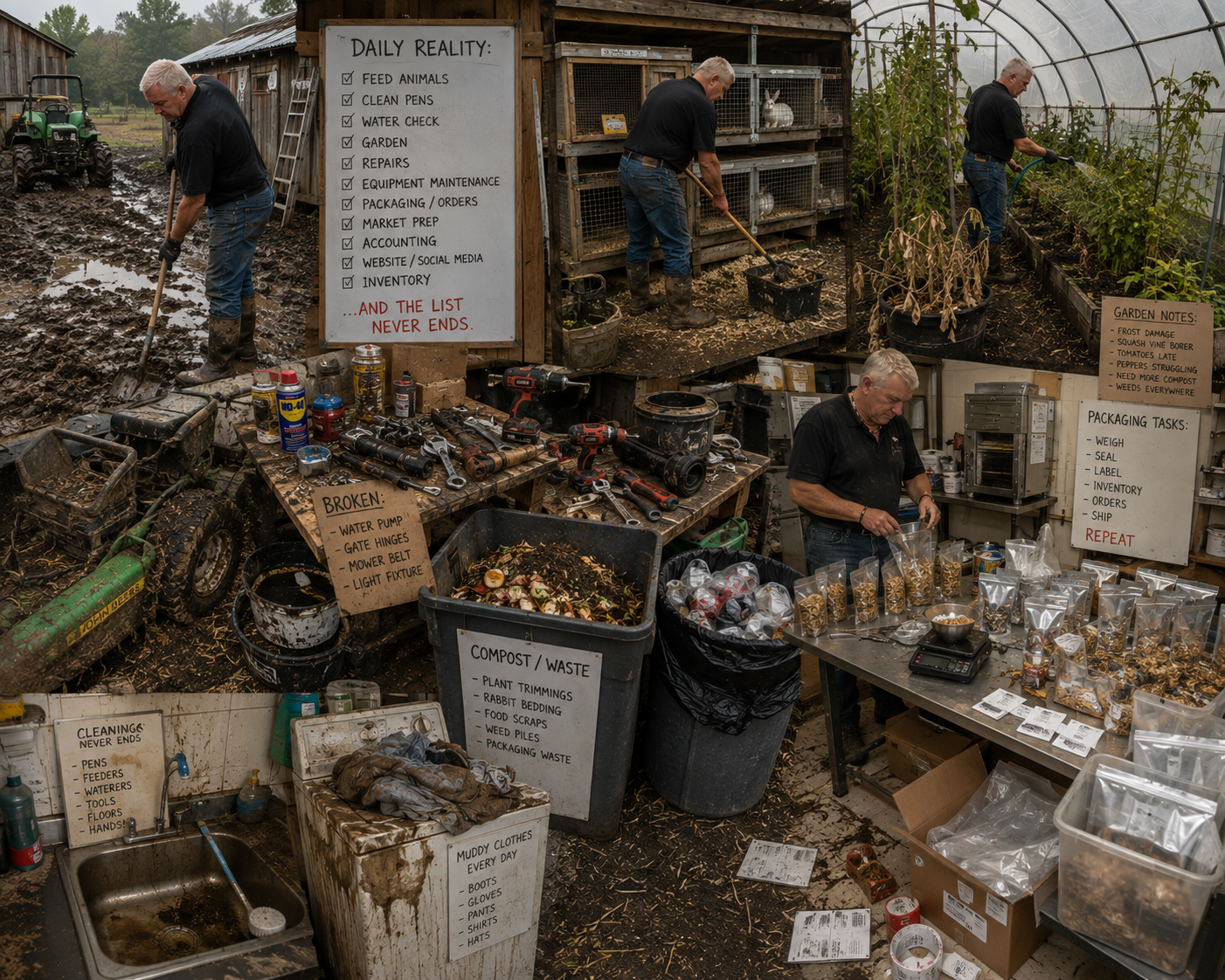
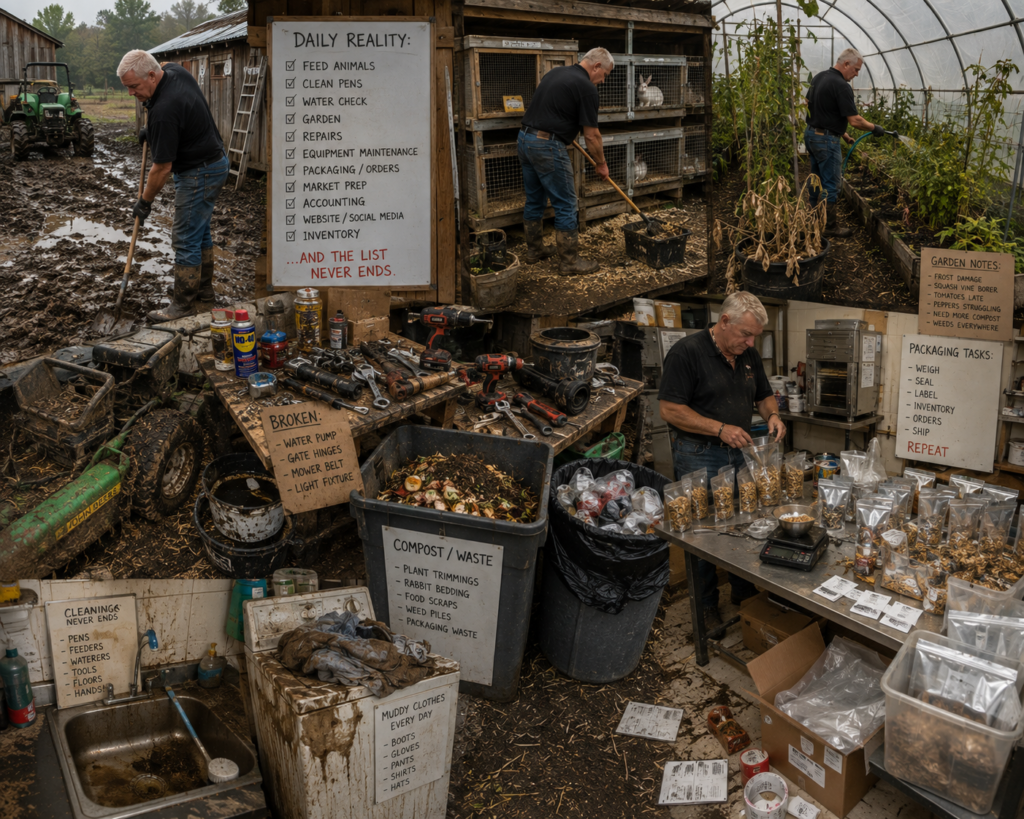
I’ve recently created an image around this idea.
A farmer standing in the middle of a rural property surrounded by things that need fixing.
-
-
- The list is enormous.
- The fence needs attention.
- The gate needs attention.
- The greenhouse needs attention.
- The rabbit housing needs attention.
- The equipment needs attention.
- Something else is probably leaking.
- Something else is probably broken.
- And the list keeps going.
-
The opening image is exaggerated for humour, but the basic idea isn’t.
There is always another repair.
And when one repair gets finished, another one seems perfectly happy to take its place.
That doesn’t mean the property is falling apart.
It means the property is being used.
Maintenance Doesn’t Look Like a Finished Project
That’s an important distinction.
A finished project makes a great photograph.
A maintained project usually doesn’t.
If I build a rabbit enclosure, I can photograph it when it’s finished.
If I spend an afternoon replacing a damaged piece of fencing, there may be nothing particularly interesting to photograph afterward.
The fence looks like a fence.
That’s the point.
The successful maintenance job often leaves very little evidence that it happened.
That’s one reason the invisible work can be easy to underestimate.
Cleaning Is Everywhere
I mentioned cleaning already.
There is more.
-
-
- Cleaning the animal areas.
- Cleaning equipment.
- Cleaning work surfaces.
- Cleaning containers.
- Cleaning tools.
- Cleaning the kitchen after processing food.
- Cleaning up after packaging.
- Cleaning the area after a project.
- Cleaning something that was cleaned yesterday.
-
Sometimes I feel like I spend a remarkable amount of time returning things to approximately the state they were in before I started working.
That’s not wasted time.
It’s simply part of the operation.
But it’s not particularly exciting content.
Nobody wants to watch a six-minute video of me washing a food-processing container.
At least I assume they don’t.
Waste Is Part of Production
This is another part nobody photographs.
There is waste.
-
-
- Peels.
- Trimmings.
- Spoiled produce.
- Packaging scraps.
- Broken materials.
- Old components.
-
Things that cannot be reused.
Things that can be reused but currently have nowhere to go.
A working homestead generates waste because a working homestead involves production.
-
-
- Some of it can be composted.
- Some can be reused.
- Some can be recycled.
- Some needs to be disposed of.
-
None of it is particularly glamorous.
But it exists.
And ignoring it doesn’t make it disappear.
Packaging Doesn’t Look Like Farming
This is one of the interesting things about Blue Gypsy Homestead.
A photograph of the farm might show animals, plants and buildings.
A photograph of the business might show neatly packaged products.
What connects the two is a lot of work that doesn’t look particularly agricultural.
-
-
- Labels.
- Packaging materials.
- Inventory.
- Boxes.
- Storage.
- Shipping supplies.
- Scales.
- Spreadsheets.
- Printers.
- Computers.
-
A product can begin as something grown or produced on the property and end up sitting beside a computer while I’m checking inventory.
That’s the reality of trying to turn a homestead into a business.
The photograph of the finished product doesn’t tell that story.
Sometimes the Best Photograph Is the Worst One
I’ve started appreciating photographs that aren’t particularly pretty.
-
-
- The muddy boots.
- The damaged fence.
- The half-finished project.
- The pile of materials waiting to be used.
- The workbench covered in tools.
- The garden after something went wrong.
- The empty rabbit enclosure while I’m trying to figure out where the missing rabbit went.
-
Those photographs have context.
They show the process.
They show that the finished product didn’t simply appear.
There was work before it.
And there will be work after it.
The Internet Has a Preference for Finished Things
That’s understandable.
Finished things are satisfying.
Before and after photographs are popular because the contrast is obvious.
-
-
- A pile of lumber becomes a structure.
- An empty garden becomes a harvest.
- Raw ingredients become packaged food.
- A messy workspace becomes a finished project.
-
The transformation is the story.
But the middle is where most of the work actually happened.
That’s the part I don’t want to erase.
A Working Homestead Is Not a Photo Shoot
There are moments when everything looks good.
I’ll take advantage of them.
Of course I will.
-
-
- If the light is good and the garden looks great, I’m taking the photograph.
- If the rabbits are behaving themselves and the enclosure looks clean, I’m taking the photograph.
- If a product looks good, I’m taking the photograph.
- If the farm looks particularly good after a snowfall, I’m taking the photograph.
-
I’m not opposed to beautiful photographs.
Far from it.
I just don’t want the beautiful photographs to become the entire story.
Because they aren’t.
They’re one frame.
The Dirty Work Has Value
The unphotographed work is still producing something.
-
-
- Cleaning makes the next production run possible.
- Maintenance keeps equipment operating.
- Packaging turns a product into something that can actually be sold.
- Inventory tells me what I have.
- Repairs keep infrastructure functioning.
- Removing waste keeps work areas usable.
- Cleaning animal housing keeps the livestock operation functioning.
-
None of those things necessarily produces a photograph worth posting.
They still matter.
There Are Days When Nothing Looks Accomplished
This is probably one of the stranger parts of working on a homestead.
I can spend most of a day working and look around afterward and wonder what I actually accomplished.
-
-
- Nothing new was built.
- Nothing was harvested.
- Nothing was sold.
- No beautiful before-and-after photograph exists.
-
But perhaps a gate now works.
-
-
- A piece of equipment is ready for tomorrow.
- The animal areas are clean.
- The storage room is organized.
- The packaging supplies are restocked.
- The inventory is updated.
-
A problem that could have become expensive has been dealt with.
The day produced maintenance rather than something tangible.
That still counts.
It just doesn’t photograph particularly well.
This Is What “Working Homestead” Means
I’ve become more interested in that phrase.
Not homestead as an aesthetic.
Not homestead as a collection of attractive photographs.
A working homestead.
A place where things are being produced.
-
-
- Animals are being raised.
- Food is being preserved.
- Products are being made.
- Equipment is being used.
- Infrastructure is being built and maintained.
- Orders are being prepared.
- Customers are being served.
- Things get dirty.
- Things break.
- Things get repaired.
- Things get thrown away.
- Things occasionally fail.
-
And then the work continues.
That’s considerably messier than the photographs.
I Don’t Want to Hide the Mess
Not because the mess is somehow noble.
It’s not.
Sometimes it’s just a mess.
But it’s an honest part of what happens here.
If I only photograph the good-looking parts, someone looking at the site could easily develop an entirely different impression of what this operation actually involves.
-
-
- They might see the finished product without seeing the production.
- The clean animal enclosure without seeing the cleaning.
- The garden without seeing the dead plants.
- The repaired fence without seeing the repair.
- The market table without seeing the loading, transportation and teardown.
- The product without seeing the packaging station.
-
The photograph captures the result.
The homestead is everything that happens to produce that result.
Sometimes There Is Nothing to Photograph
And that’s okay.
Sometimes I spend the day doing something completely necessary and completely boring.
Sometimes the best description of the day is:
I fixed some stuff.
Sometimes:
I cleaned everything.
Sometimes:
I spent three hours looking for a part.
Sometimes:
The garden didn’t cooperate.
Sometimes:
The numbers didn’t work.
Sometimes:
I don’t know yet.
Those aren’t particularly polished statements.
They’re also real.
The Photograph Is Only One Frame
That’s really what this comes down to.
I’m not going to stop taking photographs.
I love photography.
I’ll continue photographing the animals, products, projects, landscape and everything else that makes Blue Gypsy Homestead what it is.
But I’m increasingly conscious of what a photograph leaves out.
-
-
- The mud.
- The smell.
- The noise.
- The cleanup.
- The broken equipment.
- The failed plants.
- The discarded materials.
- The repairs.
- The packaging.
- The inventory.
- The paperwork.
-
The hours spent doing something nobody will ever notice.
All of that exists outside the frame.
And when the goal is to document a working homestead rather than create a picture-perfect version of one, those things deserve a place in the story too.
Not because every dirty boot needs its own article.
Sometimes a dirty boot is just a dirty boot.
But because the collection of all those ordinary, unphotogenic things is what makes the beautiful photograph possible in the first place.
The garden photograph exists because somebody worked the garden.
The product photograph exists because somebody made and packaged the product.
The livestock photograph exists because somebody built and maintained the enclosure.
The finished project exists because somebody dealt with the unfinished one.
That’s the part the camera can’t always capture.
So sometimes I’ll take the pretty picture.
And sometimes I’ll take the picture of the mess.
Because both are Blue Gypsy Homestead.
One just happens to look better on the wall.
That’s the unfiltered version.
Follow the Blue Gypsy Homestead Journey
I share what I’m learning about homesteading, business, food preservation, technology, AI, photography, gardening, livestock and the ongoing process of turning Blue Gypsy Homestead into a working one-man business.

YouTube
Blue Gypsy Homestead on YouTube — follow the ongoing projects, products, lessons and behind-the-scenes work.
https://www.youtube.com/@bluegypsyhomestead/videos
TikTok
Blue Gypsy Homestead on TikTok — follow the ongoing projects, products, lessons and behind-the-scenes work.
https://www.tiktok.com/@bluegypsyhomestead
Learn More
Blue Gypsy Homestead — follow the ongoing projects, products, lessons and behind-the-scenes work.
https://www.bluegypsyhomestead.com/
Online Store
Blue Gypsy Homestead Online Store — follow the ongoing projects, products, lessons and behind-the-scenes work.
https://blue-gypsy-homestead.square.site/
About Blue Gypsy Homestead
Blue Gypsy Homestead is a 62-acre farm located approximately 35 minutes south of Ottawa, Ontario, Canada. What was once a winery is being transformed into a working homestead and one-man business incorporating livestock, gardening, food preservation, freeze-drying, product development, direct-to-consumer sales, farmers’ markets, technology and artificial intelligence.
The goal isn’t to present a polished version of rural life. It’s to document the actual process of building something from the ground up—projects that work, projects that don’t, products that sell, products that don’t, unexpected problems, unexpected successes and everything that happens in between.