

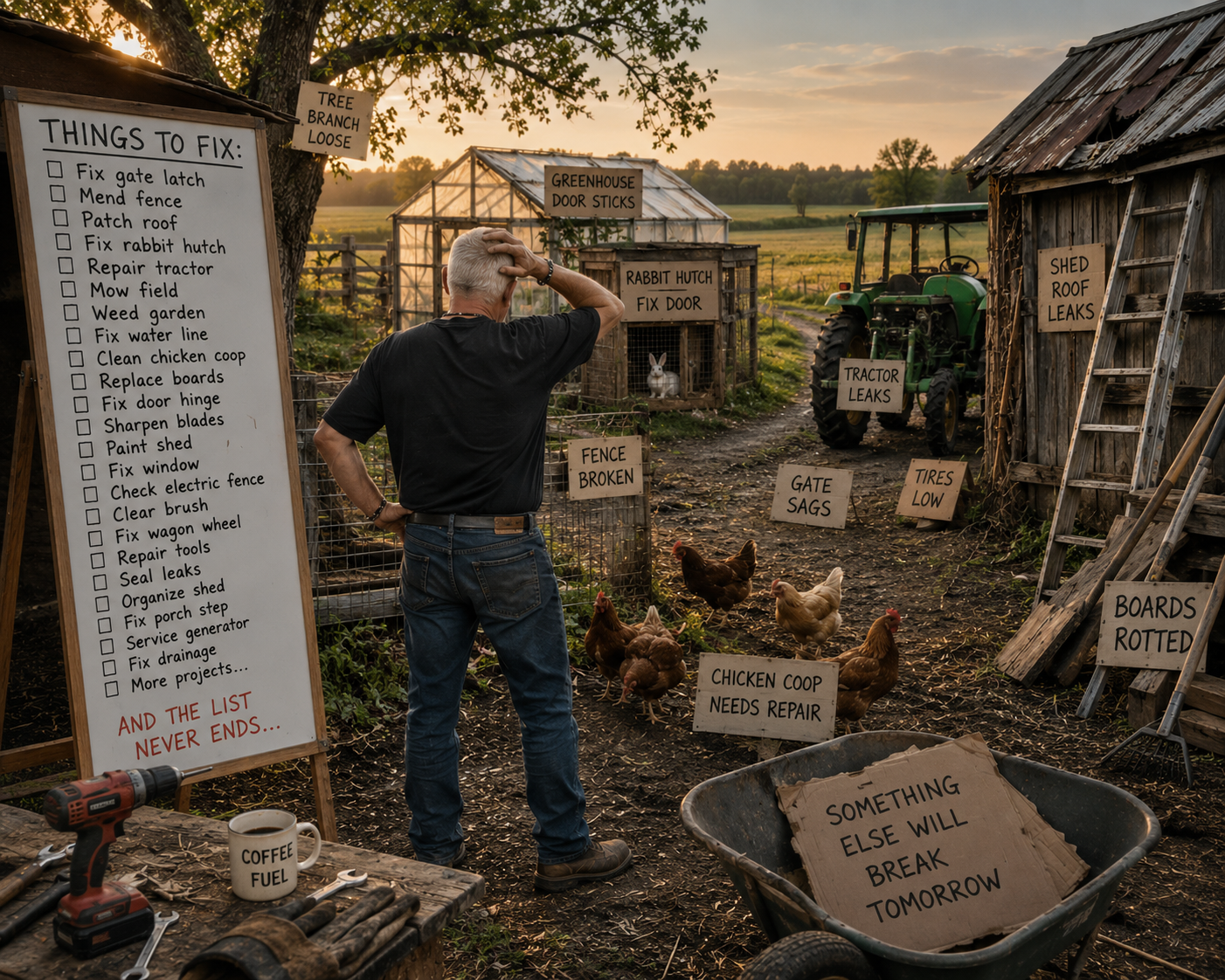
The Point of The Unfiltered Homestead
I started this series because I think there is value in showing the whole picture.
-
-
- Not just what works.
- Not just what looks good.
- Not just the finished project.
-
I want to talk about what happens in between.
-
-
- The mistakes.
- The lessons.
- The unexpected expenses.
- The successes.
- The failures.
- The moments when I wonder what I was thinking.
-
And the moments when I look around and realize:
I actually built this.
That’s the part I don’t want to lose.
Because homesteading isn’t about getting everything right.
It’s about learning how to keep going when things don’t go right.
And when everything goes wrong?
-
-
- I take a breath.
- I figure out what actually needs attention.
- I deal with that first.
- Then I move on to the next thing.
-
That’s my homesteading experience.
And this is the unfiltered version.
There Is Always One More Thing to Fix
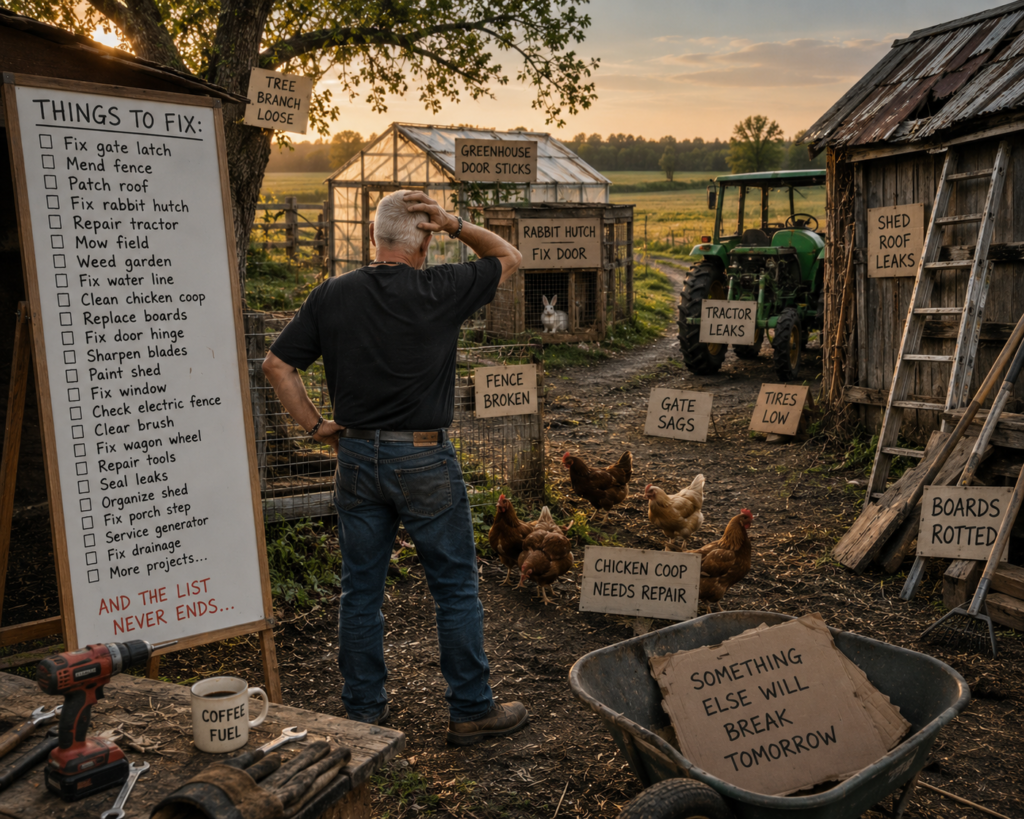
There is a difference between maintaining a house and maintaining a rural property.
I’ve lived in houses.
-
-
- Something breaks, you fix it.
- The toilet leaks.
- Fix the toilet.
- The furnace needs attention.
- Call somebody.
- A light stops working.
- Replace the bulb.
- The roof needs work.
-
Eventually, you deal with the roof.
It’s not that house maintenance is easy.
It’s that the boundaries are relatively obvious.
The house is the house.
Everything else is somebody else’s problem.
A rural property doesn’t work that way.
At Blue Gypsy Homestead, everything seems to belong to somebody.
And that somebody is usually me.
The Fence Is Never Just the Fence
Take a fence.
A fence sounds simple.
It keeps something in.
Or it keeps something out.
That’s the theory.
In practice, fencing is a living project.
-
-
- Posts move.
- Wire loosens.
- Ground freezes and thaws.
- Vegetation grows through things.
- Branches fall.
- Animals push against it.
- Gates sag.
- Latches stop cooperating.
-
Something that was perfectly fine last year suddenly isn’t.
And because the property is large, there isn’t just one fence.
There are fences around things.
-
-
- Fences between things.
- Fences protecting things.
- Fences that were installed for reasons I have occasionally forgotten.
-
And every one of them eventually needs attention.
Then There Are the Buildings
The same thing happens with buildings.
A rural building doesn’t simply sit there looking after itself.
-
-
- Weather gets at it.
- Water gets into places it shouldn’t.
- Wood ages.
- Metal rusts.
- Fasteners loosen.
- Doors stop fitting quite as well as they used to.
-
Something that worked perfectly when it was built eventually needs adjustment.
And because I’m working with existing structures as well as things I’ve built or modified myself, there is always another piece of history to contend with.
Sometimes I know exactly why something was built the way it was.
Sometimes I look at it and think:
Why the hell did somebody do that?
Then I remember that somebody may have been me.
Rural Property Maintenance Has a Larger Definition
That’s probably the biggest difference I’ve noticed.
When I think about maintaining a house, I think about the structure.
When I think about maintaining the homestead, I think about the entire property.
-
-
- The driveway.
- The buildings.
- The fences.
- The animal enclosures.
- The garden.
- The greenhouse.
- The equipment.
- The electrical systems.
- The water.
- The storage areas.
- The paths.
- The trees.
- The fields.
- The things that I haven’t even thought about for six months.
-
They’re all part of the same maintenance problem.
And unlike a house, the property itself keeps growing.
-
-
- Grass grows.
- Trees grow.
- Brush grows.
- Gardens grow.
-
Weeds grow with an enthusiasm I personally find offensive.
Nature doesn’t seem particularly interested in my maintenance schedule.
Then Something Breaks
This is where the maintenance cycle gets interesting.
-
-
- I can start the morning with a plan.
- Maybe I’m going to work on a project.
- I’ve got the tools ready.
- I’ve got an idea of what needs to happen.
-
Then I notice something.
Maybe a gate isn’t closing properly.
Now I’m fixing the gate.
While fixing the gate, I notice something else.
Now I’m looking at that.
While looking at that, I discover another problem.
And suddenly the original project is sitting there waiting patiently while I deal with something that didn’t exist on my schedule ten minutes earlier.
That’s rural property maintenance.
The to-do list isn’t really a list.
It’s more like a suggestion.
Maintenance Doesn’t Always Announce Itself
Some repairs are obvious.
Something breaks.
You know it’s broken.
Other problems develop slowly.
-
-
- A piece of wood starts deteriorating.
- A hinge gets loose.
- A section of fencing shifts.
- A roof begins leaking.
- A machine starts making a noise that wasn’t there before.
-
Those are the ones that can be expensive.
Not necessarily because the repair itself is complicated.
Because small problems have a habit of becoming larger problems when they are ignored.
And on a rural property, there are enough small problems that it’s easy to miss one.
Especially when you’re busy dealing with five others.
The Weather Has a Vote
Weather is another difference.
A house is exposed to weather, obviously.
But a rural property has an enormous amount of infrastructure sitting outside in it.
-
-
- Everything gets rained on.
- Snowed on.
- Frozen.
- Thawed.
- Baked in the sun.
- Covered in mud.
- Blown around.
-
And then it starts all over again.
Ontario winters are particularly good at reminding me that materials have limits.
Freeze and thaw cycles don’t care how carefully something was built.
Neither does water.
Water will find the smallest weakness imaginable and eventually turn it into a problem.
Equipment Has Its Own Agenda
Then there is equipment.
-
-
- Mowers.
- Tools.
- Small engines.
- Anything with moving parts.
- Anything with fuel.
- Anything with batteries.
- Anything that I depend on to make another job possible.
-
Equipment maintenance is particularly irritating because the equipment often chooses the worst possible time to announce that it needs attention.
It rarely breaks when I’m sitting around wondering what to do.
It breaks when I have something else scheduled.
Of course.
That’s practically a law of farm equipment.
The Animals Add Another Layer
Then I have livestock.
That changes maintenance again.
-
-
- A fence isn’t merely a fence when rabbits or chickens depend on it.
- A door isn’t merely a door.
- A water system isn’t merely plumbing.
- An enclosure isn’t merely a structure.
-
Now the consequences of something failing can involve living animals.
That makes certain maintenance jobs considerably more important.
If a shed door doesn’t close properly, that’s annoying.
If an animal enclosure doesn’t close properly, that’s a different category of problem.
I’ve learned that distinction the hard way.
Repairs Don’t Always Stay Repairs
One of the more frustrating things about rural property maintenance is that a repair can uncover another problem.
I fix one thing.
Behind it is something else.
I remove one piece.
Now I can see something I couldn’t see before.
I replace something.
The replacement exposes another issue.
It’s like peeling an onion, except the onion is made of lumber, wire, screws and things that haven’t been touched since approximately 1987.
Eventually I stop asking:
What does this repair cost?
and start asking:
What am I going to find when I open this up?
There Is Also Preventive Maintenance
I’m getting better at this.
Not perfect.
Better.
There is a certain satisfaction in fixing something before it breaks.
It isn’t nearly as exciting.
Nobody stands back from a properly tightened hinge and says:
Look what I accomplished today.
But preventing a problem is usually cheaper than dealing with the aftermath.
The problem is that preventive maintenance competes with everything else.
If nothing is broken, it is remarkably easy to find something more interesting to do.
That’s human nature.
Until the thing breaks.
Then it becomes extremely interesting.
The Cost Isn’t Always Money
This is something I’ve become increasingly aware of.
-
-
- A repair costs more than the replacement part.
- It costs time.
- It costs attention.
- Sometimes it costs another opportunity.
-
If I’m repairing something for three hours, I’m not doing something else for those three hours.
That’s particularly important when you’re trying to build a one-man business.
My labour isn’t free simply because I’m not currently paying myself an hourly wage.
Time spent repairing infrastructure is time that can’t be spent producing something, selling something, improving the business or working on another project.
That’s where homestead maintenance becomes a business issue.
Maintenance Has a COGS Problem Too
This is one of those places where the homestead and business sides of Blue Gypsy Homestead intersect.
If I build something for production, the cost isn’t just the materials.
-
-
- There is maintenance.
- There are repairs.
- There is replacement.
- There is depreciation.
- There is time spent keeping the system operational.
-
That’s particularly relevant when I’m producing things for sale.
A piece of equipment might make a product possible.
But if it requires constant maintenance, the economics of that product change.
A cheap solution isn’t necessarily cheap if it consumes enormous amounts of my time.
A more expensive solution isn’t necessarily expensive if it dramatically reduces maintenance.
I’m still working through exactly how to measure all of that.
But I’m paying more attention to it.
The Maintenance List Never Reaches Zero
I’ve stopped expecting it to.
There will always be something.
-
-
- If everything currently works, something will eventually stop working.
- If everything is repaired, something will deteriorate.
- If everything is maintained, something will get damaged.
- If nothing breaks, something will need improving.
-
And if somehow absolutely everything is perfect, I will probably discover something I forgot existed.
The idea of reaching the mythical point where Everything is done is probably unrealistic.
I don’t think I’ve ever seen it.
Sometimes the Job Is Simply Triage
That’s the word that comes to mind.
Triage.
-
-
- Which problem matters most?
- What needs to happen today?
- What can wait?
- What is annoying but harmless?
- What could become expensive?
- What affects the animals?
- What affects production?
- What affects customers?
- What affects safety?
-
Those questions help determine what gets my attention.
Because I have one pair of hands.
I cannot repair everything simultaneously.
I have to decide.
Sometimes the decision is easy.
Sometimes it’s simply:
That can wait until tomorrow.
And sometimes tomorrow arrives with a completely different problem.
The Property Keeps Score
There is another thing about maintenance that I’ve noticed.
The property remembers.
Not literally, of course.
But every shortcut leaves something behind.
-
-
- Every temporary repair eventually becomes part of the infrastructure.
- Every “I’ll fix that properly later” creates another item on the mental list.
- Every improvement changes something else.
-
That’s how properties evolve.
Not necessarily through grand renovation projects.
Through thousands of small decisions.
-
-
- A screw here.
- A bracket there.
- A piece of lumber.
- A replacement hinge.
- A new latch.
- A patch.
- A modification.
- A temporary solution that somehow survives for five years.
-
Eventually, the property becomes a physical record of how I’ve been solving problems.
Some Repairs Are Ridiculous
There are also repairs that are difficult to explain to somebody who doesn’t live here.
Something is broken.
I know how to fix it.
The fix will take fifteen minutes.
But first I have to find the right part.
The part is somewhere… I know I bought it.
I just don’t know where I put it.
So now I’m searching through a storage area looking for a component worth about six dollars.
Forty-five minutes later, I’ve found it.
Another ten minutes and the repair is finished.
Total repair time: Fifty-five minutes.
Actual fixing: Ten minutes.
That’s rural maintenance.
Some Repairs Are Surprisingly Satisfying
The opposite happens too.
Something has been bothering me for months.
-
-
- It’s inefficient.
- It’s awkward.
- It doesn’t work properly.
-
One day I finally fix it.
Five minutes later, the job is done.
And every time I use that thing afterward, I notice the difference.
Those are good repairs.
Not because they were difficult.
Because they eliminate friction.
The best maintenance doesn’t always make something look better.
Sometimes it simply makes the next hundred uses easier.
I Don’t Think Maintenance Is a Failure
I’ve started looking at it differently.
Maintenance isn’t evidence that something was built badly.
Things require maintenance.
That’s what things do.
The mistake is expecting a property to remain exactly as it was when it was built.
It won’t.
-
-
- The property changes.
- The equipment changes.
- The animals change.
- The weather changes.
- My needs change.
- The business changes.
-
Maintenance is simply the process of keeping everything moving as those things change.
That doesn’t make it glamorous.
It does make it necessary.
The One-Man Problem
On a larger operation, maintenance can be somebody’s entire job.
At Blue Gypsy Homestead, it’s another responsibility added to everything else.
That’s the part that can make it feel endless.
I’m not just maintaining a rural property, I’m also trying to run the business that is developing on that property.
So the same person who notices the broken gate may also have three orders to package.
The person who needs to repair the mower may also need to update inventory.
The person who discovers a problem with an animal enclosure may have been planning to work on a product that afternoon.
There is no maintenance department waiting for me.
There is just me looking at the problem and deciding when I can deal with it.
And Tomorrow There Will Be Another One
That’s the part I’ve finally accepted.
-
-
- Not happily.
- Just realistically.
- There will be another repair.
- Another adjustment.
- Another loose screw.
- Another gate.
- Another piece of equipment.
- Another section of fencing.
- Another thing that needs attention.
-
I can finish everything on today’s list and still have more work waiting tomorrow.
That isn’t necessarily a sign that I’m failing.
It is simply what happens when you own a large rural property and try to make it function as a working homestead and business.
There is always one more thing to fix.
-
-
- Sometimes I fix it.
- Sometimes I put it on the list.
- Sometimes I stare at it for a while and decide it can wait.
- And occasionally, I discover that the thing I thought needed fixing wasn’t actually the problem at all.
-
Those are particularly fun days.
But that’s what the property is teaching me about maintenance.
-
-
- Not that rural life is hard.
- Not that everything goes wrong.
-
Just that maintenance is never really finished.
The goal isn’t to reach the end.
There probably isn’t an end because it is a cycle.
The goal is to keep the important things working well enough that I can get on with everything else.
And then, inevitably, notice the next thing.
Follow the Blue Gypsy Homestead Journey
I share what I’m learning about homesteading, business, food preservation, technology, AI, photography, gardening, livestock and the ongoing process of turning Blue Gypsy Homestead into a working one-man business.

YouTube
Blue Gypsy Homestead on YouTube — follow the ongoing projects, products, lessons and behind-the-scenes work.
https://www.youtube.com/@bluegypsyhomestead/videos
TikTok
Blue Gypsy Homestead on TikTok — follow the ongoing projects, products, lessons and behind-the-scenes work.
https://www.tiktok.com/@bluegypsyhomestead
Learn More
Blue Gypsy Homestead — follow the ongoing projects, products, lessons and behind-the-scenes work.
https://www.bluegypsyhomestead.com/
Online Store
Blue Gypsy Homestead Online Store — follow the ongoing projects, products, lessons and behind-the-scenes work.
https://blue-gypsy-homestead.square.site/
About Blue Gypsy Homestead
Blue Gypsy Homestead is a 62-acre farm located approximately 35 minutes south of Ottawa, Ontario, Canada. What was once a winery is being transformed into a working homestead and one-man business incorporating livestock, gardening, food preservation, freeze-drying, product development, direct-to-consumer sales, farmers’ markets, technology and artificial intelligence.
The goal isn’t to present a polished version of rural life. It’s to document the actual process of building something from the ground up—projects that work, projects that don’t, products that sell, products that don’t, unexpected problems, unexpected successes and everything that happens in between.